PUBLISHER: Global Market Insights Inc. | PRODUCT CODE: 1998781

PUBLISHER: Global Market Insights Inc. | PRODUCT CODE: 1998781
Amniocentesis Needle Market Opportunity, Growth Drivers, Industry Trend Analysis, and Forecast 2026 - 2035
The Global Amniocentesis Needle Market was valued at USD 194.2 million in 2025 and is estimated to grow at a CAGR of 5% to reach USD 316.9 million by 2035.
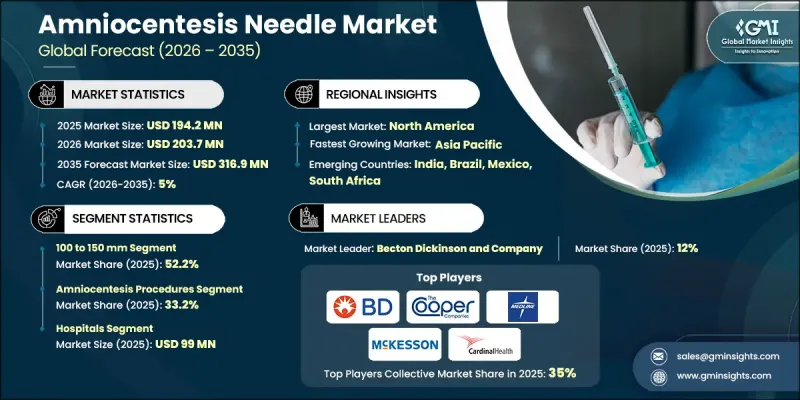
Market growth is driven by the rising maternal age, increasing high-risk pregnancies, and the growing prevalence of chronic conditions among expectant mothers. Advances in amniocentesis needle design and technology are also supporting adoption, enabling safer and more precise procedures. Congenital disorders remain a major concern, particularly in low- and middle-income regions where nine out of ten children with serious birth defects are born, highlighting the importance of early detection. Amniocentesis needles allow accurate sampling of amniotic fluid for genetic, chromosomal, and biochemical analysis, facilitating timely interventions. The combination of rising maternal age, high-risk pregnancies, and the need for early prenatal diagnosis continues to boost the market. Healthcare providers increasingly rely on advanced needle designs to improve procedural efficiency and maternal-fetal outcomes, further reinforcing market expansion.
| Market Scope | |
|---|---|
| Start Year | 2025 |
| Forecast Year | 2026-2035 |
| Start Value | $194.2 Million |
| Forecast Value | $316.9 Million |
| CAGR | 5% |
The needles ranging from 100 mm to 150 mm segment held a 52.2% share in 2025. These lengths are ideal for mid- to late-gestation procedures, accommodating the increased distance to the amniotic sac while ensuring safe fluid collection. Features such as side-port designs, spiral tip engravings, and echogenic markings enhance fluid aspiration, ultrasound visibility, and precise placement, even in challenging anatomical conditions.
The amniocentesis procedures segment accounted for 33.2% share in 2025. This minimally invasive diagnostic method, typically performed between 15 and 20 weeks of gestation, allows for detailed chromosomal and genetic analysis. Innovations in needle design, including sharp non-coring tips and enhanced ultrasound reflectivity, reduce tissue trauma while improving procedural accuracy and safety.
U.S. Amniocentesis Needle Market is projected to grow from USD 68.3 million in 2025 to USD 106.9 million by 2035. Rising rates of congenital disorders and the increasing adoption of advanced needle technologies, such as color-coded hubs, non-coring designs, and echogenic tips, are driving demand. Hospitals and clinics are investing in devices that enhance accuracy, safety, and efficiency in prenatal diagnostics.
Key players in the Global Amniocentesis Needle Market include Becton, Dickinson and Company, Cardinal Health, Biopsybell, Medline Industries, McKesson Corporation, Roko AB, Medax S, M.D.L S.R.L., The Cooper Companies, Moller Medical GmbH, Suzhou Leapmed Healthcare Corporation, Eurosurgical, Laboratoire, RI.MOS, and Vigeo srl. Companies in the Global Amniocentesis Needle Market strengthen their presence by investing in R&D to develop safer and more precise needle designs, including echogenic tips and non-coring shafts. Strategic partnerships with hospitals and clinics enable wider adoption of their products. They focus on regulatory compliance and quality certifications to gain trust in healthcare systems. Additionally, targeted marketing and training programs for clinicians help build brand loyalty and improve procedural efficiency. Geographic expansion, particularly into emerging markets, combined with innovations in needle materials and ultrasound visibility, ensures sustained growth and a competitive edge.
Table of Contents
Chapter 1 Methodology and Scope
- 1.1 Market scope and definitions
- 1.2 Research design
- 1.2.1 Research approach
- 1.2.2 Data collection methods
- 1.3 Data mining sources
- 1.3.1 Global
- 1.3.2 Regional/country
- 1.4 Base estimates and calculations
- 1.4.1 Base year calculation
- 1.4.2 Key trends for market estimation
- 1.5 Primary research and validation
- 1.5.1 Primary sources
- 1.6 Forecast model
- 1.7 Research assumptions and limitations
Chapter 2 Executive Summary
- 2.1 Industry 360º synopsis
- 2.2 Key market trends
- 2.2.1 Regional trends
- 2.2.2 Product type trends
- 2.2.3 Procedure trends
- 2.2.4 End use trends
- 2.3 CXO perspectives: Strategic imperatives
Chapter 3 Industry Insights
- 3.1 Industry ecosystem analysis
- 3.2 Industry impact forces
- 3.2.1 Growth drivers
- 3.2.1.1 Increasing maternal age and high- risk pregnancies
- 3.2.1.2 Growing burden of congenital disorders
- 3.2.1.3 Rising prevalence of chronic diseases among expectant mothers
- 3.2.1.4 Technological advancements in amniocentesis needles
- 3.2.2 Industry pitfalls and challenges
- 3.2.2.1 Availability of alternative methods
- 3.2.2.2 Dearth of skilled professionals
- 3.2.3 Market opportunities
- 3.2.3.1 Regional expansion in emerging markets
- 3.2.1 Growth drivers
- 3.3 Growth potential analysis
- 3.4 Regulatory landscape (Driven by Primary Research)
- 3.5 Technology landscape (Driven by Primary Research)
- 3.5.1 Current technological trends
- 3.5.2 Emerging technologies
- 3.6 Future market trends (Driven by Primary Research)
- 3.7 Impact of AI and generative AI on the market
- 3.8 Porter's analysis
- 3.9 PESTEL analysis
Chapter 4 Competitive Landscape, 2025
- 4.1 Introduction
- 4.2 Company market share analysis
- 4.3 Company matrix analysis
- 4.4 Competitive analysis of major market players
- 4.5 Competitive positioning matrix
- 4.6 Key developments
- 4.6.1 Mergers and acquisitions
- 4.6.2 Partnerships and collaborations
- 4.6.3 New product launches
- 4.6.4 Expansion plans
Chapter 5 Market Estimates and Forecast, By Product Type, 2022 - 2035 ($ Mn)
- 5.1 Key trends
- 5.2 100 to 150 mm
- 5.3 Smaller than 100 mm
- 5.4 Larger than 150 mm
Chapter 6 Market Estimates and Forecast, By Procedure, 2022 - 2035 ($ Mn)
- 6.1 Key trends
- 6.2 Amniocentesis procedures
- 6.3 Amnioreduction procedures
- 6.4 Fetal blood transfusion
- 6.5 Amnioinfusion procedure
- 6.6 Cordocentesis procedure
Chapter 7 Market Estimates and Forecast, By End Use, 2022 - 2035 ($ Mn)
- 7.1 Key trends
- 7.2 Hospitals
- 7.3 Diagnostics centers
- 7.4 Clinics
- 7.5 Other end users
Chapter 8 Market Estimates and Forecast, By Region, 2022 - 2035 ($ Mn)
- 8.1 Key trends
- 8.2 North America
- 8.2.1 U.S.
- 8.2.2 Canada
- 8.3 Europe
- 8.3.1 Germany
- 8.3.2 UK
- 8.3.3 France
- 8.3.4 Italy
- 8.3.5 Spain
- 8.3.6 Netherlands
- 8.4 Asia Pacific
- 8.4.1 China
- 8.4.2 India
- 8.4.3 Japan
- 8.4.4 Australia
- 8.4.5 South Korea
- 8.5 Latin America
- 8.5.1 Brazil
- 8.5.2 Mexico
- 8.5.3 Argentina
- 8.6 Middle East and Africa
- 8.6.1 Saudi Arabia
- 8.6.2 South Africa
- 8.6.3 UAE
Chapter 9 Company Profiles
- 9.1 Becton, Dickinson and Company
- 9.2 Biopsybell
- 9.3 Cardinal Health
- 9.4 Eurosurgical
- 9.5 Laboratoire
- 9.6 M.D.L S.R.L.
- 9.7 McKesson Corporation
- 9.8 Medax S
- 9.9 Medline Industries
- 9.10 Moller Medical GmbH
- 9.11 RI.MOS
- 9.12 Roko AB
- 9.13 Suzhou Leapmed Healthcare Corporation
- 9.14 The Cooper Companies
- 9.15 Vigeo srl

