PUBLISHER: Global Market Insights Inc. | PRODUCT CODE: 1998790

PUBLISHER: Global Market Insights Inc. | PRODUCT CODE: 1998790
Animal Feed Preservatives Market Opportunity, Growth Drivers, Industry Trend Analysis, and Forecast 2026 - 2035
The Global Animal Feed Preservatives Market was valued at USD 6.4 billion in 2025 and is estimated to grow at a CAGR of 4.6% to reach USD 10.2 billion by 2035.
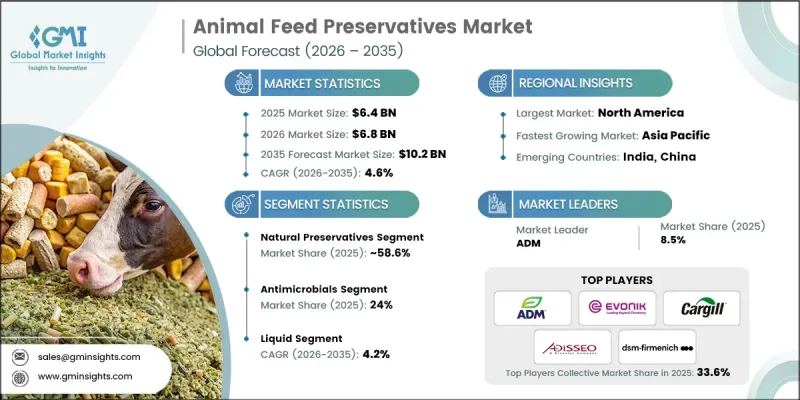
The animal feed preservatives market has evolved into a vital component of the broader feed and livestock value chain. While preservatives were originally introduced primarily to extend feed shelf life, their role has significantly expanded to include maintaining feed quality, preserving essential nutrients, and minimizing production risks for livestock producers. Modern livestock operations rely on preservatives to maintain feed stability across diverse environmental, storage, and transportation conditions, making them an essential element of contemporary feed management strategies. Increasing focus on animal health, food safety, and reliable supply chains is encouraging feed manufacturers to adopt higher-performance preservation technologies. As a result, companies are developing formulations designed to support clean labeling practices while providing antimicrobial protection that helps limit contamination and spoilage. Industry stakeholders are also investing in advanced preservation solutions that improve operational efficiency by reducing waste, improving ingredient handling, and extending the usability of feed materials during storage and distribution.
| Market Scope | |
|---|---|
| Start Year | 2025 |
| Forecast Year | 2026-2035 |
| Start Value | $6.4 Billion |
| Forecast Value | $10.2 Billion |
| CAGR | 4.6% |
The natural preservatives segment accounted for 58.6% share in 2025 and is projected to grow at a CAGR of 4.7% through 2035. This segment has gained prominence as livestock producers increasingly prioritize safer and more sustainable feed ingredients. Natural preservative solutions are being widely adopted because they align well with evolving regulatory standards and rising consumer expectations regarding responsible livestock production. These preservatives offer effective protection against microbial contamination while supporting the growing demand for feed products that emphasize transparency, sustainability, and reduced reliance on synthetic additives.
The antimicrobial segment held 24% share in 2025 and is expected to grow at a CAGR of 4.7% between 2026 and 2035. Antimicrobial preservatives are widely utilized because they help protect feed products from harmful microorganisms that can compromise both feed quality and animal health. Their effectiveness in preventing microbial growth during storage, transportation, and handling makes them a critical component of feed preservation strategies. These solutions support safe feed management practices by maintaining hygienic conditions and reducing the risk of contamination across both intensive and large-scale livestock operations.
North America Animal Feed Preservatives Market held 31.5% share in 2025. The region benefits from highly developed livestock production systems and a well-established feed manufacturing industry that emphasizes quality and regulatory compliance. Strong industry standards related to feed safety, contamination control, and biosecurity have increased the demand for advanced preservation technologies. As livestock producers focus on maintaining consistent feed quality and improving operational efficiency, adoption of advanced preservative solutions continues to rise across large-scale feed production systems in the region.
Major companies operating in the Global Animal Feed Preservatives Market include BASF SE, Cargill, Incorporated, ADM, Evonik Industries AG, DSM-Firmenich AG, Kemin Industries, IFF, Nutreco N.V., Adisseo, Novus International, Alltech, Inc., Phibro Animal Health, Solvay S.A., and Novonesis Group. Companies active in the Animal Feed Preservatives Market are strengthening their competitive position through innovation, strategic collaborations, and expanded production capabilities. Leading firms are investing in research and development to create advanced preservative formulations that improve feed stability while meeting evolving regulatory standards and sustainability expectations. Many companies are also focusing on developing naturally derived preservation solutions to address the growing demand for clean-label livestock feed products. Strategic partnerships with feed manufacturers and livestock producers are helping companies expand their product applications and strengthen market reach. In addition, organizations are enhancing their global distribution networks and improving supply chain capabilities to support consistent product availability.
Table of Contents
Chapter 1 Methodology & Scope
- 1.1 Market scope and definition
- 1.2 Research design
- 1.2.1 Research approach
- 1.2.2 Data collection methods
- 1.3 Data mining sources
- 1.3.1 Global
- 1.3.2 Regional/Country
- 1.4 Base estimates and calculations
- 1.4.1 Base year calculation
- 1.4.2 Key trends for market estimation
- 1.5 Primary research and validation
- 1.5.1 Primary sources
- 1.6 Forecast model
- 1.7 Research assumptions and limitations
Chapter 2 Executive Summary
- 2.1 Industry 360° synopsis
- 2.2 Key market trends
- 2.2.1 Regional
- 2.2.2 Preservative Type
- 2.2.3 Compound Type
- 2.2.4 Form
- 2.2.5 Feed Type
- 2.2.6 Animal Type
- 2.3 TAM Analysis, 2026-2035
- 2.4 CXO perspectives: Strategic imperatives
- 2.4.1 Executive decision points
- 2.4.2 Critical success factors
- 2.5 Future Outlook and Strategic Recommendations
Chapter 3 Industry Insights
- 3.1 Industry ecosystem analysis
- 3.1.1 Supplier landscape
- 3.1.2 Profit margin
- 3.1.3 Value addition at each stage
- 3.1.4 Factor affecting the value chain
- 3.1.5 Disruptions
- 3.2 Industry impact forces
- 3.2.1 Growth drivers
- 3.2.1.1 Increasing demand for high-quality animal nutrition
- 3.2.1.2 Rising awareness and adoption
- 3.2.1.3 Stringent regulations and food safety concerns
- 3.2.2 Industry pitfalls and challenges
- 3.2.2.1 Cost concerns
- 3.2.2.2 Environmental and health concerns
- 3.2.3 Market opportunities
- 3.2.3.1 Rising demand for natural & organic preservatives
- 3.2.3.2 Advances in precision nutrition & digital formulation
- 3.2.1 Growth drivers
- 3.3 Growth potential analysis
- 3.4 Regulatory landscape
- 3.4.1 North America
- 3.4.2 Europe
- 3.4.3 Asia Pacific
- 3.4.4 Latin America
- 3.4.5 Middle East & Africa
- 3.5 Porter's analysis
- 3.6 PESTEL analysis
- 3.7 Price trends
- 3.7.1 By region
- 3.7.2 By preservative type
- 3.8 Future market trends
- 3.9 Technology and Innovation landscape
- 3.9.1 Current technological trends
- 3.9.2 Emerging technologies
- 3.10 Patent Landscape
- 3.11 Trade statistics (HS code)
- 3.11.1 Major importing countries
- 3.11.2 Major exporting countries
- 3.12 Sustainability and environmental aspects
- 3.12.1 Sustainable practices
- 3.12.2 Waste reduction strategies
- 3.12.3 Energy efficiency in production
- 3.12.4 Eco-friendly initiatives
- 3.13 Carbon footprint consideration
Chapter 4 Competitive Landscape, 2025
- 4.1 Introduction
- 4.2 Company market share analysis
- 4.2.1 By region
- 4.2.1.1 North America
- 4.2.1.2 Europe
- 4.2.1.3 Asia Pacific
- 4.2.1.4 LATAM
- 4.2.1.5 MEA
- 4.2.1 By region
- 4.3 Company matrix analysis
- 4.4 Competitive analysis of major market players
- 4.5 Competitive positioning matrix
- 4.6 Key developments
- 4.6.1 Mergers & acquisitions
- 4.6.2 Partnerships & collaborations
- 4.6.3 New Product Launches
- 4.6.4 Expansion Plans
Chapter 5 Market Estimates and Forecast, By Preservative Type, 2022-2035 (USD Million) (Kilo Tons)
- 5.1 Key trends
- 5.2 Natural preservatives
- 5.2.1 Plant extracts
- 5.2.2 Essential oils
- 5.2.3 Organic acids
- 5.2.4 Tocopherols (Vitamin E)
- 5.3 Synthetic preservatives
- 5.3.1 BHA
- 5.3.2 BHT
- 5.3.3 Ethoxyquin
- 5.3.4 Propionic acid
- 5.3.5 Formic acid
Chapter 6 Market Estimates and Forecast, By Compound Type, 2022-2035 (USD Million) (Kilo Tons)
- 6.1 Key trends
- 6.2 Feed acidifiers
- 6.3 Antioxidants
- 6.4 Antimicrobials
- 6.5 Mold inhibitors
- 6.6 Mycotoxin binders
- 6.7 Anti-caking agents
Chapter 7 Market Estimates and Forecast, By Form, 2022-2035 (USD Million) (Kilo Tons)
- 7.1 Key trends
- 7.2 Liquid
- 7.2.1 Aqueous Solutions
- 7.2.2 Oil-Based Suspensions
- 7.3 Dry
- 7.3.1 Powders
- 7.3.2 Granules
- 7.3.3 Pellets
Chapter 8 Market Estimates and Forecast, By Feed Type, 2022-2035 (USD Million) (Kilo Tons)
- 8.1 Key trends
- 8.2 Compound Feed
- 8.3 Feed Premix
- 8.4 Silage
- 8.5 Feed Meal
Chapter 9 Market Estimates and Forecast, By Animal Type, 2022-2035 (USD Million) (Kilo Tons)
- 9.1 Key trends
- 9.2 Poultry
- 9.2.1 Broiler
- 9.2.2 Layer
- 9.2.3 Turkey
- 9.3 Swine
- 9.3.1 Starter
- 9.3.2 Grower
- 9.3.3 Sow
- 9.4 Cattle
- 9.4.1 Dairy
- 9.4.2 Beef
- 9.4.3 Calf
- 9.5 Aquaculture
- 9.5.1 Salmon
- 9.5.2 Trout
- 9.5.3 Shrimp
- 9.5.4 Carp
- 9.5.5 Tilapia
- 9.6 Pet Food
- 9.6.1 Dog
- 9.6.2 Cat
- 9.6.3 Other Pets
- 9.7 Equine
- 9.8 Others
Chapter 10 Market Estimates and Forecast, By Region, 2022-2035 (USD Million) (Kilo Tons)
- 10.1 Key trends
- 10.2 North America
- 10.2.1 U.S.
- 10.2.2 Canada
- 10.3 Europe
- 10.3.1 Germany
- 10.3.2 UK
- 10.3.3 France
- 10.3.4 Spain
- 10.3.5 Italy
- 10.3.6 Rest of Europe
- 10.4 Asia Pacific
- 10.4.1 China
- 10.4.2 India
- 10.4.3 Japan
- 10.4.4 Australia
- 10.4.5 South Korea
- 10.4.6 Rest of Asia Pacific
- 10.5 Latin America
- 10.5.1 Brazil
- 10.5.2 Mexico
- 10.5.3 Argentina
- 10.5.4 Rest of Latin America
- 10.6 Middle East and Africa
- 10.6.1 Saudi Arabia
- 10.6.2 South Africa
- 10.6.3 UAE
- 10.6.4 Rest of Middle East and Africa
Chapter 11 Company Profiles
- 11.1 Cargill, Incorporated
- 11.2 ADM
- 11.3 BASF SE
- 11.4 Evonik Industries AG
- 11.5 IFF
- 11.6 Kemin Industries
- 11.7 DSM-Firmenich AG
- 11.8 Nutreco N.V.
- 11.9 Adisseo
- 11.10 Novus International
- 11.11 Alltech, Inc.
- 11.12 Phibro Animal Health
- 11.13 Solvay S.A.
- 11.14 Novonesis Group

