PUBLISHER: Global Market Insights Inc. | PRODUCT CODE: 1998795

PUBLISHER: Global Market Insights Inc. | PRODUCT CODE: 1998795
Remote Weapon Station Market Opportunity, Growth Drivers, Industry Trend Analysis, and Forecast 2026 - 2035
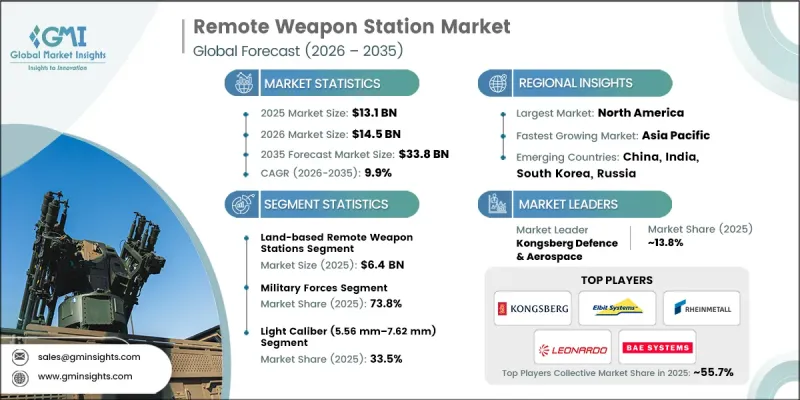
The Global Remote Weapon Station Market was valued at USD 13.1 billion in 2025 and is estimated to grow at a CAGR of 9.9% to reach USD 33.8 billion in 2035.
Market growth is fueled by rising global defense modernization budgets, expanding asymmetric threat scenarios, and increasing demand for force protection solutions across land, sea, and air platforms. The adoption of unmanned and autonomous platforms, along with AI-enabled targeting and advanced sensor fusion systems, is transforming operational capabilities, enabling more precise and rapid responses on modern battlefields. Additional drivers include cross-border security investments, naval and coastal defense upgrades, and government initiatives supporting indigenous defense production, which together accelerate the deployment of remote weapon stations worldwide. Rising defense expenditures, coupled with technological innovation and strategic procurement policies, continue to strengthen adoption across multiple military domains and operational theaters.
| Market Scope | |
|---|---|
| Start Year | 2025 |
| Forecast Year | 2026-2035 |
| Start Value | $13.1 Billion |
| Forecast Value | $33.8 Billion |
| CAGR | 9.9% |
The market is strongly influenced by government investment in modernizing weapons systems, enhancing fleet readiness, and integrating RWS into unmanned vehicles. Rising asymmetric threats, increased naval and border security acquisitions, and government-backed local manufacturing programs are significant contributors to market expansion. AI-driven targeting and sensor fusion technologies allow operators to make faster, more accurate decisions, which further boosts adoption of remote weapon stations.
The land-based remote weapon stations segment reached USD 6.4 billion in 2025. These systems are widely deployed on armored vehicles, infantry fighting vehicles, and combat trucks, offering continuous battlefield surveillance, precise target engagement, and integration with advanced sensors. Their operational versatility and reliability make them a cornerstone for modern armies seeking enhanced protection and remote engagement capabilities.
The light-caliber (5.56 mm-7.62 mm) segment held 33.5% share in 2025. Light-caliber RWS are favored for their precision, minimal recoil, and dual manual and automatic operation. These systems support tactical operations in urban environments and conflict zones while ensuring civilian safety. AI-assisted tracking and electro-optical sensor integration enhance mission efficiency, making light-caliber RWS a preferred choice for militaries worldwide.
North America Remote Weapon Station Market held a 33% share in 2025. Growth in this region is driven by large-scale defense modernization programs, elevated defense spending, and strategic focus on unmanned systems and force protection. Funding from the U.S. Department of Defense for AI-enabled targeting and sensor fusion technologies, combined with the region's mature defense industrial base, strengthens North America's position as a leader in RWS adoption. Border security, counter-terrorism initiatives, and coalition operations further reinforce market expansion through 2035.
Prominent players in the Global Remote Weapon Station Market include Kongsberg Defence & Aerospace, Rheinmetall AG, Rafael Advanced Defense Systems, KNDS Group, BAE Systems plc, FN Herstal, Leonardo S.p.A., Elbit Systems Ltd., ST Engineering, Electro Optic Systems, Pro Optica, Norinco, Thales Group, ASELSAN A.S, General Dynamics Corporation, and Saab AB. Companies in the Global Remote Weapon Station Market are adopting multiple strategies to consolidate their presence and expand market share. These include investing heavily in R&D to develop AI-assisted targeting, sensor fusion, and modular platforms adaptable to multiple vehicles and environments. Strategic partnerships with defense ministries, technology firms, and OEMs help integrate advanced systems into operational fleets. Firms are also focusing on localized production and technology transfer initiatives to meet government requirements and reduce supply chain dependency. Expansion of regional service centers, training programs, and rapid upgrade capabilities ensures operational readiness while enhancing customer engagement.
Table of Contents
Chapter 1 Methodology and Scope
- 1.1 Market scope and definition
- 1.2 Research design
- 1.2.1 Research approach
- 1.2.2 Data collection methods
- 1.3 Data mining sources
- 1.3.1 Global
- 1.3.2 Regional/Country
- 1.4 Base estimates and calculations
- 1.4.1 Base year calculation
- 1.4.2 Key trends for market estimation
- 1.5 Primary research and validation
- 1.5.1 Primary sources
- 1.6 Forecast model
- 1.7 Research assumptions and limitations
Chapter 2 Executive Summary
- 2.1 Industry 360° synopsis, 2022 - 2035
- 2.2 Key market trends
- 2.2.1 Platform type trends
- 2.2.2 Weapon type trends
- 2.2.3 Mobility type trends
- 2.2.4 Highest autonomy level trends
- 2.2.5 Sensor suite configuration trends
- 2.2.6 End-user trends
- 2.2.7 Regional trends
- 2.3 TAM Analysis, 2026-2035
- 2.4 CXO perspectives: Strategic imperatives
- 2.4.1 Executive decision points
- 2.4.2 critical success factors
- 2.5 Future outlook and strategic recommendations
Chapter 3 Industry Insights
- 3.1 Industry ecosystem analysis
- 3.1.1 Supplier Landscape
- 3.1.2 Profit Margin
- 3.1.3 Cost structure
- 3.1.4 Value addition at each stage
- 3.1.5 Factor affecting the value chain
- 3.1.6 Disruptions
- 3.2 Industry impact forces
- 3.2.1 Growth drivers
- 3.2.1.1 Rising global defense modernization spending
- 3.2.1.2 Increased asymmetric warfare and force-protection needs
- 3.2.1.3 Expansion of unmanned systems integration
- 3.2.1.4 Growing naval RWS deployments for coastal defense
- 3.2.1.5 Border security and homeland security procurements
- 3.2.2 Industry pitfalls and challenges
- 3.2.2.1 Complex integration with legacy platforms
- 3.2.2.2 Cybersecurity and electronic warfare vulnerabilities
- 3.2.3 Market opportunities
- 3.2.3.1 AI-driven autonomous engagement systems
- 3.2.3.2 RWS on unmanned ground and aerial platforms
- 3.2.1 Growth drivers
- 3.3 Growth potential analysis
- 3.4 Regulatory landscape
- 3.4.1 North America
- 3.4.2 Europe
- 3.4.3 Asia Pacific
- 3.4.4 Latin America
- 3.4.5 Middle East & Africa
- 3.5 Porter's analysis
- 3.6 PESTEL analysis
- 3.7 Technology and Innovation landscape
- 3.7.1 Current technological trends
- 3.7.2 Emerging technologies
- 3.8 Price trends
- 3.8.1 By region
- 3.8.2 By product
- 3.9 Pricing Strategies
- 3.10 Emerging Business Models
- 3.11 Compliance Requirements
- 3.12 Patent and IP analysis
- 3.13 Geopolitical and trade dynamics
Chapter 4 Competitive Landscape, 2025
- 4.1 Introduction
- 4.2 Company market share analysis
- 4.2.1 By region
- 4.2.1.1 North America
- 4.2.1.2 Europe
- 4.2.1.3 Asia Pacific
- 4.2.1.4 Latin America
- 4.2.1.5 Middle East & Africa
- 4.2.2 Market concentration analysis
- 4.2.1 By region
- 4.3 Competitive benchmarking of key players
- 4.3.1 Financial performance comparison
- 4.3.1.1 Revenue
- 4.3.1.2 Profit margin
- 4.3.1.3 R&D
- 4.3.2 Product portfolio comparison
- 4.3.2.1 Product range breadth
- 4.3.2.2 Technology
- 4.3.2.3 Innovation
- 4.3.3 Geographic presence comparison
- 4.3.3.1 Global footprint analysis
- 4.3.3.2 Service network coverage
- 4.3.3.3 Market penetration by region
- 4.3.4 Competitive positioning matrix
- 4.3.4.1 Leaders
- 4.3.4.2 Challengers
- 4.3.4.3 Followers
- 4.3.4.4 Niche players
- 4.3.5 Strategic outlook matrix
- 4.3.1 Financial performance comparison
- 4.4 Key developments
- 4.4.1 Mergers and acquisitions
- 4.4.2 Partnerships and collaborations
- 4.4.3 Technological advancements
- 4.4.4 Expansion and investment strategies
- 4.4.5 Digital transformation initiatives
- 4.5 Emerging/ startup competitors landscape
Chapter 5 Market Estimates and Forecast, By Platform Type, 2022 - 2035 (USD Million)
- 5.1 Key trends
- 5.2 Land-based remote weapon stations
- 5.2.1 Light tactical vehicles
- 5.2.2 MRAP & armored vehicles (APCs + IFVs + MBTs)
- 5.2.3 Unmanned ground vehicles (UGVs)
- 5.3 Naval remote weapon stations
- 5.3.1 Small naval vessels (patrol boats, coast guard / border patrol)
- 5.3.2 Corvettes
- 5.3.3 Large naval vessels (frigates, destroyers, amphibious assault vessels)
- 5.4 Fixed / stationary installations
- 5.5 Airborne remote weapon stations
- 5.5.1 Helicopters
- 5.5.2 Unmanned aerial vehicles (UAVs)
Chapter 6 Market Estimates and Forecast, By Weapon Type, 2022 - 2035 (USD Million)
- 6.1 Key trends
- 6.2 Light caliber (5.56mm - 7.62mm)
- 6.3 Medium caliber (12.7mm / .50 cal)
- 6.4 Heavy caliber (14.5mm - 20mm)
- 6.5 Cannon (25mm - 40mm)
Chapter 7 Market Estimates and Forecast, By Mobility Type, 2022 - 2035 (USD Million)
- 7.1 Key trends
- 7.2 Mobile RWS
- 7.3 Stationary RWS
Chapter 8 Market Estimates and Forecast, By Highest Autonomy Level, 2022 - 2035 (USD Million)
- 8.1 Key trends
- 8.2 Manual remote operation only
- 8.3 Semi-autonomous
- 8.4 Autonomous engagement capable
Chapter 9 Market Estimates and Forecast, By Sensor Suite Configuration, 2022 - 2035 (USD Million)
- 9.1 Key trends
- 9.2 Basic (day camera only)
- 9.3 Standard (day + thermal)
- 9.4 Advanced (day + thermal + LRF)
- 9.5 Premium (Multi-Spectral + LRF + auto-tracking + AI)
Chapter 10 Market Estimates and Forecast, By End-User, 2022 - 2035 (USD Million)
- 10.1 Key trends
- 10.2 Military forces
- 10.3 Homeland security & border protection
- 10.4 Law enforcement & internal security
- 10.5 Commercial & critical infrastructure
Chapter 11 Market Estimates and Forecast, By Region, 2022 - 2035 (USD Million)
- 11.1 Key trends
- 11.2 North America
- 11.2.1 U.S.
- 11.2.2 Canada
- 11.3 Europe
- 11.3.1 Germany
- 11.3.2 UK
- 11.3.3 France
- 11.3.4 Spain
- 11.3.5 Italy
- 11.3.6 Russia
- 11.4 Asia Pacific
- 11.4.1 China
- 11.4.2 India
- 11.4.3 Japan
- 11.4.4 Australia
- 11.4.5 South Korea
- 11.5 Latin America
- 11.5.1 Brazil
- 11.5.2 Mexico
- 11.5.3 Argentina
- 11.6 Middle East and Africa
- 11.6.1 South Africa
- 11.6.2 Saudi Arabia
- 11.6.3 UAE
Chapter 12 Company Profiles
- 12.1 Global Key Players
- 12.1.1 BAE Systems plc
- 12.1.2 Rheinmetall AG
- 12.1.3 Leonardo S.p.A
- 12.1.4 Thales Group
- 12.1.5 Saab AB
- 12.2 Regional key players
- 12.2.1 North America
- 12.2.1.1 General Dynamics Corporation
- 12.2.2 Asia Pacific
- 12.2.2.1 ASELSAN A.S
- 12.2.2.2 Norinco
- 12.2.2.3 ST Engineering
- 12.2.3 Europe
- 12.2.3.1 FN Herstal
- 12.2.3.2 KNDS Group
- 12.2.1 North America
- 12.3 Niche Players/Disruptors
- 12.3.1 Kongsberg Defence & Aerospace
- 12.3.2 Elbit Systems Ltd.
- 12.3.3 Electro Optic Systems
- 12.3.4 Rafael Advanced Defense Systems
- 12.3.5 Pro Optica

