
PUBLISHER: Global Market Insights Inc. | PRODUCT CODE: 1998819

PUBLISHER: Global Market Insights Inc. | PRODUCT CODE: 1998819
Smart Fleet Management Market Opportunity, Growth Drivers, Industry Trend Analysis, and Forecast 2026 - 2035
The Global Smart Fleet Management Market was valued at USD 61.4 billion in 2025 and is estimated to grow at a CAGR of 8.9% to reach USD 139.5 billion by 2035.
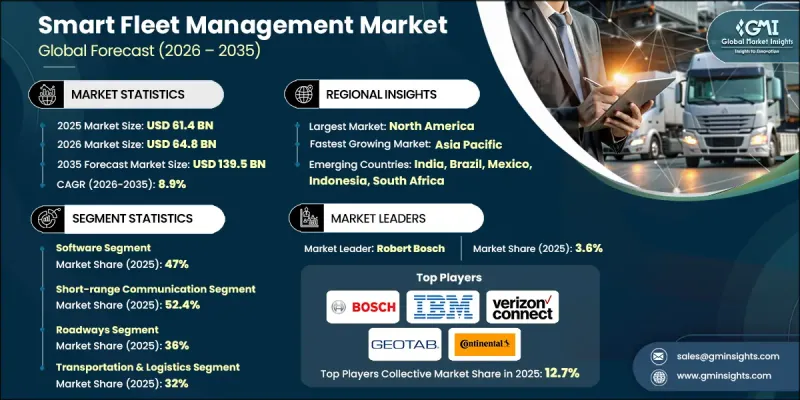
Market growth is poised for significant growth as businesses increasingly prioritize operational visibility and efficiency. Companies managing vehicle fleets are investing in smart fleet management systems to gain comprehensive oversight of vehicle locations, driver performance, and operational metrics. This enables managers to make data-driven decisions, reduce delays, optimize fleet utilization, and improve overall efficiency. Rising fuel costs and operational pressures are driving the adoption of solutions that minimize idling, optimize routes, and track driver behavior. By leveraging analytics and telematics, fleet operators can reduce fuel consumption, enhance productivity, and implement predictive maintenance strategies. The growing integration of connected vehicles and IoT-enabled systems also facilitates real-time monitoring and actionable insights, enabling companies to address operational challenges while improving cost efficiency and fleet performance across industries.
| Market Scope | |
|---|---|
| Start Year | 2025 |
| Forecast Year | 2026-2035 |
| Start Value | $61.4 Billion |
| Forecast Value | $139.5 Billion |
| CAGR | 8.9% |
The short-range communication segment held a 52.4% share in 2025 and is expected to grow at a CAGR of 8% through 2035. Technologies such as Bluetooth, RFID, and Wi-Fi allow limited-distance data exchange between vehicles or between vehicles and local infrastructure. These solutions support localized monitoring, rapid updates via sensors, and fleet coordination across depots, loading points, and campus operations.
The transportation and logistics sector accounted for 32% share in 2025. Smart fleet management tools help operators optimize vehicle utilization, route planning, driver behavior, and fuel efficiency. Real-time tracking, predictive maintenance, and analytics reduce costs, ensure timely deliveries, and enhance operational efficiency across regional and international networks.
U.S. Smart Fleet Management Market reached USD 21 billion in 2025. Commercial fleet operators in the U.S. increasingly use telematics to monitor fuel usage, optimize delivery routes, and track driver performance. Cloud-based platforms and AI-driven predictive maintenance solutions are widely adopted across different vehicle types. Regulatory compliance for electronic logging devices (ELDs) further supports real-time reporting and performance benchmarking, improving safety, accountability, and operational efficiency across large trucking networks.
Key players in the Global Smart Fleet Management Market include IBM, Cisco Systems, Siemens, Continental, Denso, Infineon Technologies, Robert Bosch, Magellan and Trimble Navigation, Zonar Systems, and General Motors. Companies in the Smart Fleet Management Market are leveraging multiple strategies to solidify their market presence. Key approaches include investing in advanced telematics and IoT platforms that enable real-time fleet tracking and predictive analytics. Strategic partnerships with logistics operators and automotive manufacturers allow firms to expand their customer base and integrate solutions across vehicle types. Several players are enhancing their offerings through AI-driven route optimization, fuel management tools, and driver behavior monitoring systems. Expansion into new geographic regions and development of modular, scalable solutions provide flexibility for small and large fleet operators alike. Additionally, firms are focusing on regulatory compliance, cybersecurity, and cloud-based platforms to maintain trust, improve operational efficiency, and strengthen competitive positioning in the global smart fleet management market.
Table of Contents
Chapter 1 Methodology
- 1.1 Research approach
- 1.2 Quality commitments
- 1.3 GMI AI policy & data integrity commitment
- 1.4 Research trail & confidence scoring
- 1.4.1 Research trail components
- 1.4.2 Scoring components
- 1.5 Data collection
- 1.5.1 Partial list of primary sources
- 1.6 Data mining sources
- 1.6.1 Paid sources
- 1.7 Base estimates and calculations
- 1.7.1 Base year calculation
- 1.8 Forecast model
- 1.9 Research transparency addendum
Chapter 2 Executive Summary
- 2.1 Industry 360° synopsis
- 2.2 Key market trends
- 2.2.1 Regional
- 2.2.2 Component
- 2.2.3 Connectivity technology
- 2.2.4 Transport mode
- 2.2.5 End use industry
- 2.3 TAM analysis, 2026-2035
- 2.4 CXO perspectives: Strategic imperatives
Chapter 3 Industry Insights
- 3.1 Industry ecosystem analysis
- 3.1.1 Supplier landscape
- 3.1.2 Profit margin
- 3.1.3 Cost structure
- 3.1.4 Value addition at each stage
- 3.1.5 Factor affecting the value chain
- 3.1.6 Disruptions
- 3.2 Industry impact forces
- 3.2.1 Growth drivers
- 3.2.1.1 Real-time fleet visibility
- 3.2.1.2 Fuel cost optimization
- 3.2.1.3 Safety & compliance regulations
- 3.2.1.4 E-commerce & last-mile delivery growth
- 3.2.2 Industry pitfalls and challenges
- 3.2.2.1 High initial deployment costs
- 3.2.2.2 Data privacy & cybersecurity risks
- 3.2.3 Market opportunities
- 3.2.3.1 EV charging infrastructure integration
- 3.2.3.2 Emerging market expansion
- 3.2.3.3 Usage-based insurance (UBI)
- 3.2.3.4 Public sector fleet digitization
- 3.2.1 Growth drivers
- 3.3 Growth potential analysis
- 3.4 Regulatory landscape
- 3.4.1 North America
- 3.4.1.1 National Highway Traffic Safety Administration (NHTSA)
- 3.4.1.2 Transport Canada Motor Vehicle Safety Standards (CMVSS)
- 3.4.2 Europe
- 3.4.2.1 European Whole Vehicle Type Approval (WVTA)
- 3.4.2.2 ECE Regulation 124 (R124)
- 3.4.3 Asia Pacific
- 3.4.3.1 Japan Automotive Standards Organization (JASO)
- 3.4.3.2 AIS (Automotive Industry Standards) - India
- 3.4.4 Latin America
- 3.4.4.1 Brazilian National Traffic Council (CONTRAN) - Resolution 242
- 3.4.4.2 Mexican NOM Standards (Normas Oficiales Mexicanas)
- 3.4.5 Middle East & Africa
- 3.4.5.1 Emirates Authority for Standardization and Metrology (ESMA)
- 3.4.5.2 South African Bureau of Standards (SABS)
- 3.4.1 North America
- 3.5 Porter's analysis
- 3.6 PESTEL analysis
- 3.7 Technology and innovation landscape
- 3.7.1 Current technological trends
- 3.7.2 Emerging technologies
- 3.8 Pricing Analysis (Driven by Primary Research)
- 3.8.1 Historical Price Trend Analysis
- 3.8.2 Pricing Strategy by Player Type (Premium / Value / Cost-plus)
- 3.9 Cost breakdown analysis
- 3.10 Patent analysis (Driven by Primary Research)
- 3.11 Sustainability and environmental aspects
- 3.11.1 Sustainable practices
- 3.11.2 Waste reduction strategies
- 3.11.3 Energy efficiency in production
- 3.11.4 Eco-friendly initiatives
- 3.11.5 Carbon footprint considerations
- 3.12 Impact of AI & Generative AI on the Market
- 3.12.1 AI-driven disruption of existing business models
- 3.12.2 GenAI use cases & adoption roadmap by segment
- 3.12.3 Risks, limitations & regulatory considerations
- 3.13 Infrastructure & deployment landscape (driven by primary research)
- 3.13.1 Deployment penetration by region & buyer segment
- 3.13.2 Scalability constraints & infrastructure investment trends
- 3.14 Forecast assumptions & scenario analysis (driven by primary research)
- 3.14.1 Base Case - key macro & industry variables driving CAGR
- 3.14.2 Optimistic Scenarios - Favorable macro and industry tailwinds
- 3.14.3 Pessimistic Scenario - Macroeconomic slowdown or industry headwinds
Chapter 4 Competitive Landscape, 2025
- 4.1 Introduction
- 4.2 Company market share analysis
- 4.2.1 North America
- 4.2.2 Europe
- 4.2.3 Asia Pacific
- 4.2.4 LATAM
- 4.2.5 MEA
- 4.3 Competitive analysis of major market players
- 4.4 Competitive positioning matrix
- 4.5 Key developments
- 4.5.1 Mergers & acquisitions
- 4.5.2 Partnerships & collaborations
- 4.5.3 New product launches
- 4.5.4 Expansion plans and funding
- 4.6 Company tier benchmarking
- 4.6.1 Tier classification criteria & qualifying thresholds
- 4.6.2 Tier positioning matrix by revenue, geography & innovation
Chapter 5 Market Estimates & Forecast, By Component, 2022 - 2035 ($Mn, Units)
- 5.1 Key trends
- 5.2 Hardware
- 5.2.1 Tracking devices
- 5.2.2 Telematics devices
- 5.2.3 Sensors
- 5.2.4 Remote diagnostics
- 5.2.5 Communication devices
- 5.2.6 Others
- 5.3 Software
- 5.3.1 Vehicle tracking
- 5.3.2 Route optimization
- 5.3.3 Compliance & reporting
- 5.3.4 Others
- 5.4 Services
- 5.4.1 Professional services
- 5.4.1.1 Consulting & integration
- 5.4.1.2 Customization
- 5.4.1.3 System deployment
- 5.4.2 Managed services
- 5.4.2.1 Remote monitoring
- 5.4.2.2 Support & maintenance
- 5.4.1 Professional services
Chapter 6 Market Estimates & Forecast, By Connectivity Technology, 2022 - 2035 ($Mn)
- 6.1 Key trends
- 6.2 Short-range communication
- 6.3 Long-range communication
- 6.4 Hybrid
Chapter 7 Market Estimates & Forecast, By Transport Mode, 2022 - 2035 ($Mn)
- 7.1 Key trends
- 7.2 Roadways
- 7.3 Marine
- 7.4 Airways
- 7.5 Railways
Chapter 8 Market Estimates & Forecast, By End Use Industry, 2022 - 2035 ($Mn)
- 8.1 Key trends
- 8.2 Transportation & logistics
- 8.3 Retail & e-commerce
- 8.4 Healthcare & emergency services
- 8.5 Oil & gas
- 8.6 Construction & mining
- 8.7 Field services
- 8.8 Government & public sector
- 8.9 Others
Chapter 9 Market Estimates & Forecast, By Region, 2022 - 2035 ($Mn)
- 9.1 Key trends
- 9.2 North America
- 9.2.1 US
- 9.2.2 Canada
- 9.3 Europe
- 9.3.1 Germany
- 9.3.2 UK
- 9.3.3 France
- 9.3.4 Italy
- 9.3.5 Spain
- 9.3.6 Nordics
- 9.3.7 Russia
- 9.3.8 Poland
- 9.3.9 Romania
- 9.4 Asia Pacific
- 9.4.1 China
- 9.4.2 India
- 9.4.3 Japan
- 9.4.4 South Korea
- 9.4.5 ANZ
- 9.4.6 Vietnam
- 9.4.7 Indonesia
- 9.4.8 Philippines
- 9.5 Latin America
- 9.5.1 Brazil
- 9.5.2 Mexico
- 9.5.3 Argentina
- 9.6 MEA
- 9.6.1 South Africa
- 9.6.2 Saudi Arabia
- 9.6.3 UAE
Chapter 10 Company Profiles
- 10.1 Global companies
- 10.1.1 Cisco Systems
- 10.1.2 Continental
- 10.1.3 Denso
- 10.1.4 General Motors
- 10.1.5 IBM
- 10.1.6 Infineon Technologies
- 10.1.7 Magellan and Trimble Navigation
- 10.1.8 Robert Bosch
- 10.1.9 Siemens
- 10.1.10 Zonar Systems
- 10.2 Regional players
- 10.2.1 MiX Telematics
- 10.2.2 Samsara
- 10.2.3 Teletrac Navman
- 10.2.4 Omnitracs
- 10.2.5 Fleet Complete
- 10.2.6 Hitachi
- 10.2.7 Powerfleet
- 10.2.8 Gurtam (Wialon)
- 10.3 Emerging players
- 10.3.1 Azuga
- 10.3.2 CalAmp
- 10.3.3 Noregon
- 10.3.4 Zubie

