
PUBLISHER: Global Market Insights Inc. | PRODUCT CODE: 1998820

PUBLISHER: Global Market Insights Inc. | PRODUCT CODE: 1998820
Spectral Sensor Market Opportunity, Growth Drivers, Industry Trend Analysis, and Forecast 2026 - 2035
The Global Spectral Sensor Market was valued at USD 1.6 billion in 2025 and is estimated to grow at a CAGR of 13.1% to reach USD 5.3 billion by 2035.
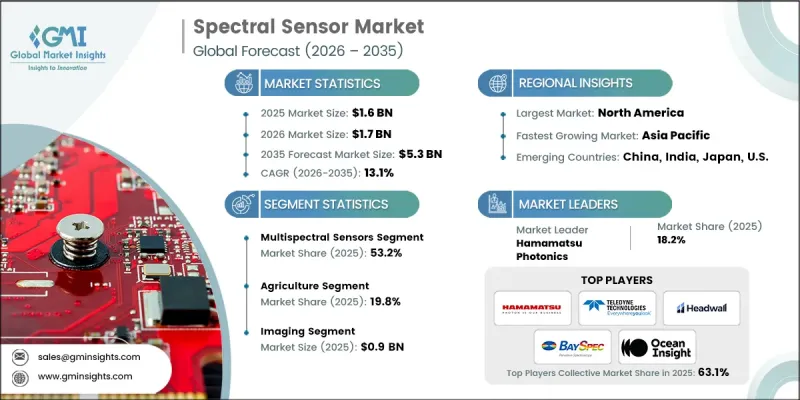
The spectral sensor market is experiencing strong momentum as industries increasingly adopt advanced optical sensing technologies to improve measurement accuracy and data-driven decision-making. Spectral sensing solutions are gaining traction across multiple sectors because they allow detailed analysis of materials, substances, and environmental conditions using different wavelengths of light. This capability is enabling businesses and research institutions to conduct more precise inspections, improve quality monitoring, and enhance analytical capabilities. Rapid technological development in sensing platforms has also made spectral sensors more compact, efficient, and adaptable to a wide variety of applications. At the same time, growing investments in scientific research, automation, and digital monitoring technologies are accelerating the adoption of advanced sensing systems across industrial and research environments. As organizations continue to rely on sophisticated data analysis tools to improve operational performance and product quality, spectral sensors are becoming an essential component in modern sensing and diagnostic systems. These factors collectively support the sustained growth of the global spectral sensor market.
| Market Scope | |
|---|---|
| Start Year | 2025 |
| Forecast Year | 2026-2035 |
| Start Value | $1.6 Billion |
| Forecast Value | $5.3 Billion |
| CAGR | 13.1% |
The spectral sensor market is also benefiting from the growing need for advanced monitoring technologies that support more precise data collection across several industries. Spectral sensing technologies enable accurate detection and analysis of materials by measuring how different wavelengths of light interact with various substances. This capability makes spectral sensors valuable tools for monitoring biological conditions, evaluating product composition, and supporting advanced scientific research. In addition, rapid progress in hyperspectral and multispectral sensing technologies is expanding the range of applications where these systems can be deployed. As industries seek improved analytical accuracy and faster inspection processes, spectral sensing solutions are increasingly integrated into automated monitoring platforms and data analysis systems.
The multispectral sensors segment accounted for 53.2% share in 2025. These sensors remain widely adopted due to their ability to capture information across multiple specific wavelength bands, allowing detailed analysis of materials and environmental conditions. Multispectral sensors offer a balanced combination of performance, affordability, and operational efficiency, which has contributed to their widespread use across numerous monitoring and inspection applications. Their compatibility with various deployment platforms also supports large-scale data collection and real-time monitoring capabilities. As industries increasingly rely on advanced sensing technologies to improve operational efficiency and quality assessment, multispectral sensors continue to play a central role in the development of modern sensing systems.
The non-imaging segment is projected to grow at a CAGR of 14.5% during 2026-2035, supported by increasing adoption of compact spectral measurement systems in analytical and monitoring applications. Non-imaging spectral sensors focus on capturing precise spectral data without generating spatial images, making them suitable for integration into portable analytical devices and embedded sensing platforms. Their compact size and measurement accuracy allow them to be incorporated into a wide range of inspection and analytical tools used in laboratories, manufacturing facilities, and field operations. As industries continue to prioritize rapid and reliable material analysis, the demand for compact non-imaging spectral sensing technologies is expected to increase steadily.
North America Spectral Sensor Market accounted for 31.3% share in 2025. The region is experiencing steady growth as industries increasingly adopt advanced sensing technologies for scientific research, industrial inspection, and environmental monitoring applications. Strong technological infrastructure and continued investment in optical sensing innovation have encouraged widespread deployment of advanced spectral sensing solutions across various sectors. Research institutions, technology developers, and private organizations are actively investing in photonics and advanced sensing technologies to improve analytical capabilities and support emerging scientific applications. These ongoing investments are helping strengthen the region's position as a major hub for innovation and development in the spectral sensor market.
Key companies operating in the Global Spectral Sensor Market include Teledyne Technologies, Corning Incorporated, Hamamatsu Photonics, Ocean Insight, Headwall Photonics, Resonon Inc., Avantes, BaySpec, Spectral Engines, Middleton Spectral Vision, InfraTec GmbH, Photonfocus AG, Si-Ware Systems, Brimrose Corporation of America, and TriEye. Companies participating in the Global Spectral Sensor Market are implementing several strategic initiatives to strengthen their technological capabilities and expand their global presence. Many organizations are investing in research and development to enhance sensor sensitivity, improve spectral resolution, and reduce device size for easier integration into various applications. Expanding product portfolios with innovative sensing solutions designed for emerging industries is also a key priority. Strategic partnerships with research institutions, technology developers, and industrial companies allow sensor manufacturers to accelerate product innovation and broaden application opportunities. Businesses are also focusing on improving manufacturing efficiency and developing scalable production processes to meet increasing global demand.
Table of Contents
Chapter 1 Methodology and Scope
- 1.1 Market scope and definition
- 1.2 Research design
- 1.2.1 Research approach
- 1.2.2 Data collection methods
- 1.3 Data mining sources
- 1.3.1 Global
- 1.3.2 Regional/Country
- 1.4 Base estimates and calculations
- 1.4.1 Base year calculation
- 1.4.2 Key trends for market estimation
- 1.5 Primary research and validation
- 1.5.1 Primary sources
- 1.6 Forecast model
- 1.7 Research assumptions and limitations
Chapter 2 Executive Summary
- 2.1 Industry 360° synopsis, 2022 - 2035
- 2.2 Key market trends
- 2.2.1 Product type trends
- 2.2.2 Technology trends
- 2.2.3 Application trends
- 2.2.4 Regional trends
- 2.3 TAM Analysis, 2026-2035
- 2.4 CXO perspectives: Strategic imperatives
Chapter 3 Industry Insights
- 3.1 Industry ecosystem analysis
- 3.1.1 Supplier Landscape
- 3.1.2 Profit Margin
- 3.1.3 Cost structure
- 3.1.4 Value addition at each stage
- 3.1.5 Factor affecting the value chain
- 3.1.6 Disruptions
- 3.2 Industry impact forces
- 3.2.1 Growth drivers
- 3.2.1.1 Rising precision agriculture adoption for crop health monitoring
- 3.2.1.2 Rising food safety verification using spectral sensing
- 3.2.1.3 Growing hyperspectral imaging use in medical diagnostics
- 3.2.1.4 Increasing industrial quality inspection using spectral analysis
- 3.2.1.5 Expansion of smart environmental monitoring networks
- 3.2.2 Industry pitfalls and challenges
- 3.2.2.1 High hyperspectral sensor system integration costs
- 3.2.2.2 Complex spectral data processing requirements
- 3.2.3 Market opportunities
- 3.2.3.1 Integration with AI-driven spectral data analytics
- 3.2.3.2 Expansion of wearable non-invasive health monitoring sensors
- 3.2.1 Growth drivers
- 3.3 Growth potential analysis
- 3.4 Regulatory landscape
- 3.4.1 North America
- 3.4.2 Europe
- 3.4.3 Asia Pacific
- 3.4.4 Latin America
- 3.4.5 Middle East & Africa
- 3.5 Porter's analysis
- 3.6 PESTEL analysis
- 3.7 Technology and Innovation landscape
- 3.7.1 Current technological trends
- 3.7.2 Emerging technologies
- 3.8 Price trends
- 3.8.1 By region
- 3.8.2 By product
- 3.9 Pricing Strategies
- 3.10 Emerging Business Models
- 3.11 Compliance Requirements
- 3.12 Patent and IP analysis
- 3.13 Impact of AI & Generative AI on the Market
- 3.13.1 AI-Driven Disruption of Existing Business Models
- 3.13.2 GenAI Use Cases & Adoption Roadmap by Segment
- 3.13.2.1 Automated Spectral Data Interpretation
- 3.13.2.2 AI-Enhanced Sensor Calibration & Compensation
- 3.13.2.3 Predictive Maintenance for Spectral Sensing Systems
- 3.14 Capacity & Production Landscape (Based on Paid Databases)
- 3.14.1 Installed Capacity by Region & Key Producer
- 3.14.2 Capacity Utilization Rates & Expansion Pipelines
Chapter 4 Competitive Landscape, 2025
- 4.1 Introduction
- 4.2 Company market share analysis
- 4.2.1 By region
- 4.2.1.1 North America
- 4.2.1.2 Europe
- 4.2.1.3 Asia Pacific
- 4.2.1.4 Latin America
- 4.2.1.5 Middle East & Africa
- 4.2.2 Market concentration analysis
- 4.2.1 By region
- 4.3 Competitive benchmarking of key players
- 4.3.1 Financial performance comparison
- 4.3.1.1 Revenue
- 4.3.1.2 Profit margin
- 4.3.1.3 R&D
- 4.3.2 Product portfolio comparison
- 4.3.2.1 Product range breadth
- 4.3.2.2 Technology
- 4.3.2.3 Innovation
- 4.3.3 Geographic presence comparison
- 4.3.3.1 Global footprint analysis
- 4.3.3.2 Service network coverage
- 4.3.3.3 Market penetration by region
- 4.3.4 Competitive positioning matrix
- 4.3.4.1 Leaders
- 4.3.4.2 Challengers
- 4.3.4.3 Followers
- 4.3.4.4 Niche players
- 4.3.5 Strategic outlook matrix
- 4.3.1 Financial performance comparison
- 4.4 Key developments
- 4.4.1 Mergers and acquisitions
- 4.4.2 Partnerships and collaborations
- 4.4.3 Technological advancements
- 4.4.4 Expansion and investment strategies
- 4.4.5 Digital transformation initiatives
- 4.5 Emerging/ startup competitors landscape
Chapter 5 Market Estimates and Forecast, By Product Type, 2022 - 2035 (USD Million)
- 5.1 Key trends
- 5.2 Multispectral sensors
- 5.3 Hyperspectral sensors
Chapter 6 Market Estimates and Forecast, By Technology, 2022 - 2035 (USD Million)
- 6.1 Key trends
- 6.2 Imaging
- 6.3 Non-imaging
Chapter 7 Market Estimates and Forecast, By Application, 2022 - 2035 (USD Million)
- 7.1 Key trends
- 7.2 Agriculture
- 7.3 Environmental monitoring
- 7.4 Healthcare
- 7.5 Food & beverage
- 7.6 Aerospace & defense
- 7.7 Industrial manufacturing
- 7.8 Others
Chapter 8 Market Estimates and Forecast, By Region, 2022 - 2035 (USD Million)
- 8.1 Key trends
- 8.2 North America
- 8.2.1 U.S.
- 8.2.2 Canada
- 8.3 Europe
- 8.3.1 Germany
- 8.3.2 UK
- 8.3.3 France
- 8.3.4 Spain
- 8.3.5 Italy
- 8.3.6 Netherlands
- 8.4 Asia Pacific
- 8.4.1 China
- 8.4.2 India
- 8.4.3 Japan
- 8.4.4 Australia
- 8.4.5 South Korea
- 8.5 Latin America
- 8.5.1 Brazil
- 8.5.2 Mexico
- 8.5.3 Argentina
- 8.6 Middle East and Africa
- 8.6.1 South Africa
- 8.6.2 Saudi Arabia
- 8.6.3 UAE
Chapter 9 Company Profiles
- 9.1 Global Key Players
- 9.1.1 Teledyne Technologies
- 9.1.2 Hamamatsu Photonics
- 9.1.3 Corning Incorporated
- 9.2 Regional key players
- 9.2.1 North America
- 9.2.1.1 Ocean Insight
- 9.2.1.2 Headwall Photonics
- 9.2.1.3 Resonon Inc.
- 9.2.2 Asia Pacific
- 9.2.2.1 TriEye
- 9.2.3 Europe
- 9.2.3.1 Avantes
- 9.2.3.2 Photonfocus AG
- 9.2.3.3 InfraTec GmbH
- 9.2.1 North America
- 9.3 Niche Players/Disruptors
- 9.3.1 BaySpec
- 9.3.2 Middleton Spectral Vision
- 9.3.3 Brimrose Corporation of America
- 9.3.4 Si-Ware Systems
- 9.3.5 Spectral Engines

