PUBLISHER: Global Market Insights Inc. | PRODUCT CODE: 1998830

PUBLISHER: Global Market Insights Inc. | PRODUCT CODE: 1998830
Bicycle Mechanical Disc Brake Market Opportunity, Growth Drivers, Industry Trend Analysis, and Forecast 2026 - 2035
The Global Bicycle Mechanical Disc Brake Market was valued at USD 542 million in 2025 and is estimated to grow at a CAGR of 4% to reach USD 796.9 million by 2035.
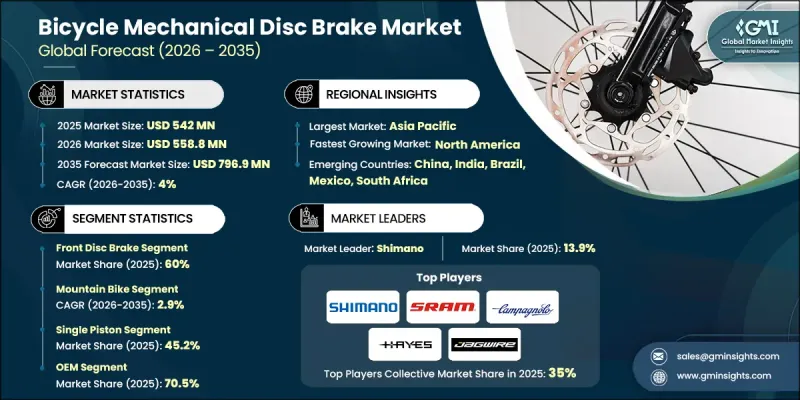
The market is driven by rising global bicycle adoption, fueled by urban commuting, recreational cycling, and expanding bike-sharing programs. As more cities integrate cycling into sustainable transportation planning, bicycle manufacturers and component suppliers are equipping a wider range of models with mechanical disc brakes to meet increasing safety and performance standards. Growing environmental consciousness is encouraging riders to favor bicycles over motorized vehicles, while the rapid adoption of e-bikes for daily commuting and leisure activities further strengthens demand for mechanical disc brakes that provide dependable stopping power under varying riding conditions. Innovations in brake components are also enhancing the appeal of mechanical disc brakes. Advances in rotor design, cable systems, and materials improve wear resistance, heat dissipation, and braking modulation, keeping mechanical systems competitive against costlier hydraulic alternatives. These improvements allow manufacturers to differentiate products and maintain relevance across commuter, hybrid, gravel, and mountain bike segments.
| Market Scope | |
|---|---|
| Start Year | 2025 |
| Forecast Year | 2026-2035 |
| Start Value | $542 Million |
| Forecast Value | $796.9 Million |
| CAGR | 4% |
The front disc brake segment held a 60% share in 2025 and is expected to grow at a CAGR of 3.4% through 2035. Front disc brakes handle the majority of braking force, ensuring smooth modulation, shorter stopping distances, and reliable performance in both wet and dry conditions. Their integration is a top priority for OEMs and component suppliers aiming to meet safety regulations and deliver high-performance braking solutions across mountain, gravel, road, urban, and e-bike platforms.
The mountain bikes segment held a 45.7% share in 2025 and is forecasted to grow at a CAGR of 2.9% from 2026 to 2035. Mechanical disc brakes are essential for off-road trails, steep descents, and uneven terrain because they provide consistent stopping power in mud, water, and debris-laden conditions. This reliability makes them indispensable for mountain bike manufacturers, professional riders, and trail cycling enthusiasts.
U.S. Bicycle Mechanical Disc Brake Market reached USD 94.2 million in 2025. Growth in the region is driven by the adoption of advanced braking solutions by manufacturers, e-bike operators, and component distributors. Precision mechanical disc brakes ensure consistent performance, enhance rider safety, and maintain compatibility with modern frame standards, reducing brake failure risks in high-volume markets. Companies are also upgrading rotor designs and modular caliper platforms to optimize braking across both traditional and electric bicycles.
Major players operating in the Global Bicycle Mechanical Disc Brake Market include Shimano, SRAM, Campagnolo, Hayes, Jagwire, Magura, Cane Creek, Formula, Tektro, and Box Components. Key strategies adopted by companies in the Global Bicycle Mechanical Disc Brake Market include extensive R&D for improved rotor and caliper designs, developing lightweight and corrosion-resistant materials, and enhancing heat dissipation and modulation performance. Firms focus on expanding product portfolios across e-bikes, mountain, commuter, and hybrid segments to meet diverse customer needs. Strategic collaborations with bicycle OEMs and aftermarket distributors help integrate braking systems early in the design process. Market players also leverage marketing campaigns emphasizing safety, durability, and performance reliability, while establishing regional manufacturing hubs to improve supply chain efficiency, reduce costs, and strengthen global market presence.
Table of Contents
Chapter 1 Methodology
- 1.1 Research approach
- 1.2 Quality commitments
- 1.2.1 GMI AI policy & data integrity commitment
- 1.3 Research trail & confidence scoring
- 1.3.1 Research trail components
- 1.3.2 Scoring components
- 1.4 Data collection
- 1.4.1 Partial list of primary sources
- 1.5 Data mining sources
- 1.5.1 Paid sources
- 1.6 Base estimates and calculations
- 1.6.1 Base year calculation
- 1.7 Forecast model
- 1.8 Research transparency addendum
Chapter 2 Executive Summary
- 2.1 Industry 360° synopsis
- 2.2 Key market trends
- 2.2.1 Regional
- 2.2.2 Brake
- 2.2.3 Offering
- 2.2.4 Application
- 2.2.5 Distribution Channel
- 2.3 TAM analysis, 2026-2035
- 2.4 CXO perspectives: Strategic imperatives
- 2.4.1 Executive decision points
- 2.4.2 Critical success factors
- 2.5 Future outlook
- 2.6 Strategic recommendations
Chapter 3 Industry Insights
- 3.1 Industry ecosystem analysis
- 3.1.1 Supplier landscape
- 3.1.2 Profit margin
- 3.1.3 Cost structure
- 3.1.4 Value addition at each stage
- 3.1.5 Factor affecting the value chain
- 3.1.6 Disruptions
- 3.2 Industry impact forces
- 3.2.1 Growth drivers
- 3.2.1.1 Increase in bicycle adoption across the world
- 3.2.1.2 Environmental awareness encourages the shift to eco-friendly transport
- 3.2.1.3 Technological advancements in brake components
- 3.2.1.4 Government initiatives supporting cycling infrastructure
- 3.2.2 Industry pitfalls and challenges
- 3.2.2.1 High competition and price sensitivity
- 3.2.2.2 Shift toward hydraulic disc brakes
- 3.2.3 Market opportunities
- 3.2.3.1 Growing Demand in Emerging Markets
- 3.2.3.2 Expansion of Gravel, Hybrid, and Commuter Bikes
- 3.2.3.3 Aftermarket Upgrades and Replacement Segment
- 3.2.3.4 Rising Urban Commuting and Micro-Mobility Trends
- 3.2.1 Growth drivers
- 3.3 Growth potential analysis
- 3.4 Regulatory landscape
- 3.4.1 North America
- 3.4.1.1 Consumer Product Safety Commission (CPSC)
- 3.4.1.2 ASTM International - Bicycle Standards (ASTM F2043 & F1952)
- 3.4.1.3 Canada: Canada Consumer Product Safety Act (CCPSA)
- 3.4.2 Europe
- 3.4.2.1 EN ISO 4210 - Safety Requirements for Bicycles
- 3.4.2.2 EU General Product Safety Directive (GPSD) / General Product Safety Regulation (GPSR)
- 3.4.3 Asia Pacific
- 3.4.3.1 China: GB Standards for Bicycle Components (GB 3565)
- 3.4.3.2 India: Bureau of Indian Standards (BIS) - IS 1570 & IS 15602
- 3.4.4 Latin America
- 3.4.4.1 Brazil: ABNT NBR Standards for Bicycles
- 3.4.4.2 Mexico: NOM Standards for Bicycle Safety
- 3.4.5 Middle East & Africa
- 3.4.5.1 UAE & Gulf States: ESMA Product Safety Regulations
- 3.4.5.2 Saudi Arabia: SASO Bicycle and Consumer Product Standards
- 3.4.5.3 African Union (AU): African Continental Consumer Protection Framework
- 3.4.1 North America
- 3.5 Porter's analysis
- 3.6 PESTEL analysis
- 3.7 Technology and innovation landscape
- 3.7.1 Current technological trends
- 3.7.2 Emerging technologies
- 3.8 Patent analysis (Driven by Primary Research)
- 3.9 Pricing Analysis (Driven by Primary Research)
- 3.9.1 Historical Price Trend Analysis
- 3.9.2 Pricing Strategy by Player Type
- 3.10 Trade statistics (Driven by Paid Database)
- 3.10.1 Production hubs
- 3.10.2 Consumption hubs
- 3.10.3 Export and import
- 3.11 Business Models and Monetization Framework
- 3.11.1 Revenue Models
- 3.11.2 Value Chain and Ecosystem
- 3.11.3 Go-to-Market Strategy
- 3.12 Quality Standards, Compliance, and Product Risk
- 3.12.1 Component Safety and Regulatory Compliance
- 3.12.2 Product Performance and Durability Risk
- 3.12.3 Operational and Supply Chain Risks
- 3.13 Braking System Architecture
- 3.13.1 Multi-Component Brake Assembly Models
- 3.13.2 Bicycle-to-Infrastructure and Smart Mobility Integration
- 3.14 Impact of AI & generative AI on the market
- 3.14.1 AI-driven disruption of existing business models
- 3.14.1.1 Predictive Maintenance & Operations Optimization
- 3.14.1.2 Automated design optimization
- 3.14.1.3 Supply chain AI for demand forecasting
- 3.14.1.4 GenAI use cases & adoption roadmap by segment
- 3.14.1 AI-driven disruption of existing business models
- 3.15 Sustainability and environmental aspects
- 3.15.1 Sustainable Manufacturing Practices
- 3.15.2 Energy efficiency in production
- 3.15.3 Carbon footprint considerations
- 3.16 Forecast assumptions & scenario analysis (Driven by Primary Research)
- 3.16.1 Base Case - key macro & industry variables driving CAGR
- 3.16.2 Optimistic Scenarios - Favorable Macro and Industry Tailwinds
- 3.16.3 Pessimistic Scenario - Macroeconomic slowdown or industry headwinds
Chapter 4 Competitive Landscape, 2025
- 4.1 Introduction
- 4.2 Company market share analysis
- 4.2.1 North America
- 4.2.2 Europe
- 4.2.3 Asia Pacific
- 4.2.4 LATAM
- 4.2.5 MEA
- 4.3 Competitive analysis of major market players
- 4.4 Competitive positioning matrix
- 4.5 Strategic outlook matrix
- 4.6 Key developments
- 4.6.1 Mergers & acquisitions
- 4.6.2 Partnerships & collaborations
- 4.6.3 New product launches
- 4.6.4 Expansion plans and funding
Chapter 5 Market Estimates & Forecast, By Brake, 2022 - 2035 ($Mn, Units)
- 5.1 Key trends
- 5.2 Front disc brake
- 5.3 Rear disc brake
Chapter 6 Market Estimates & Forecast, By Offering, 2022 - 2035 ($Mn, Units)
- 6.1 Key trends
- 6.2 Single piston
- 6.3 Dual piston
- 6.4 Four piston
- 6.5 Multi-piston
Chapter 7 Market Estimates & Forecast, By Application, 2022 - 2035 ($Mn, Units)
- 7.1 Key trends
- 7.2 Road bike
- 7.3 Mountain bike
- 7.4 Racing bike
- 7.5 Gravel bikes
Chapter 8 Market Estimates & Forecast, By Distribution Channel, 2022 - 2035 ($Mn, Units)
- 8.1 Key trends
- 8.2 OEM
- 8.3 Aftermarket
Chapter 9 Market Estimates & Forecast, By Region, 2022 - 2035 ($Mn, Units)
- 9.1 Key trends
- 9.2 North America
- 9.2.1 US
- 9.2.2 Canada
- 9.3 Europe
- 9.3.1 Germany
- 9.3.2 UK
- 9.3.3 France
- 9.3.4 Italy
- 9.3.5 Spain
- 9.3.6 Nordics
- 9.3.7 Russia
- 9.3.8 Norway
- 9.3.9 Denmark
- 9.3.10 Netherlands
- 9.3.11 Belgium
- 9.4 Asia Pacific
- 9.4.1 China
- 9.4.2 India
- 9.4.3 Japan
- 9.4.4 South Korea
- 9.4.5 ANZ
- 9.4.6 Vietnam
- 9.4.7 Indonesia
- 9.4.8 Singapore
- 9.4.9 Malaysia
- 9.4.10 Thailand
- 9.5 Latin America
- 9.5.1 Brazil
- 9.5.2 Mexico
- 9.5.3 Argentina
- 9.6 MEA
- 9.6.1 South Africa
- 9.6.2 Saudi Arabia
- 9.6.3 UAE
Chapter 10 Company Profiles
- 10.1 Global companies
- 10.1.1 Shimano
- 10.1.2 SRAM
- 10.1.3 Tektro / TRP (Tektro Racing Products)
- 10.1.4 Magura
- 10.1.5 Hayes Performance Systems
- 10.1.6 Campagnolo
- 10.1.7 Formula
- 10.1.8 Jagwire
- 10.1.9 Hope Technology
- 10.1.10 Clarks Cycle Systems
- 10.1.11 Promax
- 10.2 Regional players
- 10.2.1 Nutt Technology
- 10.2.2 MTX Braking
- 10.2.3 Kool-Stop International
- 10.2.4 Cane Creek
- 10.2.5 EBC Brakes
- 10.2.6 Galfer
- 10.2.7 Paul Component Engineering
- 10.2.8 Funn Components
- 10.2.9 Alligator Cables

