PUBLISHER: Global Market Insights Inc. | PRODUCT CODE: 1998831

PUBLISHER: Global Market Insights Inc. | PRODUCT CODE: 1998831
Medical Bed Market Opportunity, Growth Drivers, Industry Trend Analysis, and Forecast 2026 - 2035
The Global Medical Bed Market was valued at USD 4.3 billion in 2025 and is estimated to grow at a CAGR of 5.6% to reach USD 7.4 billion by 2035.
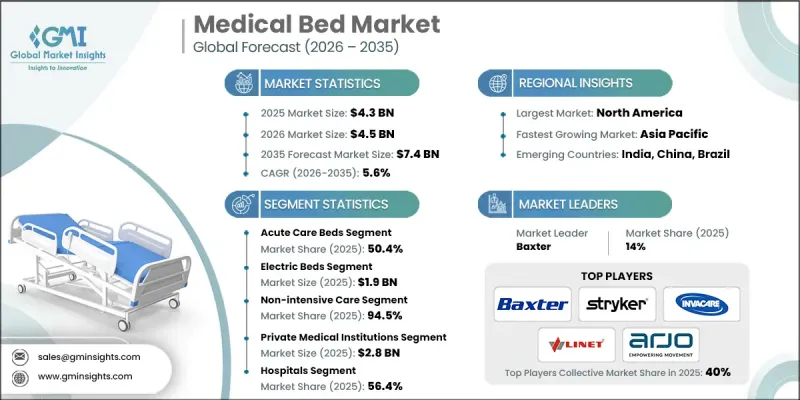
The market expansion is driven by several key factors, including a rising global geriatric population, growing investments in healthcare infrastructure across developing nations, and increasing hospital admissions due to chronic and lifestyle-related illnesses. Private healthcare facilities in emerging markets are rapidly adding hospital beds to meet rising patient volumes, support medical tourism, and cater to the expanding middle-class population. ICU and critical care infrastructure improvements, along with hospital modernization initiatives, further stimulate demand. Private hospitals focus on offering high-quality, comfortable, and standardized bed solutions to enhance patient experience and brand reputation. Increasing demand for multispecialty hospitals and hospital chains has led to large-scale procurement of beds for general wards, ICUs, and recovery units. Medical beds are specialized healthcare equipment designed for hospitals, nursing homes, and home care settings, incorporating features that support patient care, comfort, and rehabilitation needs.
| Market Scope | |
|---|---|
| Start Year | 2025 |
| Forecast Year | 2026-2035 |
| Start Value | $4.3 Billion |
| Forecast Value | $7.4 Billion |
| CAGR | 5.6% |
The acute care beds segment held a 50.4% share in 2025. These beds are primarily used for short-term treatment of patients in medical-surgical units, emergency departments, and ICUs. Fully electric and adjustable acute care beds are preferred due to their ease of patient repositioning, simplified clinical procedures, and 24/7 monitoring capabilities. These features reduce caregiver stress and save time, making them highly sought after in modern healthcare facilities.
The electric beds segment reached USD 1.9 billion in 2025. Electric beds feature motorized mechanisms that allow caregivers to adjust patient height and position via electronic or hand controls, enhancing patient comfort while minimizing caregiver effort. These beds are widely used across hospitals, long-term care centers, and private healthcare facilities. Safety features such as low-height settings, lockable positions, and integration with monitoring systems enhance clinical effectiveness and patient security.
U.S. Medical Bed Market reached USD 1.57 billion in 2025, fueled by advanced healthcare infrastructure, high hospital bed replacement rates, and adoption of technologically advanced equipment. Hospitals prioritize bed upgrades to improve patient safety, reduce caregiver workload, and support value-based care initiatives. Demand for electric, ICU, and smart beds is especially strong in acute and critical care settings. An aging population and rising prevalence of chronic diseases continue to drive inpatient care and long-term hospitalization needs, supporting consistent market growth.
Key players in the Global Medical Bed Market include ANTANO Group, Arjo, Baxter, BESCO, DiaMedical, DRIVE DEVILBISS HEALTHCARE, GENDRON, HARD Manufacturing Company, INVACARE, LINET, MALVESTIO, Midmark, PARAMOUNT BED, Savaria, STIEGELMEYER, Stryker, and Umano Medical. Companies in the medical bed industry are strengthening their market presence through strategic innovation, global expansion, and partnerships with healthcare institutions. Manufacturers focus on developing advanced electric and smart beds with integrated monitoring and safety features to differentiate their offerings. Collaboration with hospitals and long-term care providers ensures product customization and adoption. R&D investments enable the creation of ergonomically designed, technologically advanced beds that improve patient outcomes and caregiver efficiency. Expanding distribution networks, entering emerging markets, and providing maintenance and training services further enhance market foothold.
Table of Contents
Chapter 1 Research Methodology
- 1.1 Research approach
- 1.2 Quality commitments
- 1.2.1 GMI AI policy & data integrity commitment
- 1.2.1.1 Source consistency protocol
- 1.2.1 GMI AI policy & data integrity commitment
- 1.3 Research trail & confidence scoring
- 1.3.1 Research trail components
- 1.3.2 Scoring components
- 1.4 Data collection
- 1.4.1 Partial list of primary sources
- 1.5 Data mining sources
- 1.5.1 Paid sources
- 1.5.1.1 Sources, by region
- 1.5.1 Paid sources
- 1.6 Base estimates and calculations
- 1.6.1 Base year calculation
- 1.7 Forecast model
- 1.7.1 Quantified market impact analysis
- 1.7.1.1 Mathematical impact of growth parameters on forecast
- 1.7.1 Quantified market impact analysis
- 1.8 Research transparency addendum
- 1.8.1 Source attribution framework
- 1.8.2 Quality assurance metrics
- 1.8.3 Our commitment to trust
Chapter 2 Executive Summary
- 2.1 Industry 360° synopsis
- 2.2 Key market trends
- 2.2.1 Regional trends
- 2.2.2 Product trends
- 2.2.3 Bed type trends
- 2.2.4 Application trends
- 2.2.5 Medical facilities trends
- 2.2.6 End use trends
- 2.3 CXO perspectives: Strategic imperatives
Chapter 3 Industry Insights
- 3.1 Industry ecosystem analysis
- 3.2 Industry impact forces
- 3.2.1 Growth drivers
- 3.2.1.1 Growing geriatric population worldwide
- 3.2.1.2 Increasing funding on healthcare infrastructure in developing economies
- 3.2.1.3 Surging hospital admissions due to chronic diseases
- 3.2.1.4 Rising volume of hospital beds in private hospitals in developing countries
- 3.2.2 Industry pitfalls and challenges
- 3.2.2.1 High cost of specialty beds
- 3.2.3 Opportunities
- 3.2.3.1 Rapid expansion of home care and remote patient monitoring
- 3.2.3.2 Integration of IoT and AI in patient beds
- 3.2.1 Growth drivers
- 3.3 Growth potential analysis
- 3.4 Regulatory landscape
- 3.4.1 North America
- 3.4.2 Europe
- 3.4.3 Asia Pacific
- 3.4.4 Latin America
- 3.4.5 MEA
- 3.5 Technology and innovation landscape
- 3.5.1 Current technological trends
- 3.5.2 Emerging technologies
- 3.6 Policy landscape
- 3.7 Supply chain analysis
- 3.8 Smart bed feature benchmarking
- 3.9 Pricing analysis by bed type (Driven by Primary Research)
- 3.10 Rental and leasing model analysis (Driven by Primary Research)
- 3.11 Environmental and sustainability initiatives
- 3.12 Porter's analysis
- 3.13 PESTEL analysis
- 3.14 Gap analysis
- 3.15 Consumer insights (Driven by Primary Research)
- 3.16 Future market trends (Driven by Primary Research)
- 3.17 Impact of AI and generative AI on the market
Chapter 4 Competitive Landscape, 2025
- 4.1 Introduction
- 4.2 Company matrix analysis
- 4.3 Company market share analysis (Driven by Primary Research)
- 4.3.1 Global
- 4.3.2 North America
- 4.3.3 Europe
- 4.3.4 Asia Pacific
- 4.4 Competitive analysis of major market players (Driven by Primary Research)
- 4.5 Competitive positioning matrix
- 4.6 Key developments
- 4.6.1 Mergers & acquisitions
- 4.6.2 Partnerships & collaborations
- 4.6.3 New product launches
- 4.6.4 Expansion plans
Chapter 5 Market Estimates and Forecast, By Product, 2022 - 2035 ($ Mn & Units)
- 5.1 Key trends
- 5.2 Acute care beds
- 5.2.1 MedSurg beds
- 5.2.2 ICU beds
- 5.2.3 Pediatric beds
- 5.2.4 Birthing beds
- 5.2.5 Other acute care beds
- 5.3 Long-term care beds
- 5.4 Psychiatric care beds
- 5.5 Bariatric care beds
- 5.6 Other products
Chapter 6 Market Estimates and Forecast, By Bed Type, 2022 - 2035 ($ Mn)
- 6.1 Key trends
- 6.2 Manual beds
- 6.3 Electric beds
- 6.4 Semi-electric beds
Chapter 7 Market Estimates and Forecast, By Application, 2022 - 2035 ($ Mn)
- 7.1 Key trends
- 7.2 Intensive care
- 7.3 Non-intensive care
Chapter 8 Market Estimates and Forecast, By Medical Facilities, 2022 - 2035 ($ Mn)
- 8.1 Key trends
- 8.2 Private medical institutions
- 8.3 Public medical institutions
Chapter 9 Market Estimates and Forecast, By End Use, 2022 - 2035 ($ Mn)
- 9.1 Key trends
- 9.2 Hospitals
- 9.3 Home care settings
- 9.4 Elderly care facilities
- 9.5 Other end users
Chapter 10 Market Estimates and Forecast, By Region, 2022 - 2035 ($ Mn & Units)
- 10.1 Key trends
- 10.2 North America
- 10.2.1 U.S.
- 10.2.2 Canada
- 10.3 Europe
- 10.3.1 Germany
- 10.3.2 UK
- 10.3.3 France
- 10.3.4 Spain
- 10.3.5 Italy
- 10.3.6 Netherlands
- 10.4 Asia Pacific
- 10.4.1 China
- 10.4.2 Japan
- 10.4.3 India
- 10.4.4 Australia
- 10.4.5 South Korea
- 10.5 Latin America
- 10.5.1 Brazil
- 10.5.2 Mexico
- 10.5.3 Argentina
- 10.6 MEA
- 10.6.1 South Africa
- 10.6.2 Saudi Arabia
- 10.6.3 UAE
Chapter 11 Company Profiles
- 11.1 ANTANO Group
- 11.2 Arjo
- 11.3 Baxter
- 11.4 BESCO
- 11.5 DiaMedical
- 11.6 DRIVE DEVILBISS HEALTHCARE
- 11.7 GENDRON
- 11.8 HARD Manufacturing Company
- 11.9 INVACARE
- 11.10 LINET
- 11.11 MALVESTIO
- 11.12 Midmark
- 11.13 PARAMOUNT BED
- 11.14 Savaria
- 11.15 STIEGELMEYER
- 11.16 Stryker
- 11.17 Umano Medical

