PUBLISHER: Global Market Insights Inc. | PRODUCT CODE: 1998832

PUBLISHER: Global Market Insights Inc. | PRODUCT CODE: 1998832
Vehicle Conversion Market Opportunity, Growth Drivers, Industry Trend Analysis, and Forecast 2026 - 2035
The Global Vehicle Conversion Market was valued at USD 7.4 billion in 2025 and is estimated to grow at a CAGR of 10.3% to reach USD 19.7 billion by 2035.
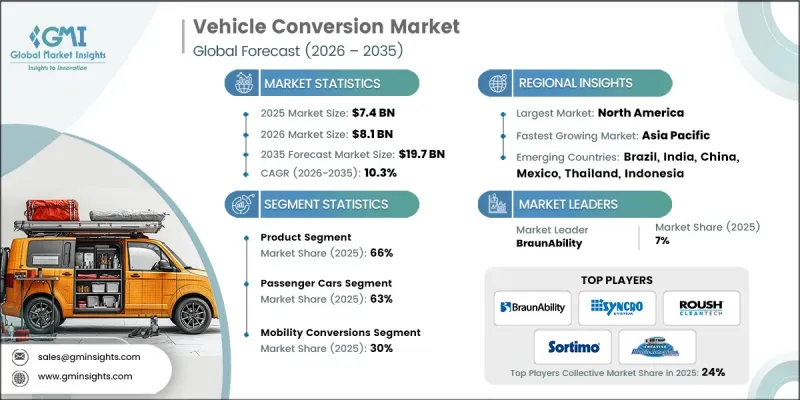
The industry is gaining strong momentum as mobility providers and consumers increasingly demand customized transportation solutions that improve functionality, accessibility, and safety. Vehicle conversion solutions involve structural, electronic, and operational modifications that transform standard vehicles into specialized platforms tailored for unique purposes. These upgrades include accessibility modifications, safety technology integration, powertrain transformation, and specialized configurations designed for mission-specific operations. The market serves a wide range of end users, including fleet operators, government institutions, commercial enterprises, and private consumers who require vehicles optimized for operational efficiency and enhanced safety performance. Rapid advancements in vehicle electronics, connectivity systems, and electrification technologies are further expanding the scope of vehicle conversions. Growing regulatory pressure related to emissions reduction and safety compliance is also encouraging organizations to retrofit existing fleets instead of replacing vehicles entirely. As transportation systems evolve toward smarter and more sustainable mobility solutions, vehicle conversion technologies are becoming increasingly relevant across both commercial and passenger vehicle segments.
| Market Scope | |
|---|---|
| Start Year | 2025 |
| Forecast Year | 2026-2035 |
| Start Value | $7.4 Billion |
| Forecast Value | $19.7 Billion |
| CAGR | 10.3% |
The vehicle conversion market comprises multiple solution categories, including hardware components, integrated software platforms, and professional installation services delivered to automotive manufacturers, fleet managers, and government agencies. Conversion solutions include electrification retrofits, emergency vehicle customization, mobility accessibility upgrades, and specialized commercial vehicle transformations. Over time, the technology has progressed from simple mechanical alterations to sophisticated integrated platforms combining electronic control units, telematics connectivity, driver assistance capabilities, and AI-enabled software applications. These integrated systems support features such as real-time vehicle monitoring, remote diagnostics, and over-the-air software updates. As a result, retrofitted vehicles can operate with advanced connectivity and safety capabilities comparable to new-generation vehicles. Increasing regulatory focus on emission control, electrification targets, and accessibility standards is encouraging adoption of conversion solutions, particularly among commercial fleets seeking cost-efficient pathways toward compliance.
The product segment accounted for 66% share in 2025 and is expected to grow at a CAGR of 9.7% between 2026 and 2035. This segment includes the physical components required for vehicle modification, such as electric motors, battery packs, conversion kits, controllers, battery management systems, charging equipment, mechanical assemblies, and installation hardware. The product category represents the core of the conversion ecosystem, supported by established supply chains ranging from specialized component manufacturers to major automotive companies entering the retrofit sector. The market now offers standardized conversion packages across multiple pricing tiers.
The mobility conversions segment held 30% share in 2025 and is expected to grow at a CAGR of 10.6% from 2026 to 2035. This segment focuses on vehicle modifications designed to provide safe and convenient transportation for individuals with physical mobility challenges, elderly passengers, and users requiring specialized transport assistance. Mobility conversions represent one of the most socially significant areas of the industry, as they support independent mobility and improve accessibility in transportation systems. Growing global awareness of inclusive transportation solutions and the increasing need for adaptive vehicles are driving the expansion of this segment. Demand continues to rise for vehicles equipped with specialized accessibility features that support safe and comfortable travel for passengers with mobility limitations.
United States Vehicle Conversion Market is projected to grow at a CAGR of 9.8% between 2026 and 2035. The country maintains a strong position due to a robust aftermarket customization industry, advanced fleet mobility requirements, and widespread adoption of certified conversion services across commercial and passenger vehicles. Strict automotive safety and emissions regulations, combined with government transportation initiatives, are encouraging the development of standardized conversion technologies for electrified mobility and specialized transport applications. Fleet operators and vehicle manufacturers in the United States are increasingly investing in modular vehicle conversion platforms that support electrification strategies, last-mile logistics operations, and customized commercial vehicle deployments across urban and highway transportation networks.
Key players operating in the Global Vehicle Conversion Market include Adventure Van Conversions, BraunAbility, Creative Mobile Interiors, DIYev, El Kapitan Conversion Vans, EV Source, EV4U Custom Conversions, Glampervan, Kisae Technology, and Midwest Automotive Designs. Companies operating in the vehicle conversion market are adopting several strategic initiatives to strengthen their competitive position and expand market presence. Industry participants are investing heavily in research and development to improve modular conversion technologies, enhance compatibility with modern vehicle architectures, and increase system efficiency. Strategic collaborations with automotive manufacturers, fleet operators, and technology providers enable companies to expand their solution portfolios and access new customer segments. Many firms are also focusing on developing scalable electrification retrofit platforms and smart connectivity features that integrate telematics, diagnostics, and predictive maintenance capabilities. Expansion of certified installation networks, investment in advanced testing facilities, and development of standardized conversion kits are further helping companies streamline deployment and ensure regulatory compliance while improving operational reliability for end users.
Table of Contents
Chapter 1 Methodology
- 1.1 Research approach
- 1.2 Quality commitments
- 1.2.1 GMI AI policy and data integration commitments
- 1.3 Research trail and confidence scoring
- 1.3.1 Research trail components
- 1.3.2 Scoring components
- 1.4 Data collection
- 1.4.1 Partial list of primary sources
- 1.5 Data mining sources
- 1.5.1 Paid sources
- 1.6 Best estimates and calculations
- 1.6.1 Base year calculation for any one approach
- 1.7 Forecast model
- 1.8 Research transparency addendum
Chapter 2 Executive Summary
- 2.1 Industry 360° synopsis, 2022 - 2035
- 2.2 Key market trends
- 2.2.1 Regional
- 2.2.2 Offering
- 2.2.3 Vehicles
- 2.2.4 Conversion Type
- 2.2.5 Component Modified
- 2.2.6 End Use
- 2.3 TAM Analysis, 2026-2035
- 2.4 CXO perspectives: Strategic imperatives
Chapter 3 Industry Insights
- 3.1 Industry ecosystem analysis
- 3.1.1 Supplier landscape
- 3.1.2 Profit margin analysis
- 3.1.3 Cost structure
- 3.1.4 Value addition at each stage
- 3.1.5 Factor affecting the value chain
- 3.1.6 Disruptions
- 3.2 Industry impact forces
- 3.2.1 Growth drivers
- 3.2.1.1 Growing demand for electric vehicle conversions driven by environmental regulations
- 3.2.1.2 Rising adoption of accessible mobility solutions for aging populations
- 3.2.1.3 Expansion of last-mile delivery and e-commerce logistics requiring specialized fleets
- 3.2.1.4 Government incentives and subsidies for EV retrofitting programs
- 3.2.1.5 Increasing consumer preference for personalized and custom vehicles
- 3.2.2 Industry pitfalls and challenges
- 3.2.2.1 High upfront costs of conversion kits and retrofitting services
- 3.2.2.2 Complex regulatory and certification requirements across regions
- 3.2.2.3 Limited availability of skilled conversion technicians and service centers
- 3.2.2.4 Battery performance and longevity concerns in converted electric vehicles
- 3.2.3 Market opportunities
- 3.2.3.1 Development of modular and plug-and-play conversion kits for the DIY market
- 3.2.3.2 Expansion into emerging markets with aging internal combustion engine vehicle fleets
- 3.2.3.3 Integration of advanced telematics and IoT technologies in converted vehicles
- 3.2.3.4 Growing recreational vehicle market driving camper van conversion demand
- 3.2.1 Growth drivers
- 3.3 Growth potential analysis
- 3.4 Regulatory landscape
- 3.4.1 North America
- 3.4.1.1 US- Federal motor vehicle safety standards (FMVSS) & conversion Vehicle Compliance
- 3.4.1.2 Canada - Motor vehicle safety act & accessibility conversion standards
- 3.4.2 Europe
- 3.4.2.1 Germany- Euro NCAP and IIHS testing protocols
- 3.4.2.2 UK- Post-Brexit individual vehicle approval & conversion certification
- 3.4.2.3 France- National homologation requirements
- 3.4.2.4 Italy- ITS-Integrated conversion standards
- 3.4.3 Asia Pacific
- 3.4.3.1 China- MIIT new energy vehicle retrofit standards & GB safety regulations
- 3.4.3.2 India- AIS standards & CMVR compliance for modified vehicles
- 3.4.3.3 Japan- Road vehicles act & structural modification approval processes
- 3.4.3.4 Australia- Australian design rules & state-based modification standards
- 3.4.4 LATAM
- 3.4.4.1 Mexico- NOM vehicle safety standards & SCT commercial vehicle conversion requirements
- 3.4.4.2 Argentina- National traffic law 24.449 & provincial vehicle modification frameworks
- 3.4.5 MEA
- 3.4.5.1 South Africa- National road traffic act 1996 & SABS conversion standards
- 3.4.5.2 Saudi Arabia- Traffic law frameworks & vision 2030 transport modernization initiatives
- 3.4.1 North America
- 3.5 Porter's analysis
- 3.6 PESTEL analysis
- 3.7 Technology and innovation landscape
- 3.7.1 Current technological trends
- 3.7.2 Emerging technologies
- 3.8 Patent landscape (Driven by primary research)
- 3.9 Cost breakdown analysis
- 3.10 Pricing analysis (Driven by primary research)
- 3.10.1 Historical price trend analysis
- 3.10.2 Pricing strategy by player type (premium, value, cost-plus)
- 3.10.3 OEM versus aftermarket price differential
- 3.10.4 Regional price variations
- 3.11 Trade data analysis (Driven by paid database)
- 3.11.1 Import and export volume and value trends
- 3.11.2 Key trade corridors and tariff impact
- 3.11.3 Regional trade flow patterns
- 3.12 Impact of AI and generative AI on the market
- 3.12.1 AI-driven disruption of existing business models
- 3.12.2 GenAI use cases & adoption roadmap by segment
- 3.12.3 Risks, limitations & regulatory considerations
- 3.13 Use cases & success stories
- 3.14 Sustainability and environmental aspects
- 3.14.1 Sustainable practices
- 3.14.2 Waste reduction strategies
- 3.14.3 Energy efficiency in production
- 3.14.4 Eco-friendly Initiatives
- 3.14.5 Carbon footprint considerations
- 3.15 Capacity & production landscape (Driven by primary research)
- 3.15.1 Installed capacity by region & key producer
- 3.15.2 Capacity utilization rates & expansion pipelines
- 3.16 Forecast assumptions & scenario analysis (Driven by primary research)
- 3.16.1 Base Case - key macro & industry variables driving CAGR
- 3.16.2 Optimistic Scenarios - Favorable macro and industry tailwinds
- 3.16.3 Pessimistic Scenario - Macroeconomic slowdown or industry headwinds
Chapter 4 Competitive Landscape, 2025
- 4.1 Introduction
- 4.2 Company market share analysis
- 4.2.1 North America
- 4.2.2 Europe
- 4.2.3 Asia Pacific
- 4.2.4 LATAM
- 4.2.5 MEA
- 4.3 Competitive analysis of major market players
- 4.4 Competitive positioning matrix
- 4.5 Company tier benchmarking
- 4.5.1 Tier classification criteria & qualifying thresholds
- 4.5.2 Tier positioning matrix by revenue, geography & innovation
- 4.6 Key developments
- 4.6.1 Mergers & acquisitions
- 4.6.2 Partnerships & collaborations
- 4.6.3 New product launches
- 4.6.4 Expansion plans and funding
Chapter 5 Market Estimates & Forecast, By Offering, 2022 - 2035 ($Bn, Units)
- 5.1 Key trends
- 5.2 Product
- 5.3 Service
Chapter 6 Market Estimates & Forecast, By Vehicle, 2022 - 2035 ($Bn, Units)
- 6.1 Key trends
- 6.2 Passenger cars
- 6.2.1 Hatchback
- 6.2.2 Sedan
- 6.2.3 SUV
- 6.3 Commercial vehicles
- 6.3.1 Light commercial vehicles (LCVs)
- 6.3.2 Medium commercial vehicles (MCVs)
- 6.3.3 Heavy commercial vehicles (HCVs)
Chapter 7 Market Estimates & Forecast, By Conversion Type, 2022 - 2035 ($Bn, Units)
- 7.1 Key trends
- 7.2 Mobility conversions
- 7.3 Commercial conversions
- 7.4 Recreational conversions
- 7.5 Propulsion conversion
- 7.6 Others
Chapter 8 Market Estimates & Forecast, By Component Modified, 2022 - 2035 ($Bn, Units)
- 8.1 Key trends
- 8.2 Powertrain & propulsion
- 8.3 Body & exterior
- 8.4 Interior & accessibility
- 8.5 Wheels, suspension & performance
- 8.6 Lighting & electronics
Chapter 9 Market Estimates & Forecast, By End Use, 2022 - 2035 ($Bn, Units)
- 9.1 Key trends
- 9.2 Individual consumers
- 9.3 Commercial fleet operators
- 9.4 Government & emergency services
- 9.5 Specialty service providers
Chapter 10 Market Estimates & Forecast, By Region, 2022 - 2035 ($Bn, Units)
- 10.1 Key trends
- 10.2 North America
- 10.2.1 US
- 10.2.2 Canada
- 10.3 Europe
- 10.3.1 Germany
- 10.3.2 UK
- 10.3.3 France
- 10.3.4 Italy
- 10.3.5 Spain
- 10.3.6 Russia
- 10.3.7 Netherlands
- 10.3.8 Sweden
- 10.3.9 Denmark
- 10.3.10 Poland
- 10.4 Asia Pacific
- 10.4.1 China
- 10.4.2 India
- 10.4.3 Japan
- 10.4.4 Australia
- 10.4.5 South Korea
- 10.4.6 Singapore
- 10.4.7 Thailand
- 10.4.8 Indonesia
- 10.4.9 Vietnam
- 10.5 Latin America
- 10.5.1 Brazil
- 10.5.2 Mexico
- 10.5.3 Argentina
- 10.5.4 Colombia
- 10.6 MEA
- 10.6.1 South Africa
- 10.6.2 Saudi Arabia
- 10.6.3 UAE
- 10.6.4 Israel
Chapter 11 Company Profiles
- 11.1 Global Players
- 11.1.1 BraunAbility
- 11.1.2 Electric Classic Cars
- 11.1.3 Midwest Automotive Designs
- 11.1.4 Zero Labs Automotive
- 11.2 Regional Players
- 11.2.1 Adventure Van Conversions
- 11.2.2 Creative Mobile Interiors
- 11.2.3 DIYev
- 11.2.4 El Kapitan Conversion Vans
- 11.2.5 EV Source
- 11.2.6 EV4U Custom Conversions
- 11.2.7 Glampervan
- 11.2.8 Green Shed Conversions
- 11.2.9 Kisae Technology
- 11.2.10 retroEv
- 11.3 Emerging Players & Technology Enablers
- 11.3.1 HI PERFORMANCE ELECTRIC VEHICLE SYSTEMS
- 11.3.2 Iconic EV
- 11.3.3 Legacy EV
- 11.3.4 OPTO Innovation
- 11.3.5 Revamp Motors
- 11.3.6 Zenith EV Conversions

