PUBLISHER: Global Market Insights Inc. | PRODUCT CODE: 1998840

PUBLISHER: Global Market Insights Inc. | PRODUCT CODE: 1998840
Signaling Devices Market Opportunity, Growth Drivers, Industry Trend Analysis, and Forecast 2026 - 2035
The Global Signaling Devices Market was valued at USD 4.2 billion in 2025 and is estimated to grow at a 5.6% to reach USD 7.2 billion by 2035.
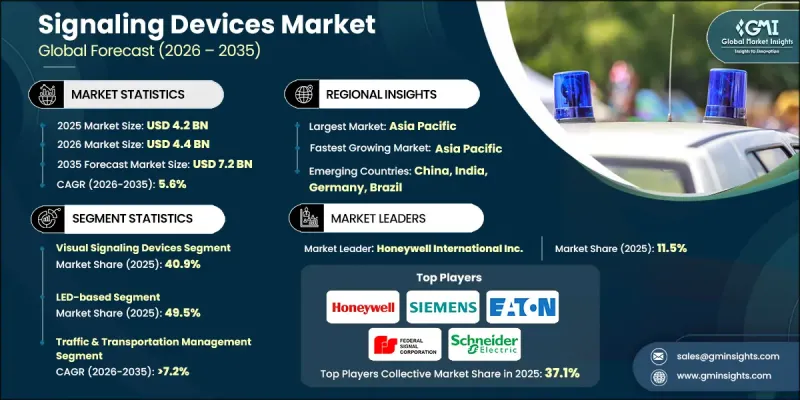
The signaling devices market is growing due to the rapid expansion of industrial automation, stricter workplace safety regulations, modernization of urban infrastructure, and rising adoption of intelligent monitoring technologies. Organizations are increasingly deploying signaling devices to support operational safety, improve communication within industrial environments, and maintain compliance with regulatory standards. In addition, growing investments in transportation systems, infrastructure development, and automated production facilities are reinforcing demand for advanced signaling solutions. The integration of smart technologies is also transforming the signaling devices market, as connected systems enable remote monitoring, real-time notifications, and predictive maintenance capabilities. These technological advancements help improve operational efficiency and reduce system downtime across industrial and infrastructure environments. Industries operating in high-risk environments are placing greater emphasis on reliable alert systems that can deliver clear visual or audible warnings. As automation technologies continue to evolve, the signaling devices market is gradually transitioning toward connected and intelligent signaling platforms that support seamless integration with digital control systems and industrial automation frameworks. The modernization of infrastructure and transportation networks is creating strong demand for reliable electrical switching and signaling solutions that support traffic control systems, operational panels, and automated management platforms. Upgrades in transportation networks, commercial facilities, and industrial infrastructure require dependable signaling components that enable safe system operation, effective monitoring, and improved connectivity. Large-scale infrastructure investments are accelerating the adoption of advanced signaling technologies designed to support modern operational requirements.
| Market Scope | |
|---|---|
| Start Year | 2025 |
| Forecast Year | 2026-2035 |
| Start Value | $4.2 Billion |
| Forecast Value | $7.2 Billion |
| CAGR | 5.6% |
The combination signaling devices segment is projected to grow at a CAGR of 7.1% during 2026 to 2035. The growing demand for integrated alert systems is driven by the need for more effective safety communication in complex industrial environments. Multi-sensory signaling devices improve operational visibility and enable quicker response to potential risks. Their ability to deliver simultaneous visual and sound notifications supports better awareness across facilities where clear communication of safety signals is essential. As industries increasingly focus on compliance and workplace safety standards, combination signaling technologies are gaining wider adoption in automation systems, industrial operations, and infrastructure projects.
The LED-based signaling devices segment accounted for 49.5% share in 2025. This segment maintains a leading position due to advantages such as energy efficiency, extended service life, minimal maintenance requirements, and broad application compatibility. LED signaling devices deliver strong brightness levels, durability, and reliable performance across a wide range of industrial and transportation environments. Their compatibility with connected technologies and smart monitoring platforms further strengthens their adoption in modern automation systems and safety-critical signaling applications worldwide.
North America Signaling Devices Market held 31.8% share in 2025, reflecting strong demand from advanced industrial sectors and infrastructure modernization initiatives. The growth of industrial automation across manufacturing, energy, and logistics facilities is increasing the deployment of signaling systems designed to enhance operational safety and monitoring capabilities. Companies in the region are increasingly upgrading to LED-based and IoT-enabled signaling technologies that support predictive maintenance, real-time alert systems, and improved operational visibility. In addition, expanding smart city programs and urban infrastructure developments are contributing to higher adoption of signaling solutions used in traffic management, public safety systems, and commercial facilities.
Key companies operating in the Global Signaling Devices Market include Honeywell International Inc., Siemens AG, ABB Ltd., Schneider Electric SE, Rockwell Automation, Inc., Emerson Electric Co., Federal Signal Corporation, Eaton, R. STAHL AG, Patlite Corporation, Werma Signaltechnik GmbH & Co. KG, Pfannenberg Group, Potter Electric Signal Company, LLC, Auer Signal, Sirena S.p.A., Leuze Electronic GmbH, Edwards Signaling, and D.G. Controls Ltd. Companies in the Global Signaling Devices Market are strengthening their competitive position through continuous technological innovation and strategic expansion initiatives. Leading manufacturers are investing heavily in research and development to introduce advanced signaling solutions with improved energy efficiency, connectivity, and system integration capabilities. Many firms are focusing on the development of IoT-enabled devices that support remote monitoring, predictive maintenance, and seamless communication with industrial automation systems. Strategic collaborations with infrastructure developers, automation solution providers, and industrial equipment manufacturers are also helping companies expand their application reach.
Table of Contents
Chapter 1 Methodology and Scope
- 1.1 Market scope and definition
- 1.2 Research design
- 1.2.1 Research approach
- 1.2.2 Data collection methods
- 1.3 Data mining sources
- 1.3.1 Global
- 1.3.2 Regional/Country
- 1.4 Base estimates and calculations
- 1.4.1 Base year calculation
- 1.4.2 Key trends for market estimation
- 1.5 Primary research and validation
- 1.5.1 Primary sources
- 1.6 Forecast model
- 1.7 Research assumptions and limitations
Chapter 2 Executive Summary
- 2.1 Industry 360° synopsis, 2022 - 2035
- 2.2 Key market trends
- 2.2.1 Product Type
- 2.2.2 Technology
- 2.2.3 Application
- 2.2.4 End-use industry
- 2.2.5 Regional trends
- 2.3 TAM Analysis, 2026-2035
- 2.4 CXO perspectives: Strategic imperatives
Chapter 3 Industry Insights
- 3.1 Industry ecosystem analysis
- 3.1.1 Supplier Landscape
- 3.1.2 Profit Margin
- 3.1.3 Cost structure
- 3.1.4 Value addition at each stage
- 3.1.5 Factor affecting the value chain
- 3.1.6 Disruptions
- 3.2 Industry impact forces
- 3.2.1 Growth drivers
- 3.2.1.1 Industrial automation expansion
- 3.2.1.2 Stringent safety & regulatory compliance
- 3.2.1.3 Urban infrastructure & traffic modernization
- 3.2.1.4 Adoption of smart & iot-enabled signaling devices
- 3.2.1.5 Growth in hazardous area operations
- 3.2.2 Industry pitfalls and challenges
- 3.2.2.1 High initial investment and installation costs
- 3.2.2.2 Technological complexity and maintenance challenges
- 3.2.3 Market opportunities
- 3.2.3.1 Retrofit and upgrade of legacy signaling systems
- 3.2.3.2 Expansion of industrial and smart city projects in emerging markets
- 3.2.1 Growth drivers
- 3.3 Growth potential analysis
- 3.4 Regulatory landscape
- 3.4.1 North America
- 3.4.2 Europe
- 3.4.3 Asia Pacific
- 3.4.4 Latin America
- 3.4.5 Middle East & Africa
- 3.5 Porter's analysis
- 3.6 PESTEL analysis
- 3.7 Technology and Innovation landscape
- 3.7.1 Current technological trends
- 3.7.2 Emerging technologies
- 3.8 Price trends
- 3.8.1 By region
- 3.8.2 By product
- 3.9 Pricing strategies
- 3.10 Emerging business models
- 3.11 Compliance requirements
- 3.12 Patent and IP analysis
- 3.13 Pricing Analysis (Driven by Primary Research)
- 3.13.1 Historical Price Trend Analysis
- 3.13.2 Pricing Strategy by Player Type
- 3.14 Trade Data Analysis (Based on Paid Databases)
- 3.14.1 Import/export volume & value trends
- 3.14.2 Key trade corridors & tariff impact
- 3.15 Impact of AI & generative AI on the market (Driven by Primary Research)
- 3.15.1 AI-driven disruption of existing business models
- 3.15.2 GenAI use cases & adoption roadmap by segment
- 3.15.3 Risks, limitations & regulatory considerations
- 3.16 Capacity & production landscape (Driven by Primary Research)
- 3.16.1 Production capacity by region & key producer
- 3.16.2 Capacity utilization rates & expansion pipelines
Chapter 4 Competitive Landscape, 2025
- 4.1 Introduction
- 4.2 Company market share analysis
- 4.2.1 By region
- 4.2.1.1 North America
- 4.2.1.2 Europe
- 4.2.1.3 Asia Pacific
- 4.2.1.4 Latin America
- 4.2.1.5 Middle East & Africa
- 4.2.2 Market concentration analysis
- 4.2.1 By region
- 4.3 Competitive benchmarking of key players
- 4.3.1 Financial performance comparison
- 4.3.1.1 Revenue
- 4.3.1.2 Profit margin
- 4.3.1.3 R&D
- 4.3.2 Product portfolio comparison
- 4.3.2.1 Product range breadth
- 4.3.2.2 Technology
- 4.3.2.3 Innovation
- 4.3.3 Geographic presence comparison
- 4.3.3.1 Global footprint analysis
- 4.3.3.2 Service network coverage
- 4.3.3.3 Market penetration by region
- 4.3.4 Competitive positioning matrix
- 4.3.4.1 Leaders
- 4.3.4.2 Challengers
- 4.3.4.3 Followers
- 4.3.4.4 Niche players
- 4.3.1 Financial performance comparison
- 4.4 Key developments
- 4.4.1 Mergers and acquisitions
- 4.4.2 Partnerships and collaborations
- 4.4.3 Technological advancements
- 4.4.4 Expansion and investment strategies
- 4.4.5 Digital transformation initiatives
- 4.5 Emerging/ startup competitors landscape
Chapter 5 Market Estimates and Forecast, By Product Type, 2022 - 2035 (USD Billion)
- 5.1 Key trends
- 5.2 Visual signaling devices
- 5.3 Audible signaling devices
- 5.4 Combination signaling devices (audiovisual)
- 5.5 Traffic & railway signaling systems
Chapter 6 Market Estimates and Forecast, By Technology, 2022 - 2035 (USD Billion & Units)
- 6.1 Key trends
- 6.2 LED-based
- 6.3 Electromechanical
- 6.4 Others
Chapter 7 Market Estimates and Forecast, By Application, 2022 - 2035 (USD Billion & Units)
- 7.1 Key trends
- 7.2 Industrial process control & monitoring
- 7.3 Emergency & safety signaling
- 7.4 Security & access control
- 7.5 Traffic & transportation management
- 7.6 Others
Chapter 8 Market Estimates and Forecast, By End-use Industry, 2022 - 2035 (USD Billion & Units)
- 8.1 Key trends
- 8.2 Oil & gas
- 8.3 Manufacturing
- 8.4 Chemical & pharmaceutical
- 8.5 Marine & offshore
- 8.6 Transportation & logistics
- 8.7 Mining & construction
- 8.8 Others
Chapter 9 Market Estimates and Forecast, By Region, 2022 - 2035 (USD Billion & Units)
- 9.1 Key trends
- 9.2 North America
- 9.2.1 U.S.
- 9.2.2 Canada
- 9.3 Europe
- 9.3.1 Germany
- 9.3.2 UK
- 9.3.3 France
- 9.3.4 Spain
- 9.3.5 Italy
- 9.3.6 Netherlands
- 9.4 Asia Pacific
- 9.4.1 China
- 9.4.2 India
- 9.4.3 Japan
- 9.4.4 Australia
- 9.4.5 South Korea
- 9.5 Latin America
- 9.5.1 Brazil
- 9.5.2 Mexico
- 9.5.3 Argentina
- 9.6 Middle East and Africa
- 9.6.1 South Africa
- 9.6.2 Saudi Arabia
- 9.6.3 UAE
Chapter 10 Company Profiles
- 10.1 Global Key Players
- 10.1.1 ABB Ltd.
- 10.1.2 Eaton
- 10.1.3 Emerson Electric Co.
- 10.1.4 Federal Signal Corporation
- 10.1.5 Honeywell International Inc.
- 10.1.6 Rockwell Automation, Inc.
- 10.1.7 Schneider Electric SE
- 10.1.8 Siemens AG
- 10.2 Regional Players
- 10.2.1 Auer Signal
- 10.2.2 D.G. Controls Ltd.
- 10.2.3 Edwards Signaling
- 10.2.4 Leuze Electronic GmbH
- 10.2.5 Patlite Corporation
- 10.2.6 Pfannenberg Group
- 10.2.7 Potter Electric Signal Company, LLC
- 10.3 Niche Players
- 10.3.1 Sirena S.p.A.
- 10.3.2 R. STAHL AG
- 10.3.3 Werma Signaltechnik GmbH & Co. KG

