PUBLISHER: Global Market Insights Inc. | PRODUCT CODE: 1998850

PUBLISHER: Global Market Insights Inc. | PRODUCT CODE: 1998850
Low Power Next Generation Display Market Opportunity, Growth Drivers, Industry Trend Analysis, and Forecast 2026 - 2035
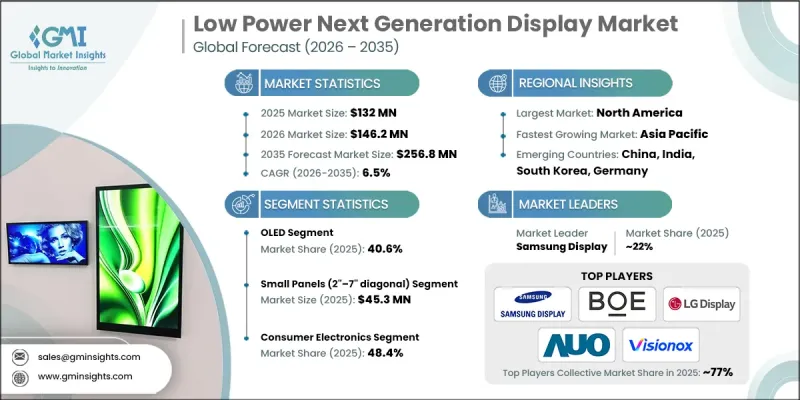
The Global Low Power Next Generation Display Market was valued at USD 132 million in 2025 and is estimated to grow at a CAGR of 6.5% to reach USD 256.8 million in 2035.
Market growth is driven by the rising adoption of energy-efficient next-generation display technologies such as OLED and microLED across consumer electronics, wearable devices, and automotive digital cockpits. Increasing demand for AR, VR, and MR applications utilizing compact low-power microdisplays is also propelling expansion. Energy-saving initiatives in the electronics sector, coupled with the shift to always-on and high-brightness displays in mobile devices and industrial equipment, are further boosting adoption. Geographic expansion is supported by rising consumer electronics penetration, smart vehicle adoption, and industrial integration of energy-efficient display technologies, creating opportunities for innovation in ultra-compact, high-performance, and eco-friendly panels.
| Market Scope | |
|---|---|
| Start Year | 2025 |
| Forecast Year | 2026-2035 |
| Start Value | $132 Million |
| Forecast Value | $256.8 Million |
| CAGR | 6.5% |
The market is significantly benefiting from the adoption of LTPO OLED technology in smartphones and tablets, which enhances battery efficiency and performance. Growing demand for AR/VR devices and wearables with always-on displays is driving the development of energy-efficient microdisplays, encouraging manufacturers to innovate in compact, high-brightness display solutions. The integration of next-generation displays in digital automotive dashboards is also contributing to global market growth, reflecting the industry's focus on energy-saving, eco-friendly technologies across consumer, industrial, and automotive applications.
The OLED segment accounted for a 40.6% share in 2025. OLED displays dominate due to their self-emissive technology, superior brightness, and energy efficiency, making them highly suitable for mobile devices, tablets, and automotive displays. Their ability to support adaptive refresh rates and minimize energy consumption has made them a preferred choice in consumer electronics, automotive panels, and industrial applications, driving widespread adoption globally.
The small panel segment (2"-7" diagonal) reached USD 45.3 million in 2025. These panels are widely used in smartphones, wearables, and tablets, offering an ideal balance between compact form factor and display performance. Power-efficient LCD and LTPO OLED integration enables always-on functionality and extended battery life, positioning small panels as the most suitable option for consumer electronics and portable devices where energy efficiency and visual performance are critical.
North America Low Power Next Generation Display Market held a 36% share in 2025. Market growth in the region is driven by strong demand for energy-efficient display technologies in consumer electronics, automotive, industrial, and smart infrastructure applications. Adoption of OLED, microLED, and quantum dot displays, which deliver enhanced visual quality with lower power consumption compared to traditional LCDs, is a key factor supporting regional revenue. The presence of major display manufacturers and early adoption of innovative low-power technologies further reinforces North America's leading market position.
Leading players in the Global Low Power Next Generation Display Market include AU Optronics Corporation, AUO Corporation, BOE Technology Group, Doosan Group, DuPont, Futaba Corporation, LG Display, Nanosys, Novaled GmbH, Panasonic Corporation, Philips, Planar Systems, QUALCOMM Incorporated, RitDisplay, Samsung Display, Sharp Corporation, Sony Corporation, Tianma, Universal Display Corporation (UDC), and Visionox Technology. Companies in the Low Power Next Generation Display Market are adopting multiple strategies to strengthen their presence and expand market share. They are heavily investing in R&D to develop high-brightness, ultra-compact, and energy-efficient OLED, microLED, and LTPO technologies. Strategic partnerships with consumer electronics, automotive, and wearable device manufacturers ensure integration of their display solutions into next-generation devices. Firms are expanding production capacity and manufacturing footprints in key regions to meet growing global demand. Additionally, technology licensing, joint ventures, and targeted marketing campaigns emphasizing energy efficiency and sustainability are being leveraged to enhance brand visibility and maintain competitive advantage in this rapidly evolving market.
Table of Contents
Chapter 1 Methodology and Scope
- 1.1 Market scope and definition
- 1.2 Research design
- 1.2.1 Research approach
- 1.2.2 Data collection methods
- 1.3 Data mining sources
- 1.3.1 Global
- 1.3.2 Regional/Country
- 1.4 Base estimates and calculations
- 1.4.1 Base year calculation
- 1.4.2 Key trends for market estimation
- 1.5 Primary research and validation
- 1.5.1 Primary sources
- 1.6 Forecast model
- 1.7 Research assumptions and limitations
Chapter 2 Executive Summary
- 2.1 Industry 360° synopsis, 2022 - 2035
- 2.2 Key market trends
- 2.2.1 Technology trends
- 2.2.2 Panel size trends
- 2.2.3 Form factor trends
- 2.2.4 Application trends
- 2.2.5 Regional trends
- 2.3 TAM Analysis, 2026-2035
- 2.4 CXO perspectives: Strategic imperatives
- 2.4.1 Executive decision points
- 2.4.2 critical success factors
- 2.5 Future outlook and strategic recommendations
Chapter 3 Industry Insights
- 3.1 Industry ecosystem analysis
- 3.1.1 Supplier Landscape
- 3.1.2 Profit Margin
- 3.1.3 Cost structure
- 3.1.4 Value addition at each stage
- 3.1.5 Factor affecting the value chain
- 3.1.6 Disruptions
- 3.2 Industry impact forces
- 3.2.1 Growth drivers
- 3.2.1.1 Rapid adoption of LTPO OLED in smartphones
- 3.2.1.2 Expanding use in wearable health monitoring devices
- 3.2.1.3 AR/VR devices requiring energy-efficient microdisplays
- 3.2.1.4 Sustainability regulations favoring lower power electronics
- 3.2.1.5 Automotive shift toward digital cockpit displays
- 3.2.2 Industry pitfalls and challenges
- 3.2.2.1 LTPO fabrication yield optimization complexities
- 3.2.2.2 Limited large-scale microLED mass production
- 3.2.3 Market opportunities
- 3.2.3.1 Foldable OLED panels with adaptive refresh
- 3.2.3.2 Low-power displays for IoT edge devices
- 3.2.1 Growth drivers
- 3.3 Growth potential analysis
- 3.4 Regulatory landscape
- 3.4.1 North America
- 3.4.2 Europe
- 3.4.3 Asia Pacific
- 3.4.4 Latin America
- 3.4.5 Middle East & Africa
- 3.5 Porter's analysis
- 3.6 PESTEL analysis
- 3.7 Technology and Innovation landscape
- 3.7.1 Current technological trends
- 3.7.2 Emerging technologies
- 3.8 Price trends
- 3.8.1 By region
- 3.8.2 By product
- 3.9 Pricing Strategies
- 3.10 Emerging Business Models
- 3.11 Compliance Requirements
- 3.12 Patent and IP analysis
- 3.13 Geopolitical and trade dynamics
Chapter 4 Competitive Landscape, 2025
- 4.1 Introduction
- 4.2 Company market share analysis
- 4.2.1 By region
- 4.2.1.1 North America
- 4.2.1.2 Europe
- 4.2.1.3 Asia Pacific
- 4.2.1.4 Latin America
- 4.2.1.5 Middle East & Africa
- 4.2.2 Market concentration analysis
- 4.2.1 By region
- 4.3 Competitive benchmarking of key players
- 4.3.1 Financial performance comparison
- 4.3.1.1 Revenue
- 4.3.1.2 Profit margin
- 4.3.1.3 R&D
- 4.3.2 Product portfolio comparison
- 4.3.2.1 Product range breadth
- 4.3.2.2 Technology
- 4.3.2.3 Innovation
- 4.3.3 Geographic presence comparison
- 4.3.3.1 Global footprint analysis
- 4.3.3.2 Service network coverage
- 4.3.3.3 Market penetration by region
- 4.3.4 Competitive positioning matrix
- 4.3.4.1 Leaders
- 4.3.4.2 Challengers
- 4.3.4.3 Followers
- 4.3.4.4 Niche players
- 4.3.5 Strategic outlook matrix
- 4.3.1 Financial performance comparison
- 4.4 Key developments
- 4.4.1 Mergers and acquisitions
- 4.4.2 Partnerships and collaborations
- 4.4.3 Technological advancements
- 4.4.4 Expansion and investment strategies
- 4.4.5 Digital transformation initiatives
- 4.5 Emerging/ startup competitors landscape
Chapter 5 Market Estimates and Forecast, By Technology, 2022 - 2035 (USD Million)
- 5.1 Key trends
- 5.2 OLED
- 5.3 MicroLED
- 5.4 E-paper
- 5.5 Advanced low-power LCD
Chapter 6 Market Estimates and Forecast, By Panel Size, 2022 - 2035 (USD Million)
- 6.1 Key trends
- 6.2 Microdisplays (< 2 inches diagonal)
- 6.3 Small panels (2" - 7" diagonal)
- 6.4 Medium panels (7" - 17" diagonal)
- 6.5 Large panels (17" - 43" diagonal)
- 6.6 Extra large panels (≥ 43" diagonal)
Chapter 7 Market Estimates and Forecast, By Form Factor, 2022 - 2035 (USD Million)
- 7.1 Key trends
- 7.2 Rigid displays
- 7.3 Flexible displays
- 7.4 Foldable displays
- 7.5 Rollable / slidable displays
Chapter 8 Market Estimates and Forecast, By Application, 2022 - 2035 (USD Million)
- 8.1 Key trends
- 8.2 Consumer electronics
- 8.3 Automotive displays
- 8.4 Wearable devices
- 8.5 AR / VR / XR devices (extended reality)
- 8.6 Industrial & commercial applications
Chapter 9 Market Estimates and Forecast, By Region, 2022 - 2035 (USD Million)
- 9.1 Key trends
- 9.2 North America
- 9.2.1 U.S.
- 9.2.2 Canada
- 9.3 Europe
- 9.3.1 Germany
- 9.3.2 UK
- 9.3.3 France
- 9.3.4 Spain
- 9.3.5 Italy
- 9.3.6 Russia
- 9.4 Asia Pacific
- 9.4.1 China
- 9.4.2 India
- 9.4.3 Japan
- 9.4.4 Australia
- 9.4.5 South Korea
- 9.5 Latin America
- 9.5.1 Brazil
- 9.5.2 Mexico
- 9.5.3 Argentina
- 9.6 Middle East and Africa
- 9.6.1 South Africa
- 9.6.2 Saudi Arabia
- 9.6.3 UAE
Chapter 10 Company Profiles
- 10.1 Global Key Players
- 10.1.1 LG Display
- 10.1.2 Samsung Display
- 10.1.3 BOE Technology Group
- 10.1.4 Universal Display Corporation (UDC)
- 10.2 Regional key players
- 10.2.1 North America
- 10.2.1.1 QUALCOMM Incorporated
- 10.2.1.2 Nanosys
- 10.2.1.3 Planar Systems
- 10.2.2 Asia Pacific
- 10.2.2.1 AU Optronics Corporation
- 10.2.2.2 AUO Corporation
- 10.2.2.3 Sharp Corporation
- 10.2.2.4 Sony Corporation
- 10.2.2.5 Panasonic Corporation
- 10.2.2.6 Tianma
- 10.2.2.7 Visionox Technology
- 10.2.2.8 Futaba Corporation
- 10.2.2.9 Doosan Group
- 10.2.3 Europe
- 10.2.3.1 Novaled GmbH
- 10.2.3.2 Philips
- 10.2.1 North America
- 10.3 Niche Players/Disruptors
- 10.3.1 Dupont
- 10.3.2 RitDisplay

