PUBLISHER: Global Market Insights Inc. | PRODUCT CODE: 1998852

PUBLISHER: Global Market Insights Inc. | PRODUCT CODE: 1998852
Breast Reconstruction Market Opportunity, Growth Drivers, Industry Trend Analysis, and Forecast 2026 - 2035
The Global Breast Reconstruction Market was valued at USD 566.7 million in 2025 and is estimated to grow at a CAGR of 4.2% to reach USD 891.3 million by 2035.
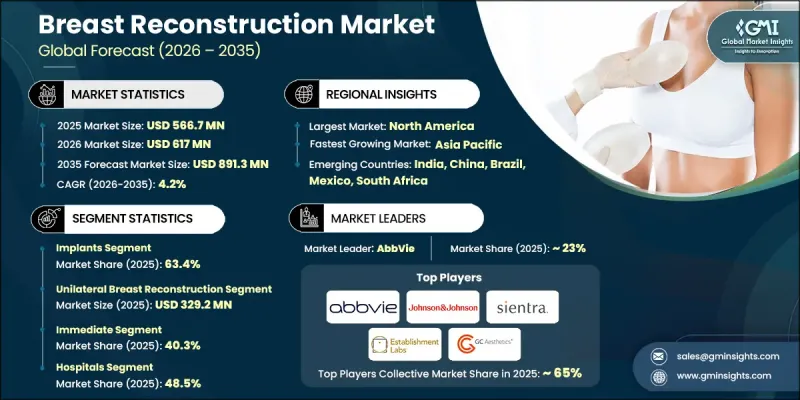
The steady expansion of the breast reconstruction market is largely driven by ongoing advancements in surgical technologies, increasing awareness regarding reconstructive treatment options, and a growing preference for minimally invasive procedures. Improvements in surgical planning techniques, biomaterials, and post-operative care have significantly enhanced clinical outcomes and patient satisfaction. At the same time, supportive reimbursement frameworks and favorable government healthcare initiatives are contributing to broader accessibility of reconstruction procedures. Rising awareness about the physical and psychological benefits of reconstructive surgery has encouraged more patients to consider these procedures as part of their treatment journey. Healthcare providers and advocacy organizations are also actively educating patients about available options, which help normalize reconstruction procedures and expand the patient base. Furthermore, innovation in regenerative tissue technologies, customized implant solutions, and advanced surgical tools continues to improve treatment precision and safety. These technological developments, combined with supportive healthcare policies and a growing focus on patient quality of life, are creating favorable growth conditions for the global breast reconstruction market.
| Market Scope | |
|---|---|
| Start Year | 2025 |
| Forecast Year | 2026-2035 |
| Start Value | $566.7 Million |
| Forecast Value | $891.3 Million |
| CAGR | 4.2% |
Breast reconstruction refers to a surgical procedure designed to restore the shape, volume, and natural appearance of the breast following surgical removal or structural damage caused by medical conditions or congenital abnormalities. The procedure can be performed using artificial implants or by utilizing tissue from the patient's own body. In certain cases, reconstruction may take place immediately after the primary surgical procedure, while in other situations it may be performed at a later stage, depending on patient preferences and clinical recommendations. Increasing awareness regarding the psychological and emotional benefits associated with reconstructive procedures has encouraged a growing number of patients to explore these treatment options. Continuous support from medical professionals and patient advocacy initiatives has also contributed to increasing demand.
The implants segment held 63.4% share in 2025. This strong market share is primarily attributed to the high adoption of implant-based reconstruction techniques due to their relatively shorter procedure duration compared with other surgical methods and the widespread availability of advanced implant technologies. Improvements in implant materials and surface engineering have enhanced durability, safety profiles, and aesthetic outcomes for patients undergoing reconstruction procedures. Continuous innovation in implant design has significantly improved clinical performance while also increasing patient satisfaction. These developments continue to support the sustained dominance of implant-based reconstruction within the global market.
The unilateral breast reconstruction segment generated USD 329.2 million in 2025 and is expected to grow at a CAGR of 3.8% between 2026 and 2035. Demand for unilateral reconstruction procedures continues to increase as patients seek treatments that restore balance and aesthetic symmetry following breast surgery. Advancements in medical imaging technologies and the introduction of artificial intelligence-assisted surgical planning systems are enabling surgeons to perform reconstruction procedures with greater accuracy and improved outcomes. These technologies help enhance surgical precision while supporting more consistent aesthetic results. In addition, ongoing regulatory progress and increased approvals for technologically advanced surgical planning tools are expected to improve clinical efficiency and further encourage the adoption of unilateral breast reconstruction procedures.
North America Breast Reconstruction Market accounted for 45.2% share in 2025. The region continues to lead the market due to a high prevalence of breast-related medical conditions and the widespread adoption of early diagnostic screening programs. Early detection initiatives significantly increase the number of patients eligible for reconstructive procedures, which in turn strengthens demand for breast reconstruction surgeries. In addition, North America is home to numerous leading medical device manufacturers and technology developers that actively introduce innovative reconstruction solutions. Continuous product innovation in implant materials, tissue support technologies, and advanced surgical tools contributes to improved procedural outcomes, supporting the ongoing market expansion.
Key companies operating in the Global Breast Reconstruction Market include Johnson & Johnson, AbbVie, POLYTECH Health & Aesthetics, GC Aesthetics, Sientra, Establishment Labs, RTI Surgical, Sebbin, SILIMED, CEREPLAS, INTEGRA, HANSBIOMED, arion LABORATORIES, BIMINI HEALTH TECH, and Wanhe. Companies participating in the Breast Reconstruction Market are implementing several strategic initiatives to strengthen their competitive positioning and expand their global footprint. Leading manufacturers are focusing on continuous research and development activities to introduce innovative implant technologies, regenerative tissue solutions, and advanced surgical support materials. Many organizations are also investing in the development of customized implant designs and improved biomaterials to enhance safety, durability, and aesthetic outcomes. Strategic collaborations with healthcare providers, research institutions, and surgical centers help companies accelerate product development and increase clinical adoption. Companies are expanding their geographic presence through distribution partnerships and regulatory approvals in new markets.
Table of Contents
Chapter 1 Research Methodology
- 1.1 Research approach
- 1.2 Quality commitments
- 1.2.1 GMI AI policy & data integrity commitment
- 1.2.1.1 Source consistency protocol
- 1.2.1 GMI AI policy & data integrity commitment
- 1.3 Research trail & confidence scoring
- 1.3.1 Research trail components
- 1.3.2 Scoring components
- 1.4 Data collection
- 1.4.1 Partial list of primary sources
- 1.5 Data mining sources
- 1.5.1 Paid sources
- 1.5.1.1 Sources, by region
- 1.5.1 Paid sources
- 1.6 Base estimates and calculations
- 1.6.1 Base year calculation for any one approach
- 1.7 Forecast model
- 1.7.1 Quantified market impact analysis
- 1.7.1.1 Mathematical impact of growth parameters on forecast
- 1.7.1 Quantified market impact analysis
- 1.8 Research transparency addendum
- 1.8.1 Source attribution framework
- 1.8.2 Quality assurance metrics
- 1.8.3 Our commitment to trust
Chapter 2 Executive Summary
- 2.1 Industry 360° synopsis
- 2.2 Key market trends
- 2.2.1 Regional trends
- 2.2.2 Product trends
- 2.2.3 Type trends
- 2.2.4 Procedure trends
- 2.2.5 End use trends
- 2.3 CXO perspectives: Strategic imperatives
Chapter 3 Industry Insights
- 3.1 Industry ecosystem analysis
- 3.2 Industry impact forces
- 3.2.1 Growth drivers
- 3.2.1.1 Increasing prevalence of breast cancer
- 3.2.1.2 Growing awareness about reconstructive surgery
- 3.2.1.3 Technological advancements in implants and mesh
- 3.2.1.4 Surge in cosmetic and aesthetic procedures
- 3.2.2 Industry pitfalls and challenges
- 3.2.2.1 High cost of breast reconstruction procedures
- 3.2.2.2 Surgical risks and complications
- 3.2.3 Market opportunities
- 3.2.3.1 Expansion in emerging markets
- 3.2.3.2 Increasing adoption of 3D printing and custom implants
- 3.2.1 Growth drivers
- 3.3 Growth potential analysis
- 3.4 Regulatory landscape (Driven by primary research)
- 3.4.1 North America
- 3.4.2 Europe
- 3.4.3 Asia Pacific
- 3.5 Technology landscape
- 3.5.1 Current technological trends
- 3.5.2 Emerging technologies
- 3.6 Reimbursement scenario (Driven by primary research)
- 3.7 Future market trends
- 3.8 Porter's analysis
- 3.9 PESTEL analysis
- 3.10 Customer insights (Driven by primary research)
- 3.11 Start-up scenarios (Driven by primary research)
- 3.12 Investment landscape (Driven by primary research)
- 3.13 Impact of AI and its future assessment
- 3.14 Gap analysis
Chapter 4 Competitive Landscape, 2025
- 4.1 Introduction
- 4.2 Company matrix analysis
- 4.3 Company market share analysis (Driven by primary research)
- 4.3.1 Global
- 4.3.2 North America
- 4.3.3 Europe
- 4.3.4 Asia Pacific
- 4.4 Competitive positioning matrix
- 4.5 Competitive analysis of major market players
- 4.6 Key developments
- 4.6.1 Mergers & acquisitions
- 4.6.2 Partnerships & collaborations
- 4.6.3 New product launches
- 4.6.4 Expansion plans
Chapter 5 Market Estimates and Forecast, By Product, 2022 - 2035 ($ Mn)
- 5.1 Key trends
- 5.2 Implants
- 5.2.1 Silicone breast implants
- 5.2.2 Saline breast implants
- 5.3 Tissue expander
- 5.4 Acellular dermal matrix
- 5.5 Other products
Chapter 6 Market Estimates and Forecast, By Type, 2022 - 2035 ($ Mn)
- 6.1 Key trends
- 6.2 Unilateral breast reconstruction
- 6.3 Bilateral breast reconstruction
Chapter 7 Market Estimates and Forecast, By Procedure, 2022 - 2035 ($ Mn)
- 7.1 Key trends
- 7.2 Immediate
- 7.3 Delayed
- 7.4 Revision
Chapter 8 Market Estimates and Forecast, By End Use, 2022 - 2035 ($ Mn)
- 8.1 Key trends
- 8.2 Hospitals
- 8.3 Ambulatory surgical centers
- 8.4 Other end users
Chapter 9 Market Estimates and Forecast, By Region, 2022 - 2035 ($ Mn)
- 9.1 Key trends
- 9.2 North America
- 9.2.1 U.S.
- 9.2.2 Canada
- 9.3 Europe
- 9.3.1 Germany
- 9.3.2 UK
- 9.3.3 France
- 9.3.4 Spain
- 9.3.5 Italy
- 9.3.6 Netherlands
- 9.4 Asia Pacific
- 9.4.1 China
- 9.4.2 Japan
- 9.4.3 India
- 9.4.4 Australia
- 9.4.5 South Korea
- 9.5 Latin America
- 9.5.1 Brazil
- 9.5.2 Mexico
- 9.5.3 Argentina
- 9.6 Middle East and Africa
- 9.6.1 South Africa
- 9.6.2 Saudi Arabia
- 9.6.3 UAE
Chapter 10 Company Profiles
- 10.1 AbbVie
- 10.2 arion LABORATORIES
- 10.3 BIMINI HEALTH TECH
- 10.4 CEREPLAS
- 10.5 Establishment Labs
- 10.6 GC Aesthetics
- 10.7 HANSBIOMED
- 10.8 INTEGRA
- 10.9 Johnson & Johnson
- 10.10 POLYTECH Health & Aesthetics
- 10.11 RTI Surgical
- 10.12 Sebbin
- 10.13 Sientra
- 10.14 SILIMED
- 10.15 Wanhe

