
PUBLISHER: Global Market Insights Inc. | PRODUCT CODE: 1998854

PUBLISHER: Global Market Insights Inc. | PRODUCT CODE: 1998854
Citrus Pectin Market Opportunity, Growth Drivers, Industry Trend Analysis, and Forecast 2026 - 2035
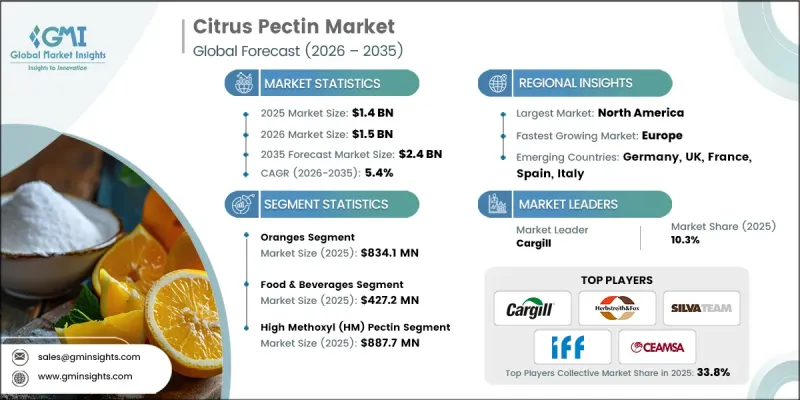
The Global Citrus Pectin Market was valued at USD 1.4 billion in 2025 and is estimated to grow at a CAGR of 5.4% to reach USD 2.4 billion by 2035.
Market expansion is driven by the growing demand for natural, plant-based ingredients in food, beverages, nutraceuticals, and pharmaceuticals. Citrus pectin, a polysaccharide extracted primarily from citrus fruit peels, is highly valued for its gelling, thickening, and stabilizing properties. Its versatility in formulation allows it to enhance texture, consistency, and shelf life across various products while supporting reduced-sugar formulations and clean-label initiatives. High methoxyl (HM) pectin forms gels under acidic and sugary conditions, whereas low methoxyl (LM) pectin requires calcium ions, enabling flexibility in application for jams, jellies, confectionery, dairy, and functional foods. Increasing consumer preference for natural, non-GMO ingredients and rising awareness of dietary health benefits are reinforcing the use of citrus pectin, making it a critical functional ingredient for manufacturers seeking to meet evolving food and supplement demands.
| Market Scope | |
|---|---|
| Start Year | 2025 |
| Forecast Year | 2026-2035 |
| Start Value | $1.4 Billion |
| Forecast Value | $2.4 Billion |
| CAGR | 5.4% |
The oranges segment accounted for USD 834.1 million in 2025, reflecting the versatility and functional performance of pectin derived from this source. Orange-based pectin is widely used in food systems for its natural thickening, gelling, and stabilizing characteristics, making it essential for improving texture and product quality. Its clean-label appeal and non-GMO status enhance demand among health-conscious consumers seeking natural and minimally processed ingredients.
The distributors and wholesalers segment reached USD 578.9 million in 2025. These channels are vital for reaching bulk buyers, including food manufacturers, dietary supplement companies, and pharmaceutical producers. They ensure widespread availability, facilitate customized formulations, and support long-term contracts, while online retail platforms are improving access for smaller manufacturers and specialty consumers seeking pectin products.
North America Citrus Pectin Market generated USD 562.9 million in 2025. Rising interest in functional foods, low-sugar products, and dietary supplements is driving adoption. In the United States, citrus pectin is widely incorporated into confectionery, beverages, and dairy products to create clean-label offerings that satisfy health-conscious consumer demands.
Leading companies operating in the Global Citrus Pectin Market include Cargill, Ingredion, Herbstreith & Fox KG Pektin-Fabriken, Tate & Lyle, Compania Espanola de Algas Marinas (CEAMSA), Quadra Chemicals, Silvateam, Fiberstar, Krishna Pectins Pvt Ltd, Labh Ingredients, and IFF. Key strategies adopted by companies in the Citrus Pectin Market focus on product innovation, including developing high-quality, low-sugar, and functional formulations to cater to health-conscious consumers. Strategic partnerships with food and beverage manufacturers help expand distribution channels and secure long-term contracts. Companies also invest in R&D to improve extraction efficiency, enhance purity, and create customized pectin solutions. Geographic expansion, especially into high-growth regions, strengthens market presence, while marketing campaigns emphasize natural, clean-label, and sustainable attributes to build brand loyalty and differentiate products in a competitive landscape.
Table of Contents
Chapter 1 Methodology & Scope
- 1.1 Market scope and definition
- 1.2 Research design
- 1.2.1 Research approach
- 1.2.2 Data collection methods
- 1.3 Data mining sources
- 1.3.1 Global
- 1.3.2 Regional/Country
- 1.4 Base estimates and calculations
- 1.4.1 Base year calculation
- 1.4.2 Key trends for market estimation
- 1.5 Primary research and validation
- 1.5.1 Primary sources
- 1.6 Forecast model
- 1.7 Research assumptions and limitations
Chapter 2 Executive Summary
- 2.1 Industry 360° synopsis
- 2.2 Key market trends
- 2.2.1 Source
- 2.2.2 Grade
- 2.2.3 Application
- 2.2.4 Distribution Channel
- 2.2.5 Regional
- 2.3 TAM Analysis, 2026-2035
- 2.4 CXO perspectives: Strategic imperatives
- 2.5 Future outlook and strategic recommendations
Chapter 3 Industry Insights
- 3.1 Industry ecosystem analysis
- 3.1.1 Supplier landscape
- 3.1.2 Profit margin
- 3.1.3 Value addition at each stage
- 3.1.4 Factor affecting the value chain
- 3.1.5 Disruptions
- 3.2 Industry impact forces
- 3.2.1 Growth drivers
- 3.2.1.1 Rising demand for clean-label ingredients
- 3.2.1.2 Expansion of functional foods and supplements
- 3.2.1.3 Increased processed and convenience food consumption
- 3.2.2 Pitfalls/challenge
- 3.2.2.1 Raw material supply fluctuations
- 3.2.2.2 High extraction and processing costs
- 3.2.3 Opportunities
- 3.2.3.1 Low-sugar and sugar-free product development
- 3.2.3.2 Pharmaceutical and nutraceutical applications
- 3.2.3.3 Sustainable and biodegradable packaging
- 3.2.1 Growth drivers
- 3.3 Growth potential analysis
- 3.4 Regulatory landscape
- 3.4.1 North America
- 3.4.2 Europe
- 3.4.3 Asia Pacific
- 3.4.4 Latin America
- 3.4.5 Middle East & Africa
- 3.5 Porter's analysis
- 3.6 PESTEL analysis
- 3.7 Technology and innovation landscape
- 3.7.1 Current technological trends
- 3.7.2 Emerging technologies
- 3.8 Price trends
- 3.8.1 By region
- 3.8.2 By source
- 3.9 Future market trends
- 3.10 Patent landscape
- 3.11 Trade statistics (HS code)
- 3.11.1 Major importing countries
- 3.11.2 Major exporting countries
- 3.12 Sustainability and environmental aspects
- 3.12.1 Sustainable practices
- 3.12.2 Waste reduction strategies
- 3.12.3 Energy efficiency in production
- 3.12.4 Eco-friendly initiatives
- 3.13 Carbon footprint consideration
Chapter 4 Competitive Landscape, 2025
- 4.1 Introduction
- 4.2 Company market share analysis
- 4.2.1 By region
- 4.2.1.1 North America
- 4.2.1.2 Europe
- 4.2.1.3 Asia Pacific
- 4.2.1.4 LATAM
- 4.2.1.5 MEA
- 4.2.1 By region
- 4.3 Company matrix analysis
- 4.4 Competitive analysis of major market players
- 4.5 Competitive positioning matrix
- 4.6 Key developments
- 4.6.1 Mergers & acquisitions
- 4.6.2 Partnerships & collaborations
- 4.6.3 New product launches
- 4.6.4 Expansion plans
Chapter 5 Market Estimates and Forecast, By Source, 2022-2035 (USD Million) (Kilo Tons)
- 5.1 Key trends
- 5.2 Oranges
- 5.3 Lemon
- 5.4 Grapefruit
- 5.5 Others
Chapter 6 Market Estimates and Forecast, By Grade, 2022-2035 (USD Million) (Kilo Tons)
- 6.1 Key trends
- 6.2 High Methoxyl (HM) Pectin
- 6.3 Low Methoxyl (LM) Pectin
Chapter 7 Market Estimates and Forecast, By Application, 2022-2035 (USD Million) (Kilo Tons)
- 7.1 Key trends
- 7.2 Food & Beverages
- 7.3 Bakery and Confectionery
- 7.4 Pharmaceutical
- 7.5 Cosmetic and Personal Care Products
- 7.6 Dietary Supplements
- 7.7 Functional Food
- 7.8 Others
Chapter 8 Market Estimates and Forecast, By Distribution Channel, 2022-2035 (USD Million) (Kilo Tons)
- 8.1 Key trends
- 8.2 Direct Sales
- 8.3 Distributors and Wholesalers
- 8.4 Online Retail
- 8.5 Convenience Stores
- 8.6 Specialty Stores
- 8.7 Others
Chapter 9 Market Estimates and Forecast, By Region, 2022-2035 (USD Million) (Kilo Tons)
- 9.1 Key trends
- 9.2 North America
- 9.2.1 U.S.
- 9.2.2 Canada
- 9.3 Europe
- 9.3.1 Germany
- 9.3.2 UK
- 9.3.3 France
- 9.3.4 Spain
- 9.3.5 Italy
- 9.3.6 Rest of Europe
- 9.4 Asia Pacific
- 9.4.1 China
- 9.4.2 India
- 9.4.3 Japan
- 9.4.4 Australia
- 9.4.5 South Korea
- 9.4.6 Rest of Asia Pacific
- 9.5 Latin America
- 9.5.1 Brazil
- 9.5.2 Mexico
- 9.5.3 Argentina
- 9.5.4 Rest of Latin America
- 9.6 Middle East and Africa
- 9.6.1 Saudi Arabia
- 9.6.2 South Africa
- 9.6.3 UAE
- 9.6.4 Rest of Middle East and Africa
Chapter 10 Company Profiles
- 10.1 Cargill
- 10.2 Ingredion
- 10.3 Herbstreith & Fox KG Pektin-Fabriken
- 10.4 Tate & Lyle
- 10.5 Compania Espanola de Algas Marinas (CEAMSA)
- 10.6 Quadra Chemicals
- 10.7 Silvateam
- 10.8 CEAMSA
- 10.9 Fiberstar
- 10.10 Krishna Pectins Pvt Ltd
- 10.11 Labh Ingredients
- 10.12 IFF

