PUBLISHER: Global Market Insights Inc. | PRODUCT CODE: 2019027

PUBLISHER: Global Market Insights Inc. | PRODUCT CODE: 2019027
Molded Fiber Tableware Market Opportunity, Growth Drivers, Industry Trend Analysis, and Forecast 2026 - 2035
The Global Molded Fiber Tableware Market was valued at USD 4.5 billion in 2025 and is estimated to grow at a CAGR of 5.3% to reach USD 7.5 billion by 2035.
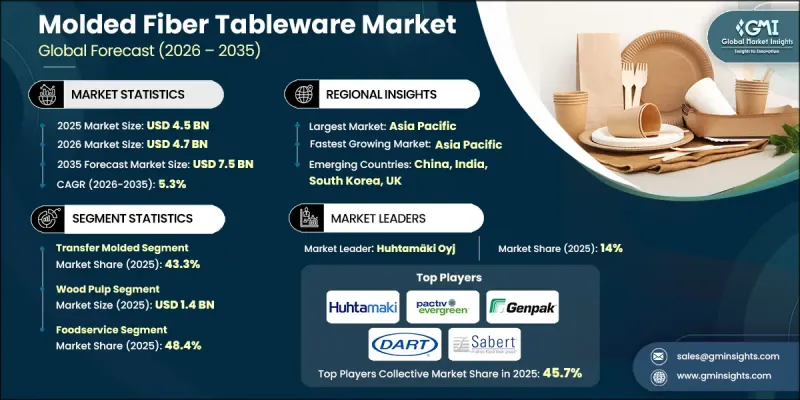
Growth in the molded fiber tableware market is driven by stricter regulatory frameworks that limit the use of conventional disposable materials and increase demand for environmentally responsible alternatives. The molded fiber tableware market is also benefiting from the growing shift toward compostable packaging solutions and the rising use of renewable raw materials in production. In addition, expanding sustainability initiatives across large-scale foodservice operations is encouraging the transition to fiber-based disposable products. The molded fiber tableware market is further supported by increasing investments in sustainable manufacturing processes and material innovation. As awareness around environmental impact continues to grow and policy support strengthens, the molded fiber tableware market is positioned for consistent growth across developed and emerging economies.
| Market Scope | |
|---|---|
| Start Year | 2025 |
| Forecast Year | 2026-2035 |
| Start Value | $4.5 Billion |
| Forecast Value | $7.5 Billion |
| CAGR | 5.3% |
The molded fiber tableware market is propelled by rising public-sector demand for environmentally responsible catering solutions, as institutional purchasing continues to influence large-scale consumption patterns. The molded fiber tableware market is also gaining traction due to the expansion of off-premise food consumption, which is increasing the global demand for disposable packaging formats. Rapid urban growth and the evolution of digital food ecosystems are accelerating this shift in consumption behavior. Another notable trend in the molded fiber tableware market is the growing preference for bagasse-derived products, as manufacturers increasingly adopt agricultural byproducts as sustainable raw materials. This transition has gained significant momentum since 2020, as producers seek alternatives that reduce reliance on traditional materials while supporting circular economy practices.
The thermoformed fiber segment is projected to grow at a CAGR of 5.9% during 2026-2035, driven by rising demand for high-quality products with improved strength, surface finish, and protective characteristics. This manufacturing approach enables the production of lightweight and precision-designed tableware, supporting its increasing use in advanced food packaging applications. The ability to combine performance efficiency with compostability is encouraging wider adoption among companies focused on sustainable product innovation.
The bagasse segment is expected to grow at a CAGR of 7.4% during 2026-2035, supported by the growing utilization of agricultural residues in eco-friendly packaging solutions. Bagasse offers strong thermal resistance and biodegradability, making it a preferred material for manufacturing disposable tableware. Increasing availability of raw materials, along with rising demand for compostable packaging, is accelerating the adoption of bagasse-based molded fiber products across global markets.
North America Molded Fiber Tableware Market held 23.7% share in 2025, driven by heightened regulatory measures aimed at reducing environmental impact from disposable packaging. The molded fiber tableware market in the region is expanding as organizations transition toward sustainable alternatives to meet compliance requirements and environmental targets. Ongoing policy developments and sustainability commitments are encouraging broader adoption of fiber-based tableware solutions, strengthening the regional market outlook.
Key companies operating in the Global Molded Fiber Tableware Market include Huhtamaki Oyj, Dart Container Corporation, Pactiv Evergreen Inc., Genpak LLC, Duni AB, Eco-Products Inc., Sabert Corporation, Vegware Ltd., World Centric, Fabri-Kal Corporation, Greenwave Products Inc., Natur-Tec Inc., Bonitopak, Ningbo Homelink Eco iTech Co., Ltd., and Biopac India Corporation Ltd. Companies in the Global Molded Fiber Tableware Market are strengthening their market position through strategic investments in sustainable material innovation and production efficiency. Many players are focusing on developing advanced manufacturing technologies to enhance product quality and reduce costs. Partnerships and collaborations across the supply chain are enabling faster adoption and broader distribution of eco-friendly solutions. Firms are also expanding their production capacities to meet increasing global demand while improving operational scalability. Additionally, companies are leveraging branding and certification strategies to align with sustainability standards and consumer expectations. Geographic expansion into emerging markets and continuous product portfolio diversification are further supporting long-term growth and competitive advantage in the molded fiber tableware market.
Table of Contents
Chapter 1 Methodology and Scope
- 1.1 Market scope and definition
- 1.2 Research design
- 1.2.1 Research approach
- 1.2.2 Data collection methods
- 1.3 Data mining sources
- 1.3.1 Global
- 1.3.2 Regional/Country
- 1.4 Base estimates and calculations
- 1.4.1 Base year calculation
- 1.4.2 Key trends for market estimation
- 1.5 Primary research and validation
- 1.5.1 Primary sources
- 1.6 Forecast model
- 1.7 Research assumptions and limitations
Chapter 2 Executive Summary
- 2.1 Industry 360° synopsis, 2022 - 2035
- 2.2 Key market trends
- 2.2.1 Product type trends
- 2.2.2 Molding technology trends
- 2.2.3 Fiber source trends
- 2.2.4 End-use trends
- 2.2.5 Regional trends
- 2.3 TAM Analysis, 2026-2035
- 2.4 CXO perspectives: Strategic imperatives
Chapter 3 Industry Insights
- 3.1 Industry ecosystem analysis
- 3.1.1 Supplier Landscape
- 3.1.2 Profit Margin
- 3.1.3 Cost structure
- 3.1.4 Value addition at each stage
- 3.1.5 Factor affecting the value chain
- 3.1.6 Disruptions
- 3.2 Industry impact forces
- 3.2.1 Growth drivers
- 3.2.1.1 Global bans on single-use plastic foodservice products
- 3.2.1.2 Government procurement of eco-friendly catering products
- 3.2.1.3 Rapid expansion of food delivery and takeaway services
- 3.2.1.4 Corporate sustainability commitments in quick-service restaurants
- 3.2.1.5 Improved molded pulp forming and barrier-coating technologies
- 3.2.2 Industry pitfalls and challenges
- 3.2.2.1 Higher cost compared to plastic and foam alternatives
- 3.2.2.2 Limited water and grease resistance without coatings
- 3.2.3 Market opportunities
- 3.2.3.1 Premium molded fiber tableware for airline catering
- 3.2.3.2 Automation in high-speed molded pulp manufacturing machines
- 3.2.1 Growth drivers
- 3.3 Growth potential analysis
- 3.4 Regulatory landscape
- 3.4.1 North America
- 3.4.2 Europe
- 3.4.3 Asia Pacific
- 3.4.4 Latin America
- 3.4.5 Middle East & Africa
- 3.5 Porter's analysis
- 3.6 PESTEL analysis
- 3.7 Technology and Innovation landscape
- 3.7.1 Current technological trends
- 3.7.2 Emerging technologies
- 3.8 Price trends
- 3.8.1 By region
- 3.8.2 By product
- 3.9 Pricing Strategies
- 3.10 Emerging Business Models
- 3.11 Compliance Requirements
- 3.12 Patent and IP analysis
Chapter 4 Competitive Landscape, 2025
- 4.1 Introduction
- 4.2 Company market share analysis
- 4.2.1 By region
- 4.2.1.1 North America
- 4.2.1.2 Europe
- 4.2.1.3 Asia Pacific
- 4.2.1.4 Latin America
- 4.2.1.5 Middle East & Africa
- 4.2.2 Market concentration analysis
- 4.2.1 By region
- 4.3 Competitive benchmarking of key players
- 4.3.1 Financial performance comparison
- 4.3.1.1 Revenue
- 4.3.1.2 Profit margin
- 4.3.1.3 R&D
- 4.3.2 Product portfolio comparison
- 4.3.2.1 Product range breadth
- 4.3.2.2 Technology
- 4.3.2.3 Innovation
- 4.3.3 Geographic presence comparison
- 4.3.3.1 Global footprint analysis
- 4.3.3.2 Service network coverage
- 4.3.3.3 Market penetration by region
- 4.3.4 Competitive positioning matrix
- 4.3.4.1 Leaders
- 4.3.4.2 Challengers
- 4.3.4.3 Followers
- 4.3.4.4 Niche players
- 4.3.5 Strategic outlook matrix
- 4.3.1 Financial performance comparison
- 4.4 Key developments
- 4.4.1 Mergers and acquisitions
- 4.4.2 Partnerships and collaborations
- 4.4.3 Technological advancements
- 4.4.4 Expansion and investment strategies
- 4.4.5 Digital transformation initiatives
- 4.5 Emerging/ startup competitors landscape
Chapter 5 Market Estimates and Forecast, By Product Type, 2022 - 2035 (USD Million)
- 5.1 Key trends
- 5.2 Plates
- 5.3 Bowls
- 5.4 Trays
- 5.5 Clamshell containers
- 5.6 Cups
- 5.7 Lids
- 5.8 Others
Chapter 6 Market Estimates and Forecast, By Molding Technology, 2022 - 2035 (USD Million)
- 6.1 Key trends
- 6.2 Thick wall molded
- 6.3 Transfer molded
- 6.4 Thermoformed fiber
Chapter 7 Market Estimates and Forecast, By Fiber Source, 2022 - 2035 (USD Million)
- 7.1 Key trends
- 7.2 Bagasse
- 7.3 Bamboo fiber
- 7.4 Wood pulp
- 7.5 Wheat straw
- 7.6 Recycled paper fiber
- 7.7 Others
Chapter 8 Market Estimates and Forecast, By End-Use, 2022 - 2035 (USD Million)
- 8.1 Key trends
- 8.2 Foodservice
- 8.3 Institutional dining
- 8.4 Household/retail
Chapter 9 Market Estimates and Forecast, By Region, 2022 - 2035 (USD Million)
- 9.1 Key trends
- 9.2 North America
- 9.2.1 U.S.
- 9.2.2 Canada
- 9.3 Europe
- 9.3.1 Germany
- 9.3.2 UK
- 9.3.3 France
- 9.3.4 Spain
- 9.3.5 Italy
- 9.4 Asia Pacific
- 9.4.1 China
- 9.4.2 India
- 9.4.3 Japan
- 9.4.4 Australia
- 9.4.5 South Korea
- 9.5 Latin America
- 9.5.1 Brazil
- 9.5.2 Mexico
- 9.5.3 Argentina
- 9.6 Middle East and Africa
- 9.6.1 South Africa
- 9.6.2 Saudi Arabia
- 9.6.3 UAE
Chapter 10 Company Profiles
- 10.1 Global Key Players
- 10.1.1 Huhtamaki Oyj
- 10.1.2 Pactiv Evergreen Inc.
- 10.1.3 Genpak LLC
- 10.1.4 Dart Container Corporation
- 10.1.5 Sabert Corporation
- 10.2 Regional key players
- 10.2.1 North America
- 10.2.1.1 Eco-Products Inc.
- 10.2.1.2 Fabri-Kal Corporation
- 10.2.1.3 Greenwave Products Inc.
- 10.2.1.4 World Centric
- 10.2.2 Asia Pacific
- 10.2.2.1 Biopac India Corporation Ltd.
- 10.2.2.2 Ningbo Homelink Eco-iTech Co., Ltd.
- 10.2.3 Europe
- 10.2.3.1 Duni AB
- 10.2.3.2 Vegware Ltd.
- 10.2.1 North America
- 10.3 Niche Players/Disruptors
- 10.3.1 Bonitopak
- 10.3.2 Natur-Tec Inc.

