PUBLISHER: Global Market Insights Inc. | PRODUCT CODE: 2019033

PUBLISHER: Global Market Insights Inc. | PRODUCT CODE: 2019033
Children Sunglasses Market Opportunity, Growth Drivers, Industry Trend Analysis, and Forecast 2026 - 2035
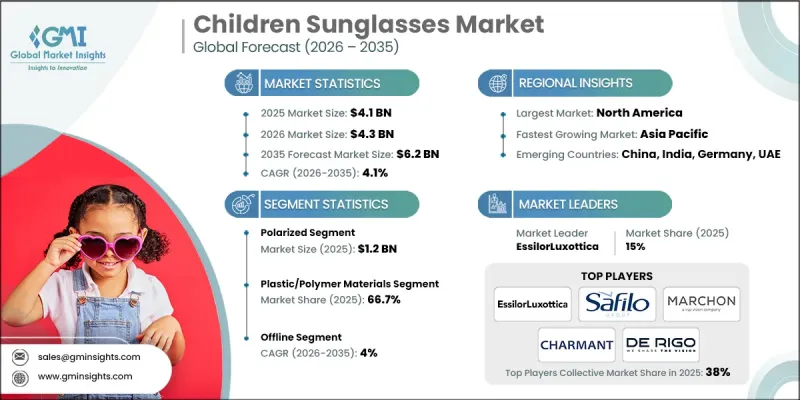
The Global Children Sunglasses Market was valued at USD 4.1 billion in 2025 and is estimated to grow at a CAGR of 4.1% to reach USD 6.2 billion by 2035.
The market is gaining steady momentum as awareness among parents regarding eye protection continues to rise. Increasing concerns about the harmful effects of ultraviolet radiation on children's vision are encouraging higher adoption of protective eyewear at an early age. In addition, rising disposable incomes and evolving lifestyle preferences are supporting demand for premium, durable, and aesthetically appealing sunglasses designed specifically for children. The growing use of digital devices among younger populations has also contributed to vision-related concerns, further strengthening the need for protective solutions. Manufacturers are actively focusing on product innovation, introducing lightweight, impact-resistant, and ergonomically designed sunglasses to meet consumer expectations. A wide variety of colors, styles, and designs has improved product appeal among both parents and children, supporting higher sales. Furthermore, digital platforms and social media influence are enhancing product visibility and accessibility, enabling brands to reach a broader audience and accelerate market growth.
| Market Scope | |
|---|---|
| Start Year | 2025 |
| Forecast Year | 2026-2035 |
| Start Value | $4.1 Billion |
| Forecast Value | $6.2 Billion |
| CAGR | 4.1% |
The polarized segment generated USD 1.2 billion in 2025 and is anticipated to grow at a CAGR of 5.1% during 2026-2035. This segment is witnessing increased demand due to growing parental awareness of glare reduction and visual comfort benefits offered by polarized lenses. These sunglasses improve clarity and reduce eye strain, making them suitable for outdoor use. Continuous advancements in lens technology, combined with attractive frame designs tailored for children, are further supporting segment expansion. As consumers prioritize both functionality and style, the adoption of polarized sunglasses continues to strengthen across global markets.
The plastic or polymer materials segment held a 66.7% share in 2025 and is expected to grow at a CAGR of 3.8% from 2026 to 2035. This segment benefits from the lightweight nature, cost-effectiveness, and high durability of polymer-based frames, making them ideal for children's usage. These materials offer flexibility and resistance to breakage, ensuring long-term usability. In addition, advancements in polymer technology have improved UV protection capabilities, further enhancing product value. The availability of diverse designs and vibrant color options also increases product attractiveness, encouraging higher adoption among parents seeking comfortable, affordable, and reliable eyewear solutions for children.
U.S. Children Sunglasses Market accounted for 76% share in 2025. Market growth in the country is supported by strong consumer awareness, high purchasing power, and well-established retail networks. Demand varies across regions due to differences in climate and sunlight exposure, which influences purchasing behavior. Consumers are increasingly inclined toward premium-quality products that offer both protection and style. In addition, the presence of advanced distribution channels and strong brand penetration contributes to sustained market expansion. The focus on child safety, combined with increasing awareness of long-term eye health, continues to drive product adoption across the country.
Key players in the Global Children Sunglasses Market include Banz, Bug + Bean Kids, Charmant Group, De Rigo Vision, EssilorLuxottica, Julbo, Marchon Eyewear, Marcolin Group, Maui Jim, Safilo Group, Smith Optics, Sun Bum, Thelios (LVMH), Uvex Sports, Valley Eyewear. Companies in the children sunglasses market are strengthening their position through continuous product innovation, focusing on lightweight materials, enhanced UV protection, and durable designs. They are expanding their product portfolios with stylish and customizable options to appeal to both children and parents. Strategic collaborations with retailers and e-commerce platforms are improving product accessibility and market reach. Brands are also leveraging digital marketing and social media to increase visibility and consumer engagement. Investments in research and development, along with the introduction of advanced lens technologies, help maintain a competitive advantage. Additionally, companies are focusing on affordability, sustainability, and brand differentiation to build long-term customer loyalty and expand their global footprint.
Table of Contents
Chapter 1 Methodology and scope
- 1.1 Research approach
- 1.2 Quality Commitments
- 1.2.1 GMI AI policy & data integrity commitment
- 1.2.1.1 Source consistency protocol
- 1.2.1 GMI AI policy & data integrity commitment
- 1.3 Research Trail & Confidence Scoring
- 1.3.1 Research Trail Components
- 1.3.2 Scoring Components
- 1.4 Data Collection
- 1.4.1 Partial list of primary sources
- 1.5 Data mining sources
- 1.5.1 Paid sources
- 1.5.1.1 Sources, by region
- 1.5.1 Paid sources
- 1.6 Base estimates and calculations
- 1.6.1 Base year calculation for any one approach
- 1.7 Forecast model
- 1.7.1 Quantified market impact analysis
- 1.7.1.1 Mathematical impact of growth parameters on forecast
- 1.7.1 Quantified market impact analysis
- 1.8 Research transparency addendum
- 1.8.1 Source attribution framework
- 1.8.2 Quality assurance metrics
- 1.8.3 Our commitment to trust
Chapter 2 Executive summary
- 2.1 Industry 360° synopsis
- 2.2 Key market trends
- 2.2.1 Regional
- 2.2.2 By Type
- 2.2.3 By Frame Material
- 2.2.4 By Lens Material
- 2.2.5 By Age Group
- 2.2.6 By Gender
- 2.2.7 By Price
- 2.2.8 By Application
- 2.2.9 By Distribution Channel
Chapter 3 Industry insights
- 3.1 Industry ecosystem analysis
- 3.1.1 Supplier landscape
- 3.1.2 Profit margin
- 3.1.3 Value addition at each stage
- 3.1.4 Factor affecting the value chain
- 3.1.5 Disruptions
- 3.2 Industry impact forces
- 3.2.1 Growth drivers
- 3.2.2 Industry pitfalls & challenges
- 3.2.3 Opportunities
- 3.3 Growth potential analysis
- 3.4 Future market trends
- 3.5 Technology and innovation landscape
- 3.5.1 Current technological trends
- 3.5.2 Emerging technologies
- 3.6 Pricing analysis (Driven by Primary Research)
- 3.6.1 Historical price trend analysis (Driven by Primary Research)
- 3.6.2 Pricing strategy by player type (Premium / Value / Cost-plus) (Driven by Primary Research)
- 3.7 Regulatory framework
- 3.7.1 UV protection standards & safety regulations
- 3.7.2 Child product safety certification requirements (CPSC, EN 1836, AS/NZS 1067)
- 3.7.3 Labeling & compliance requirements by region
- 3.8 Trade data analysis (Driven by Primary Research)
- 3.8.1 Import/export volume & value trends (Driven by Primary Research)
- 3.8.2 Key trade corridors & tariff impact (Driven by Primary Research)
- 3.9 Impact of AI & generative AI on the market
- 3.9.1 AI-driven disruption of existing business models
- 3.9.2 GenAI use cases & adoption roadmap by segment
- 3.9.3 Risks, limitations & regulatory considerations
- 3.10 Distribution infrastructure & channel penetration landscape (Driven by Primary Research)
- 3.10.1 Channel coverage by region & format (Modern vs. Traditional Trade) (Driven by Primary Research)
- 3.10.2 Last-mile infrastructure gaps & emerging channel shifts (Driven by Primary Research)
- 3.11 Porter's five forces analysis
- 3.12 PESTEL analysis
- 3.13 Consumer behavior analysis
- 3.13.1 Purchasing patterns
- 3.13.2 Preference analysis
- 3.13.3 Regional variations in consumer behavior
- 3.13.4 Impact of e-commerce on buying decisions
Chapter 4 Competitive landscape, 2025
- 4.1 Introduction
- 4.2 Company market share analysis
- 4.2.1 North America
- 4.2.2 Europe
- 4.2.3 Asia Pacific
- 4.2.4 Latin America
- 4.2.5 MEA
- 4.3 Company matrix analysis
- 4.4 Competitive analysis of major market players
- 4.5 Competitive positioning matrix
- 4.6 Key developments
- 4.6.1 Mergers & acquisitions
- 4.6.2 Partnerships & collaborations
- 4.6.3 New product launches
- 4.6.4 Expansion plans
Chapter 5 Market Estimates & Forecast, By Type, 2022 - 2035 ($Billion, Thousand Units)
- 5.1 Key trends
- 5.2 Polarized
- 5.3 Non-polarized
Chapter 6 Market Estimates & Forecast, By Frame Material, 2022 - 2035 ($Billion, Thousand Units)
- 6.1 Key trends
- 6.2 Plastic/polymer
- 6.2.1 Flexible rubber
- 6.2.2 TR90 (thermoplastic)
- 6.2.3 Standard plastic
- 6.3 Metal
- 6.4 Hybrid materials
Chapter 7 Market Estimates & Forecast, By Lens Material, 2022 - 2035 ($Billion, Thousand Units)
- 7.1 Key trends
- 7.2 Polycarbonate
- 7.3 CR-39 (allyl diglycol carbonate)
- 7.4 Polyurethane
- 7.5 Others (trivex, acrylic etc.)
Chapter 8 Market Estimates & Forecast, By Age Group, 2022 - 2035 ($Billion, Thousand Units)
- 8.1 Key trends
- 8.2 Toddlers (0-3 years)
- 8.3 Pre-school (4-6 years)
- 8.4 Primary school (7-12 years)
- 8.5 Teenagers (13-17 years)
Chapter 9 Market Estimates & Forecast, By Gender, 2022 - 2035 ($Billion, Thousand Units)
- 9.1 Key trends
- 9.2 Boys
- 9.3 Girls
- 9.4 Unisex
Chapter 10 Market Estimates & Forecast, By Price, 2022 - 2035 ($Billion, Thousand Units)
- 10.1 Key trends
- 10.2 Low (under $19)
- 10.3 Medium ($20-$54)
- 10.4 High ($55 and above)
Chapter 11 Market Estimates & Forecast, By Application, 2022 - 2035 ($Billion, Thousand Units)
- 11.1 Key trends
- 11.2 Sports and outdoor activities
- 11.3 Fashion and lifestyle
- 11.4 Medical/prescription
Chapter 12 Market Estimates & Forecast, By Distribution Channel, 2022 - 2035 ($Billion, Thousand Units)
- 12.1 Key trends
- 12.2 Online
- 12.2.1 E-commerce
- 12.2.2 Company websites
- 12.3 Offline
- 12.3.1 Optical specialty stores
- 12.3.2 Department stores
- 12.3.3 Others (pharmacy and health stores etc.)
Chapter 13 Market Estimates & Forecast, By Region, 2022 - 2035 ($Billion, Thousand Units)
- 13.1 Key trends
- 13.2 North America
- 13.2.1 U.S.
- 13.2.2 Canada
- 13.3 Europe
- 13.3.1 Germany
- 13.3.2 UK
- 13.3.3 France
- 13.3.4 Spain
- 13.3.5 Italy
- 13.3.6 Netherlands
- 13.4 Asia Pacific
- 13.4.1 China
- 13.4.2 Japan
- 13.4.3 India
- 13.4.4 Australia
- 13.4.5 South Korea
- 13.5 Latin America
- 13.5.1 Brazil
- 13.5.2 Mexico
- 13.5.3 Argentina
- 13.6 MEA
- 13.6.1 South Africa
- 13.6.2 Saudi Arabia
- 13.6.3 UAE
Chapter 14 Company Profiles
- 14.1 Banz
- 14.2 Bug + Bean Kids
- 14.3 Charmant Group
- 14.4 De Rigo Vision
- 14.5 EssilorLuxottica
- 14.6 Julbo
- 14.7 Marchon Eyewear
- 14.8 Marcolin Group
- 14.9 Maui Jim
- 14.10 Safilo Group
- 14.11 Smith Optics
- 14.12 Sun Bum
- 14.13 Thelios (LVMH)
- 14.14 Uvex Sports
- 14.15 Valley Eyewear

