
PUBLISHER: Global Market Insights Inc. | PRODUCT CODE: 2019039

PUBLISHER: Global Market Insights Inc. | PRODUCT CODE: 2019039
Pelletizer Market Opportunity, Growth Drivers, Industry Trend Analysis, and Forecast 2026 - 2035
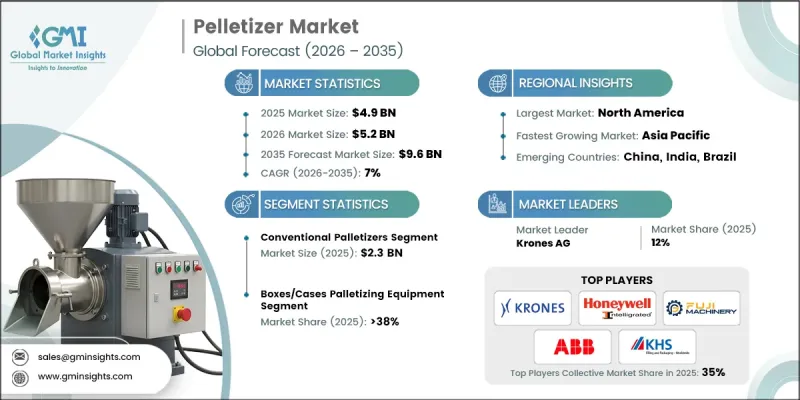
The Global Pelletizer Market was valued at USD 4.9 billion in 2025 and is estimated to grow at a CAGR of 7% to reach USD 9.6 billion by 2035.
Businesses are focusing on streamlining operations and improving workflow consistency, which is driving the adoption of advanced pelletizing systems. What was once considered a supplementary addition to production facilities is now becoming a critical component in managing daily operations and handling increasing production volumes. Rising complexity in supply chains and higher expectations for operational efficiency are encouraging companies to invest in systems that are easy to integrate, user-friendly, and adaptable to different production environments. In addition, the growing emphasis on workplace safety and consistent output is influencing system design, with manufacturers developing solutions that require minimal supervision and fit seamlessly into existing setups. Increasing demand for flexible equipment capable of handling varied product formats is further shaping the market, as businesses seek technologies that balance efficiency with adaptability.
| Market Scope | |
|---|---|
| Start Year | 2025 |
| Forecast Year | 2026-2035 |
| Start Value | $4.9 Billion |
| Forecast Value | $9.6 Billion |
| CAGR | 7% |
The conventional pelletizers segment generated USD 2.3 billion in 2025, supported by their ability to deliver cost efficiency in high-volume production environments where operations are repetitive and standardized. These systems are well-suited for consistent production conditions, offering reliable throughput and long operational lifespans. Their compatibility with established manufacturing layouts further strengthens their position, particularly in facilities where upgrading infrastructure may present challenges. The dependability and durability of conventional systems continue to support their widespread adoption across established industrial environments.
The boxes and cases segment accounted for 38% share in 2025. This segment remains dominant due to the widespread use of standardized packaging formats in automated production and logistics processes. Their uniform structure allows for efficient handling and streamlined operations within automated systems. Equipment designed for this segment integrates effectively with other packaging processes, enhancing overall operational efficiency. The continued reliance on structured packaging formats supports the segment's strong position within the broader market landscape.
United States Pelletizer Market held an 84% share, generating USD 1.3 billion in 2025. The country maintains its leadership due to a high level of automation adoption across the manufacturing and logistics sectors. Ongoing challenges related to labor availability and safety standards are accelerating the shift toward automated solutions. Strong industrial infrastructure and continued investment in advanced technologies are further reinforcing market growth. The presence of established automation ecosystems supports innovation and widespread implementation of pelletizing systems across various industries.
Key companies operating in the Global Pelletizer Market include ABB Group, Krones AG, Fanuc Corporation, Kuka AG, BEUMER Group GmbH & Co. KG, Columbia Machine, Inc., Premier Tech Chronos, Schneider Packaging Equipment Co., Inc., Honeywell Intelligrated, ARPAC LLC, Gebo Cermex (part of Sidel Group), Brenton Engineering (part of ProMach), Fuji Machinery Co., Ltd., Intralox, LLC (part of Laitram, LLC), and KHS GmbH. Companies in the Global Pelletizer Market are strengthening their competitive position through technological innovation and strategic expansion initiatives. They are investing in advanced automation technologies to improve system efficiency, flexibility, and ease of integration. Expanding product portfolios to address diverse industry requirements is a key focus area. Businesses are also forming strategic partnerships and collaborations to enhance market reach and improve service capabilities. In addition, companies are emphasizing user-friendly designs and customizable solutions to meet evolving customer demands. Strengthening after-sales support and maintenance services is another important strategy to build long-term customer relationships.
Table of Contents
Chapter 1 Research Methodology
- 1.1 Research approach
- 1.2 Quality Commitments
- 1.2.1 GMI AI policy & data integrity commitment
- 1.2.1.1 Source consistency protocol
- 1.2.1 GMI AI policy & data integrity commitment
- 1.3 Research Trail & Confidence Scoring
- 1.3.1 Research Trail Components
- 1.3.2 Scoring Components
- 1.4 Data Collection
- 1.4.1 Partial list of primary sources
- 1.5 Data mining sources
- 1.5.1 Paid sources
- 1.5.1.1 Sources, by region
- 1.5.1 Paid sources
- 1.6 Base estimates and calculations
- 1.6.1 Base year calculation for any one approach
- 1.7 Forecast model
- 1.7.1 Quantified market impact analysis
- 1.7.1.1 Mathematical impact of growth parameters on forecast
- 1.7.1 Quantified market impact analysis
- 1.8 Research transparency addendum
- 1.8.1 Source attribution framework
- 1.8.2 Quality assurance metrics
- 1.8.3 Our commitment to trust
Chapter 2 Executive Summary
- 2.1 Industry synopsis, 2022 - 2035
- 2.2 Key Trends
- 2.2.1 Region
- 2.2.2 Product type
- 2.2.3 Handling capacity
- 2.2.4 Integration type
- 2.2.5 Application
- 2.2.6 End use industry
- 2.2.7 Distribution channel
Chapter 3 Industry Insights
- 3.1 Industry ecosystem analysis
- 3.1.1 Ecosystem mapping
- 3.1.1.1 OEM
- 3.1.1.2 Integrators
- 3.1.1.3 End-users
- 3.1.1.4 Component suppliers
- 3.1.2 Stakeholder interdependence
- 3.1.3 Value chain analysis (Driven by Primary Research)
- 3.1.3.1 Value chain stages: manufacturing, distribution, installation, aftermarket
- 3.1.3.2 Profit margin analysis by value chain stage
- 3.1.3.3 Value capture mechanisms
- 3.1.1 Ecosystem mapping
- 3.2 Industry impact forces
- 3.2.1 Growth drivers
- 3.2.1.1 Rising automation adoption across manufacturing and warehousing
- 3.2.1.2 Growing e-commerce and need for high-speed material handling
- 3.2.1.3 Increasing focus on workplace safety and ergonomics
- 3.2.2 Industry pitfalls & challenges
- 3.2.2.1 High initial investment and integration costs
- 3.2.2.2 Need for skilled technicians and maintenance personnel
- 3.2.3 Opportunities
- 3.2.3.1 Expansion of robotic and collaborative palletizing solutions
- 3.2.3.2 Integration of ai, vision systems, and smart analytics
- 3.2.1 Growth drivers
- 3.3 Growth potential analysis
- 3.3.1 High-growth regional opportunities
- 3.3.2 High-growth segment opportunities
- 3.3.3 Emerging application verticals
- 3.4 Future market trends
- 3.5 Technology and innovation landscape
- 3.5.1 Emerging technology trends
- 3.5.2 Innovation roadmap by technology type
- 3.5.3 Technology adoption curves by region
- 3.6 Pricing analysis (driven by primary research)
- 3.6.1 Historical price trend analysis (2022-2025)
- 3.6.2 Price variation by technology type (Robotic vs Conventional Automated)
- 3.6.3 Regional pricing dynamics
- 3.7 Regulatory landscape
- 3.7.1 Standards and compliance requirements
- 3.7.2 Regional regulatory frameworks
- 3.7.3 Certification standards
- 3.8 Trade data analysis (driven by primary research) (HS Code: 8479)
- 3.8.1 Import/Export volume and value trends
- 3.8.2 Key trade corridors and tariff impact
- 3.8.3 Cross-border equipment flow patterns
- 3.9 Impact of AI & generative AI on the market
- 3.9.1 AI-driven disruption of existing palletizer business models
- 3.9.2 GenAI use cases and adoption roadmaps (predictive maintenance, route optimization)
- 3.9.3 Risks, limitations and regulatory considerations
- 3.10 Porter's analysis
- 3.11 PESTEL analysis
Chapter 4 Competitive Landscape, 2025
- 4.1 Introduction
- 4.2 Company market share analysis
- 4.2.1 North America
- 4.2.2 Europe
- 4.2.3 Asia Pacific
- 4.2.4 Latin America
- 4.2.5 Middle East and Africa
- 4.3 Company matrix analysis
- 4.4 Competitive analysis of major market players
- 4.5 Company tier benchmarking (Driven by Primary Research)
- 4.5.1 Tier classification criteria and qualifying thresholds
- 4.5.2 Tier positioning matrix
- 4.5.3 Brands positioning of BW Packaging against Competitors
- 4.6 Competitive positioning matrix
- 4.7 Key developments
- 4.7.1 Mergers & acquisitions
- 4.7.2 Partnerships & collaborations
- 4.7.3 New product launches
- 4.7.4 Expansion plans
Chapter 5 Market Estimates & Forecast, By Product Type, 2022 - 2035 (USD Billion) (Thousand Units)
- 5.1 Key trends
- 5.2 Robotic palletizers
- 5.2.1 Articulated arm robots (4/5/6-axis)
- 5.2.2 Gantry/portal robots
- 5.2.3 Collaborative robots (cobots)
- 5.3 Conventional palletizers (non-robotic)
- 5.3.1 Mechanical layer formers
- 5.3.2 In-line conventional systems
- 5.4 Semi-Automated palletizers
- 5.5 Manual palletizers
Chapter 6 Market Estimates & Forecast, By Handling Capacity, 2022 - 2035 (USD Billion) (Thousand Units)
- 6.1 Key trends
- 6.2 Low-speed palletizers (up to 10 cases/min)
- 6.3 Medium-speed palletizers (10-25 cases/min)
- 6.4 High-speed palletizers (25-50 cases/min)
- 6.5 Ultra-high-speed palletizers
Chapter 7 Market Estimates & Forecast, By Integration Type, 2022 - 2035 (USD Billion) (Thousand Units)
- 7.1 Key trends
- 7.2 Standalone palletizing cells
- 7.3 Integrated in-line systems
- 7.4 End-of-line palletizing
- 7.5 Multi-line palletizing
- 7.6 Mobile/flexible units
Chapter 8 Market Estimates & Forecast, By Application, 2022 - 2035 (USD Billion) (Thousand Units)
- 8.1 Key trends
- 8.2 Bags palletizing equipment
- 8.3 Boxes/cases palletizing equipment
- 8.4 Bottles/containers palletizing equipment
- 8.5 Drums/kegs palletizing equipment
- 8.6 Trays palletizing equipment
- 8.7 Mixed material handling systems
- 8.8 Others
Chapter 9 Market Estimates & Forecast, By End Use Industry, 2022 - 2035 (USD Billion) (Thousand Units)
- 9.1 Key trends
- 9.2 Food & beverage
- 9.3 Pharmaceuticals
- 9.4 Consumer goods
- 9.5 Building materials
- 9.6 Chemicals
- 9.7 Others
Chapter 10 Market Estimates & Forecast, By Distribution Channel, 2022 - 2035 (USD Billion) (Thousand Units)
- 10.1 Key trends
- 10.2 Direct Sales
- 10.3 Indirect Sales
Chapter 11 Market Estimates & Forecast, By Region, 2022 - 2035 (USD Billion) (Thousand Units)
- 11.1 Key trends
- 11.2 North America
- 11.2.1 U.S.
- 11.2.2 Canada
- 11.3 Europe
- 11.3.1 UK
- 11.3.2 Germany
- 11.3.3 France
- 11.3.4 Italy
- 11.3.5 Spain
- 11.3.6 Rest of Europe
- 11.4 Asia Pacific
- 11.4.1 China
- 11.4.2 India
- 11.4.3 Japan
- 11.4.4 South Korea
- 11.4.5 Australia
- 11.4.6 Rest of Asia Pacific
- 11.5 Latin America
- 11.5.1 Brazil
- 11.5.2 Mexico
- 11.5.3 Rest of Latin America
- 11.6 MEA
- 11.6.1 UAE
- 11.6.2 South Africa
- 11.6.3 Saudi Arabia
- 11.6.4 Rest of MEA
Chapter 12 Company Profiles
- 12.1 ABB Group
- 12.2 ARPAC LLC
- 12.3 BEUMER Group GmbH & Co. KG
- 12.4 Brenton Engineering (part of ProMach)
- 12.5 Columbia Machine, Inc.
- 12.6 Fanuc Corporation
- 12.7 Fuji Machinery Co., Ltd.
- 12.8 Gebo Cermex (part of Sidel Group)
- 12.9 Honeywell Intelligrated
- 12.10 Intralox, LLC (part of Laitram, LLC)
- 12.11 KHS GmbH
- 12.12 Krones AG
- 12.13 Kuka AG
- 12.14 Premier Tech Chronos
- 12.15 Schneider Packaging Equipment Co., Inc.

