PUBLISHER: Global Market Insights Inc. | PRODUCT CODE: 2019042

PUBLISHER: Global Market Insights Inc. | PRODUCT CODE: 2019042
North America Pickleball Equipment Market Opportunity, Growth Drivers, Industry Trend Analysis, and Forecast 2026 - 2035
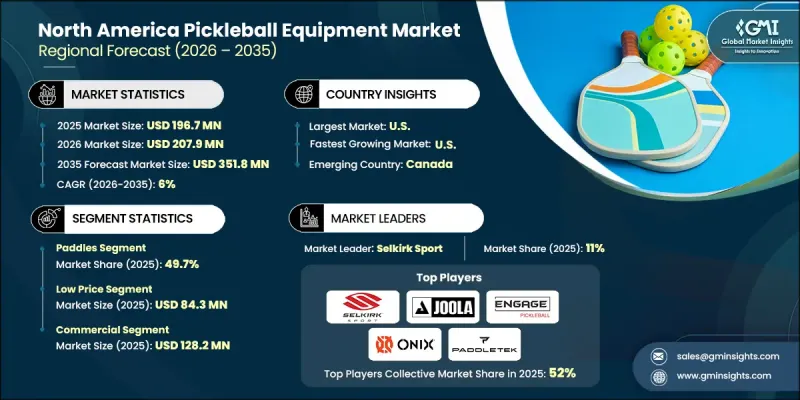
North America Pickleball Equipment Market was valued at USD 196.7 million in 2025 and is estimated to grow at a CAGR of 6% to reach USD 351.8 million by 2035.
The sport has evolved from a niche recreational activity into a mainstream fitness and social trend, attracting participants across age groups. Increasing awareness around active lifestyles and low-impact sports continues to support participation growth. The region remains a hub for product innovation, with manufacturers continuously enhancing paddles, balls, and accessories using advanced materials such as carbon fiber, graphite, and polymer cores. These improvements are enabling better control, power, and spin, elevating overall gameplay. Growing interest in sustainable product development is also influencing manufacturing trends. As participation increases and infrastructure expands, the North America pickleball equipment market continues to benefit from rising demand across both recreational and competitive segments, reinforcing its long-term growth trajectory.
| Market Scope | |
|---|---|
| Start Year | 2025 |
| Forecast Year | 2026-2035 |
| Start Value | $196.7 Million |
| Forecast Value | $351.8 Million |
| CAGR | 6% |
The paddles segment accounted for the 49.7% share, generating USD 97.8 million in 2025. This segment continues to lead due to its essential role in gameplay and the strong emphasis players place on equipment quality. Demand is supported by continuous advancements in paddle construction, evolving material technologies, and increasing consumer preference for performance-oriented products. A wide pricing spectrum, ranging from entry-level offerings below USD 50 to premium models exceeding USD 200, allows brands to target diverse customer segments. Frequent product upgrades and innovations in design, weight balance, and surface technology are encouraging repeat purchases as players refine their skills and seek enhanced performance.
The commercial segment captured USD 128.2 million in 2025. Growth in this segment is fueled by large-scale procurement from organizations investing in sports infrastructure and facility development. Bulk purchasing patterns significantly contribute to overall sales, as institutions require a consistent equipment supply for ongoing operations. The expansion of dedicated playing spaces and increased accessibility to sport continue to drive demand from this segment, strengthening its position within the overall market landscape.
United States Pickleball Equipment Market held a 78.9% share, generating USD 155.2 million in 2025. The country remains a key driver of innovation, particularly in high-performance equipment designed to meet professional standards. Strong demand for premium paddles and specialized balls continues to shape product development, with a focus on durability, precision, and advanced design features. Regulatory standards and certification requirements play a crucial role in influencing manufacturing practices and product offerings. A well-established retail ecosystem, including online platforms and specialty outlets, supports widespread product availability and consistent market growth throughout the year.
Key companies operating in the North America Pickleball Equipment Market include Selkirk Sport, JOOLA, Onix Pickleball, Paddle Tek, Engage Pickleball, Franklin Sports, Gamma Sports, Gearbox Sports, Vulcan Sporting Goods, Wilson Sporting Goods, Head NV, Diadem Sports, Prince Sports, ProKennex, and Vatic Pro. Companies in the North America Pickleball Equipment Market are strengthening their position by focusing on product innovation, strategic partnerships, and brand differentiation. They are investing in advanced materials and design technologies to enhance performance and durability. Many players are expanding their product portfolios to cater to both beginners and professional athletes, ensuring broader market reach. Collaborations with professional players and organizations are being used to build brand credibility and visibility. Firms are also enhancing their digital presence through e-commerce platforms and direct-to-consumer strategies. Sustainability initiatives, including eco-friendly materials and production processes, are gaining traction.
Table of Contents
Chapter 1 Methodology and Scope
- 1.1 Market scope and definition
- 1.2 Research design
- 1.2.1 Research approach
- 1.2.2 Data collection methods
- 1.3 Data mining sources
- 1.3.1 Regional
- 1.3.2 Regional/Country
- 1.4 Base estimates and calculations
- 1.4.1 Base year calculation
- 1.4.2 Key trends for market estimation
- 1.5 Primary research and validation
- 1.5.1 Primary sources
- 1.6 Forecast model
- 1.7 Research assumptions and limitations
Chapter 2 Executive Summary
- 2.1 Industry 360° synopsis
- 2.2 Key market trends
- 2.2.1 Regional
- 2.2.2 Product Type
- 2.2.3 Price
- 2.2.4 End Use
- 2.2.5 Distribution Channel
- 2.3 CXO perspectives: Strategic imperatives
- 2.3.1 Key decision points for industry executives
- 2.3.2 Critical success factors for market players
- 2.4 Future outlook and strategic recommendations
Chapter 3 Industry Insights
- 3.1 Industry ecosystem analysis
- 3.1.1 Supplier landscape
- 3.1.2 Profit margin
- 3.1.3 Value addition at each stage
- 3.1.4 Factor affecting the value chain
- 3.2 Industry impact forces
- 3.2.1 Growth drivers
- 3.2.1.1 Rapid expansion of dedicated pickleball facilities
- 3.2.1.2 Professional tour development and media coverage
- 3.2.1.3 Technological innovation in paddle construction
- 3.2.2 Industry pitfalls & challenges
- 3.2.2.1 Counterfeit and low-quality imported products
- 3.2.2.2 Regulatory changes and equipment certification
- 3.2.3 Opportunities
- 3.2.3.1 Expansion into underserved Canadian markets
- 3.2.3.2 Customization and personalization services
- 3.2.1 Growth drivers
- 3.3 Growth potential analysis
- 3.4 Future market trends
- 3.5 Technology and innovation landscape
- 3.5.1 Current technological trends
- 3.5.2 Emerging technologies
- 3.6 Pricing Analysis (Driven by Primary Research)
- 3.6.1 Historical Price Trend Analysis (Driven by Primary Research)
- 3.6.2 Pricing Strategy by Player Type (Premium / Value / Cost-Plus) (Driven by Primary Research)
- 3.7 Patent Landscape (Driven by Primary Research)
- 3.7.1 Patent Filing Trends by Technology Area
- 3.7.2 Key Patent Holders & IP Portfolio Analysis
- 3.7.3 Geographic Distribution of Patents
- 3.7.4 Emerging Technology Patents (Smart Tools, Material Innovations)
- 3.8 Regulatory landscape
- 3.8.1 Standards and compliance requirements
- 3.8.2 Regional regulatory frameworks
- 3.8.3 Certification standards
- 3.9 Porter's analysis
- 3.10 PESTEL analysis
- 3.11 Trade Data Analysis (Driven by Primary Research)
- 3.11.1 Import/Export Volume & Value Trends (Driven by Primary Research)
- 3.11.2 U.S.-China Trade Flows & Tariff Impact (Driven by Primary Research)
- 3.11.3 U.S.-Canada Cross-Border Trade Analysis
- 3.12 Impact of AI & Generative AI on the North America Market
- 3.12.1 AI-Driven Disruption of Existing Business Models
- 3.12.2 GenAI Use Cases & Adoption Roadmap by Segment
- 3.12.3 Risks, Limitations & Regulatory Considerations
- 3.13 Distribution Infrastructure & Channel Penetration Landscape (Driven by Primary Research)
- 3.13.1 Channel Coverage by U.S. & Canada (Modern vs. Traditional Trade) (Driven by Primary Research)
- 3.13.2 Last-Mile Infrastructure Gaps & Emerging Channel Shifts (Driven by Primary Research)
Chapter 4 Competitive Landscape, 2025
- 4.1 Introduction
- 4.2 Company market share analysis
- 4.2.1 By Country
- 4.2.1.1 U.S.
- 4.2.1.2 Canada
- 4.2.1 By Country
- 4.3 Company matrix analysis
- 4.4 Competitive analysis of major market players
- 4.5 Competitive positioning matrix
- 4.6 Key developments
- 4.6.1 Mergers & acquisitions
- 4.6.2 Partnerships & collaborations
- 4.6.3 New product launches
- 4.6.4 Expansion plans
Chapter 5 Market Estimates & Forecast, By Product Type, 2022 - 2035
- 5.1 Key trends
- 5.2 Balls
- 5.3 Paddles
- 5.4 Accessories
- 5.4.1 Practice Net
- 5.4.2 Net Weights
- 5.4.3 Teaching Cart
- 5.4.4 Portable Cart
- 5.4.5 Others (Replacement Net, etc.)
- 5.5 Others (Posts)
Chapter 6 Market Estimates & Forecast, By Price, 2022 - 2035
- 6.1 Key trends
- 6.2 Low
- 6.3 Medium
- 6.4 High
Chapter 7 Market Estimates & Forecast, By End User, 2022 - 2035
- 7.1 Key trends
- 7.2 Individual
- 7.3 Commercial
Chapter 8 Market Estimates & Forecast, By Distribution Channel, 2022 - 2035
- 8.1 Key trends
- 8.2 Online
- 8.2.1 E-Commerce
- 8.2.2 Company Site
- 8.3 Offline
- 8.3.1 Specialty Stores
- 8.3.2 Sports Retailers
- 8.3.3 Others (Departmental Stores, etc.)
Chapter 9 Market Estimates and Forecast, By Country, 2022 - 2035
- 9.1 Key trends
- 9.2 U.S.
- 9.3 Canada
Chapter 10 Company Profiles
- 10.1 Selkirk Sport
- 10.2 JOOLA
- 10.3 Onix Pickleball
- 10.4 Paddle Tek
- 10.5 Engage Pickleball
- 10.6 Franklin Sports
- 10.7 Gamma Sports
- 10.8 Gearbox Sports
- 10.9 Vulcan Sporting Goods
- 10.10 Wilson Sporting Goods
- 10.11 Head NV
- 10.12 Diadem Sports
- 10.13 Prince Sports
- 10.14 ProKennex
- 10.15 Vatic Pro

