
PUBLISHER: Global Market Insights Inc. | PRODUCT CODE: 2019044

PUBLISHER: Global Market Insights Inc. | PRODUCT CODE: 2019044
Asia Pacific VR Headsets Market Opportunity, Growth Drivers, Industry Trend Analysis, and Forecast 2026 - 2035
Asia Pacific VR Headsets Market was valued at USD 2.3 billion in 2025 and is estimated to grow at a CAGR of 15.7% to reach USD 10.4 billion by 2035.
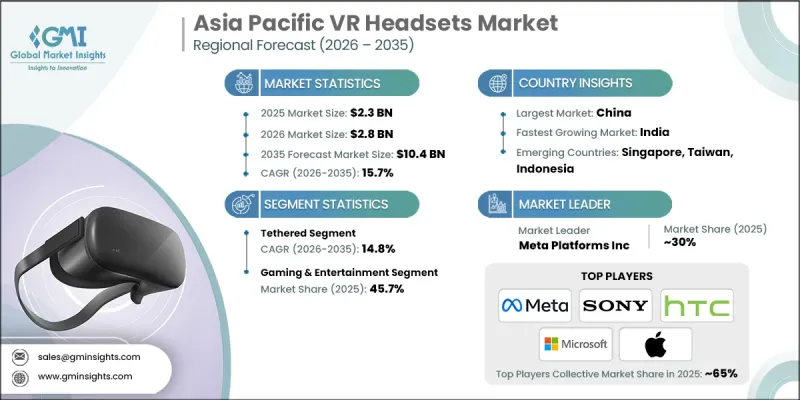
The region continues to emerge as a major contributor to global virtual reality growth, fueled by increasing investments in immersive technologies and supportive policy frameworks that encourage innovation. Rising consumer interest in interactive digital experiences, combined with expanding access to high-speed internet, is accelerating product adoption. The integration of VR headsets with digital entertainment ecosystems is further enhancing user engagement. Growing participation in immersive gaming environments and virtual experiences is reshaping how consumers interact with content. Favorable demographic patterns, improving digital literacy, and increasing disposable income levels in developing economies are further strengthening market demand. Additionally, continuous advancements in hardware capabilities and user experience are making VR technology more accessible and appealing across a wide range of applications, reinforcing long-term market growth.
| Market Scope | |
|---|---|
| Start Year | 2025 |
| Forecast Year | 2026-2035 |
| Start Value | $2.3 Billion |
| Forecast Value | $10.4 Billion |
| CAGR | 15.7% |
The tethered segment generated USD 1.4 billion in 2025 and is expected to grow at a CAGR of 14.8% between 2026 and 2035. This segment maintains a strong position in the Asia Pacific VR headsets market due to its ability to deliver high-performance experiences. These systems rely on external computing devices to handle processing functions, enabling enhanced graphical output, improved resolution, and smoother performance. Their capability to support advanced simulations and immersive environments continues to drive adoption among users seeking superior quality and reliability.
The gaming and entertainment segment accounted for 45.7% share in 2025 and is anticipated to grow at a CAGR of 14.1% through 2035. This segment represents a significant portion of demand, driven by widespread consumer interest in immersive and interactive digital content. Applications span a broad range of experiences, contributing to increased engagement and user retention. The strong presence of the gaming industry across the Asia Pacific continues to play a key role in supporting VR content development and accelerating adoption across the region.
China VR Headsets Market was valued at USD 1.2 billion in 2025 and is expected to grow at a CAGR of 15.5% from 2026 to 2035. Market growth in China is supported by its large consumer base, strong manufacturing ecosystem, and increasing focus on digital transformation. Continued investments in advanced network infrastructure and immersive technologies are reinforcing market expansion. Policy support and strategic prioritization of emerging technologies are further strengthening the country's position. The presence of both international and domestic manufacturers enhances product availability and competitiveness, enabling sustained growth within the regional market.
Key companies operating in the Asia Pacific VR Headsets Market include Meta Platforms, Inc., Apple, ByteDance Ltd, Sony Corporation, Samsung Electronics Co., Ltd., Microsoft Corporation, Google LLC, HTC Corporation, Lenovo Group Limited, HP Inc., Magic Leap, Inc., Valve Corporation, Xiaomi Corporation, Razer Inc., and Pimax Technology (Shanghai) Co., Ltd. Companies in the Asia Pacific VR Headsets Market are focusing on continuous innovation and ecosystem development to strengthen their market position. They are investing heavily in research and development to enhance hardware performance, improve user comfort, and deliver more immersive experiences. Strategic partnerships with content developers are being prioritized to expand application areas and drive user engagement. Many firms are also adopting competitive pricing strategies to penetrate emerging markets and increase accessibility. Expanding distribution networks and strengthening online sales channels are key priorities to reach a broader consumer base. Additionally, companies are leveraging advancements in connectivity and software integration to optimize device functionality and maintain a competitive advantage in the evolving market landscape.
Table of Contents
Chapter 1 Methodology & Scope
- 1.1 Market scope and definition
- 1.2 Research design
- 1.2.1 Research approach
- 1.2.2 Data collection methods
- 1.3 Data mining sources
- 1.3.1 Global
- 1.3.2 Regional/Country
- 1.4 Base estimates and calculations
- 1.4.1 Base year calculation
- 1.4.2 Key trends for market estimation
- 1.5 Primary research and validation
- 1.5.1 Primary sources
- 1.6 Forecast model
- 1.7 Research assumptions and limitations
Chapter 2 Executive Summary
- 2.1 Industry 360° synopsis
- 2.2 Key market trends
- 2.2.1 Regional
- 2.2.2 Type
- 2.2.3 Component
- 2.2.4 Operating system
- 2.2.5 Connectivity technology
- 2.2.6 Application
- 2.2.7 Distribution channel
Chapter 3 Industry Insights
- 3.1 Industry ecosystem analysis
- 3.1.1 Supplier landscape
- 3.1.2 Profit margin analysis
- 3.1.3 Value addition at each stage
- 3.1.4 Factor affecting the value chain
- 3.2 Industry impact forces
- 3.2.1 Growth drivers
- 3.2.1.1 Advancements in immersive technology
- 3.2.1.2 Expanding 5G network
- 3.2.1.3 Expanding gaming and entertainment content systems
- 3.2.2 Industry pitfalls & challenges
- 3.2.2.1 High initial investment
- 3.2.2.2 Health and safety concerns
- 3.2.1 Growth drivers
- 3.3 Growth potential analysis
- 3.4 Future market trends
- 3.5 Technology and innovation landscape
- 3.5.1 Current technological trends
- 3.5.2 Emerging technologies
- 3.6 Price trends
- 3.6.1 By region
- 3.6.2 By type
- 3.7 Regulatory landscape
- 3.7.1 Standards and compliance requirements
- 3.7.2 Regional regulatory frameworks
- 3.7.3 Certification standards
- 3.8 Porter's analysis
- 3.9 PESTEL analysis
- 3.10 Consumer behavior analysis
- 3.10.1 Purchasing patterns
- 3.10.2 Preference analysis
- 3.10.3 Regional variations in consumer behavior
Chapter 4 Competitive Landscape, 2025
- 4.1 Introduction
- 4.2 Company market share analysis
- 4.3 Company matrix analysis
- 4.4 Competitive analysis of major market players
- 4.5 Competitive positioning matrix
- 4.6 Key developments
- 4.6.1 Mergers & acquisitions
- 4.6.2 Partnerships & collaborations
- 4.6.3 New product launches
- 4.6.4 Expansion plans
Chapter 5 Market Estimates & Forecast, By Type, 2022 - 2035, (USD Billion) (Units)
- 5.1 Key trends
- 5.2 Tethered
- 5.3 Standalone
- 5.4 Mixed reality
Chapter 6 Market Estimates & Forecast, By Component, 2022 - 2035, (USD Billion) (Units)
- 6.1 Key trends
- 6.2 Hardware
- 6.3 Software
Chapter 7 Market Estimates & Forecast, By Operating System, 2022 - 2035, (USD Billion) (Units)
- 7.1 Key trends
- 7.2 Windows
- 7.3 iOS
- 7.4 Android
Chapter 8 Market Estimates & Forecast, By Connectivity Technology, 2022 - 2035, (USD Billion) (Units)
- 8.1 Key trends
- 8.2 Bluetooth
- 8.3 HDMI
- 8.4 Wi-Fi
- 8.5 Others
Chapter 9 Market Estimates & Forecast, By Application, 2022 - 2035, (USD Billion) (Units)
- 9.1 Key trends
- 9.2 Gaming & entertainment
- 9.3 Education
- 9.4 Healthcare
- 9.5 Retail & e-commerce
- 9.6 Military & defense
- 9.7 Engineering & design
- 9.8 Others
Chapter 10 Market Estimates & Forecast, By Distribution Channel, 2022 - 2035, (USD Billion) (Units)
- 10.1 Key trends
- 10.2 Online
- 10.2.1 E-commerce websites
- 10.2.2 Company websites
- 10.3 Offline
- 10.3.1 Supermarkets & department stores
- 10.3.2 Specialty stores
- 10.3.3 Others
Chapter 11 Market Estimates & Forecast, By Region, 2022 - 2035, (USD Billion) (Units)
- 11.1 Key trends
- 11.2 Asia Pacific
- 11.2.1 China
- 11.2.2 India
- 11.2.3 Japan
- 11.2.4 South Korea
- 11.2.5 Australia
- 11.2.6 Indonesia
- 11.2.7 Taiwan
- 11.2.8 Singapore
- 11.2.9 Thailand
- 11.2.10 Rest of Asia Pacific
Chapter 12 Company Profiles
- 12.1 Apple
- 12.2 ByteDance Ltd
- 12.3 Google LLC
- 12.4 HP Inc.
- 12.5 HTC Corporation
- 12.6 Lenovo Group Limited
- 12.7 Magic Leap, Inc.
- 12.8 Meta Platforms, Inc.
- 12.9 Microsoft Corporation
- 12.10 Pimax Technology (Shanghai) Co., Ltd.
- 12.11 Razer Inc.
- 12.12 Samsung Electronics Co., Ltd.
- 12.13 Sony Corporation
- 12.14 Valve Corporation
- 12.15 Xiaomi Corporation

