PUBLISHER: Global Market Insights Inc. | PRODUCT CODE: 2019048

PUBLISHER: Global Market Insights Inc. | PRODUCT CODE: 2019048
Nylon Monofilament Market Opportunity, Growth Drivers, Industry Trend Analysis, and Forecast 2026 - 2035
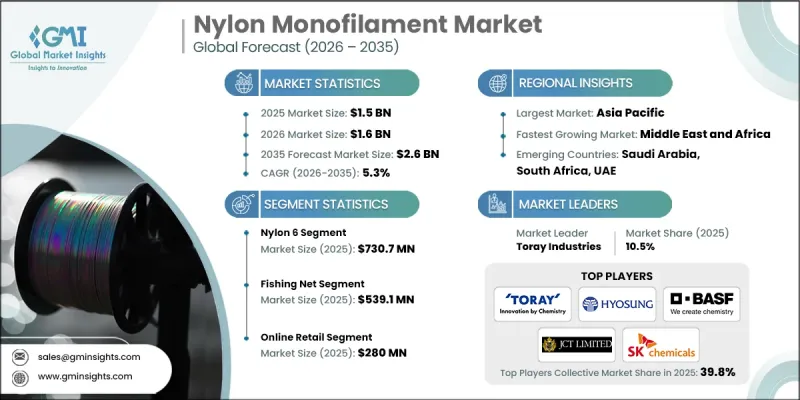
The Global Nylon Monofilament Market was valued at USD 1.5 billion in 2025 and is estimated to grow at a CAGR of 5.3% to reach USD 2.6 billion by 2035.
The nylon monofilament market focuses on the manufacturing and application of single-strand synthetic fibers derived from nylon-based polymers. These filaments are characterized by uniform diameter, smooth texture, and strong mechanical properties, including high tensile strength, flexibility, and resistance to abrasion. Advanced extrusion techniques are used to ensure consistent quality and long service life across various end uses. The versatility of nylon monofilaments allows them to meet a wide range of industrial and commercial requirements, as processing conditions can be adjusted to achieve specific material properties such as rigidity, elasticity, or chemical resistance. Continuous demand from industries that rely on durable and high-performance filament materials is supporting steady market growth. In addition, technological advancements are playing a crucial role in shaping the nylon monofilament market, with manufacturers adopting improved extrusion systems, precise diameter control, and enhanced cooling technologies to optimize production efficiency and minimize material waste while maintaining superior product performance.
| Market Scope | |
|---|---|
| Start Year | 2025 |
| Forecast Year | 2026-2035 |
| Start Value | $1.5 Billion |
| Forecast Value | $2.6 Billion |
| CAGR | 5.3% |
The nylon 6 segment reached USD 730.7 million in 2025. Its widespread adoption is driven by a balanced combination of mechanical performance, ease of processing, and cost-effectiveness, making it a preferred material across multiple applications. Nylon 6 offers flexibility and a smooth surface finish, which enhances its usability in applications requiring consistent performance. On the other hand, Nylon 66 is increasingly utilized in environments that demand higher thermal resistance, structural strength, and dimensional stability. Its ability to maintain performance under varying temperature and stress conditions makes it suitable for more demanding technical and industrial applications, thereby supporting its growing presence within the market.
The fishing net segment captured USD 539.1 million in 2025. Demand across this segment remains steady due to the need for materials that offer durability, strength, and long-term performance. Nylon monofilaments are widely used in applications that require a combination of flexibility and load-bearing capacity, as well as consistent structural integrity. Their smooth surface and uniform thickness also make them suitable for applications that require precision and reliability. In addition, continued demand from industrial, household, and maintenance-related uses is contributing to overall market stability, as these sectors rely on materials that can withstand wear and maintain performance over extended periods.
North America Nylon Monofilament Market is expected to grow from USD 376.2 million in 2025 to USD 610 million by 2035, supported by consistent demand across industrial, technical, and maintenance applications, where reliable material performance is essential. Growth is driven more by ongoing replacement cycles and sustained operational needs rather than rapid capacity expansion. In the United States, demand remains stable due to established quality standards, regulated specifications, and continuous improvements in processing and recycling technologies. Companies operating in the region are prioritizing performance consistency and material reliability to meet industry-specific requirements, further supporting the long-term development of the nylon monofilament market.
Key companies operating in the Global Nylon Monofilament Market include Toray Industries, Hyosung, JCT Limited, SK Chemicals, Suzhou Hanyun New Material Technology Co, BASF SE, Solvay, Nurel, Contifibre, AdvanSix, and NYCOA. Companies in the Nylon Monofilament Market are focusing on enhancing product quality and expanding their application scope to strengthen their competitive position. Investments in advanced manufacturing technologies are enabling improved precision, consistency, and production efficiency. Many players are prioritizing research and development to create materials with enhanced durability, flexibility, and resistance properties. Strategic collaborations and partnerships help companies access new markets and diversify their product offerings. Additionally, firms are emphasizing sustainable practices, including recycling and waste reduction, to align with evolving environmental regulations. Expanding distribution networks and maintaining strict quality standards are also key strategies supporting long-term growth and stronger market presence.
Table of Contents
Chapter 1 Methodology & Scope
- 1.1 Market scope and definition
- 1.2 Research design
- 1.2.1 Research approach
- 1.2.2 Data collection methods
- 1.3 Data mining sources
- 1.3.1 Global
- 1.3.2 Regional/Country
- 1.4 Base estimates and calculations
- 1.4.1 Base year calculation
- 1.4.2 Key trends for market estimation
- 1.5 Primary research and validation
- 1.5.1 Primary sources
- 1.6 Forecast model
- 1.7 Research assumptions and limitations
Chapter 2 Executive Summary
- 2.1 Industry 360° synopsis
- 2.2 Key market trends
- 2.2.1 Type
- 2.2.2 Application
- 2.2.3 Distribution Channel
- 2.2.4 Regional
- 2.3 TAM Analysis, 2026-2035
- 2.4 CXO perspectives: Strategic imperatives
- 2.5 Future outlook and strategic recommendations
Chapter 3 Industry Insights
- 3.1 Industry ecosystem analysis
- 3.1.1 Supplier landscape
- 3.1.2 Profit margin
- 3.1.3 Value addition at each stage
- 3.1.4 Factor affecting the value chain
- 3.1.5 Disruptions
- 3.2 Industry impact forces
- 3.2.1 Growth drivers
- 3.2.1.1 Rising demand from fishing and industrial applications
- 3.2.1.2 Consistent performance needs across textile and mechanical uses
- 3.2.1.3 Availability of nylon grades for diverse conditions
- 3.2.2 Pitfalls/challenge
- 3.2.2.1 Sensitivity of nylon properties to temperature variations during
- 3.2.2.2 Fluctuating raw material prices
- 3.2.3 Opportunities
- 3.2.3.1 Development of recyclable nylon monofilament materials
- 3.2.3.2 Customization for niche industrial and technical applications
- 3.2.1 Growth drivers
- 3.3 Growth potential analysis
- 3.4 Regulatory landscape
- 3.4.1 North America
- 3.4.2 Europe
- 3.4.3 Asia Pacific
- 3.4.4 Latin America
- 3.4.5 Middle East & Africa
- 3.5 Porter's analysis
- 3.6 PESTEL analysis
- 3.7 Technology and innovation landscape
- 3.7.1 Current technological trends
- 3.7.2 Emerging technologies
- 3.8 Price trends
- 3.8.1 By region
- 3.8.2 By type
- 3.9 Future market trends
- 3.10 Patent landscape
- 3.11 Trade statistics (HS code)
- 3.11.1 Major importing countries
- 3.11.2 Major exporting countries
- 3.12 Sustainability and environmental aspects
- 3.12.1 Sustainable practices
- 3.12.2 Waste reduction strategies
- 3.12.3 Energy efficiency in production
- 3.12.4 Eco-friendly initiatives
- 3.13 Carbon footprint consideration
Chapter 4 Competitive Landscape, 2025
- 4.1 Introduction
- 4.2 Company market share analysis
- 4.2.1 By region
- 4.2.1.1 North America
- 4.2.1.2 Europe
- 4.2.1.3 Asia Pacific
- 4.2.1.4 LATAM
- 4.2.1.5 MEA
- 4.2.1 By region
- 4.3 Company matrix analysis
- 4.4 Competitive analysis of major market players
- 4.5 Competitive positioning matrix
- 4.6 Key developments
- 4.6.1 Mergers & acquisitions
- 4.6.2 Partnerships & collaborations
- 4.6.3 New product launches
- 4.6.4 Expansion plans
Chapter 5 Market Estimates and Forecast, By Type, 2022-2035 (USD Million) (Kilo Tons)
- 5.1 Key trends
- 5.2 Nylon 6
- 5.3 Nylon 66
- 5.4 Others (Nylon 6 10, Nylon 6 12, Nylon 11, and Nylon 12, etc.)
Chapter 6 Market Estimates and Forecast, By Application, 2022-2035 (USD Million) (Kilo Tons)
- 6.1 Key trends
- 6.2 Fishing nets
- 6.3 Medical devices
- 6.4 Sewing threads
- 6.5 Brushes
- 6.6 Sports equipment
- 6.7 Other (Ropes, Crop support nets, etc.)
Chapter 7 Market Estimates and Forecast, By Distribution Channel, 2022-2035 (USD Million) (Kilo Tons)
- 7.1 Key trends
- 7.2 Online retail
- 7.3 Offline retail
Chapter 8 Market Estimates and Forecast, By Region, 2022-2035 (USD Million) (Kilo Tons)
- 8.1 Key trends
- 8.2 North America
- 8.2.1 U.S.
- 8.2.2 Canada
- 8.3 Europe
- 8.3.1 Germany
- 8.3.2 UK
- 8.3.3 France
- 8.3.4 Spain
- 8.3.5 Italy
- 8.3.6 Rest of Europe
- 8.4 Asia Pacific
- 8.4.1 China
- 8.4.2 India
- 8.4.3 Japan
- 8.4.4 Australia
- 8.4.5 South Korea
- 8.4.6 Rest of Asia Pacific
- 8.5 Latin America
- 8.5.1 Brazil
- 8.5.2 Mexico
- 8.5.3 Argentina
- 8.5.4 Rest of Latin America
- 8.6 Middle East and Africa
- 8.6.1 Saudi Arabia
- 8.6.2 South Africa
- 8.6.3 UAE
- 8.6.4 Rest of Middle East and Africa
Chapter 9 Company Profiles
- 9.1 Toray Industries
- 9.2 Hyosung
- 9.3 JCT Limited
- 9.4 Shakespeare Company, LLC.
- 9.5 Suzhou Hanyun New Material Technology Co
- 9.6 BASF SE
- 9.7 Solvay
- 9.8 Nurel
- 9.9 Contifibre
- 9.10 AdvanSix
- 9.11 NYCOA

