
PUBLISHER: Global Market Insights Inc. | PRODUCT CODE: 2019049

PUBLISHER: Global Market Insights Inc. | PRODUCT CODE: 2019049
Peanut Oil Market Opportunity, Growth Drivers, Industry Trend Analysis, and Forecast 2026 - 2035
The Global Peanut Oil Market was valued at USD 11.5 billion in 2025 and is estimated to grow at a CAGR of 3.5% to reach USD 16.2 billion by 2035.
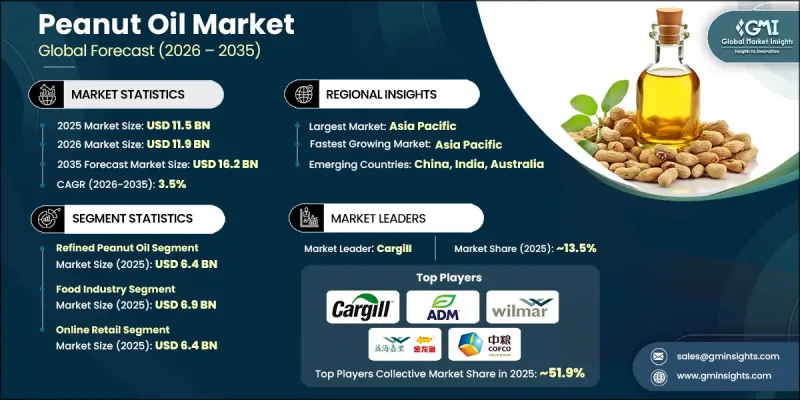
The peanut oil market continues to evolve as consumer demand for edible oils aligns with everyday cooking habits and established dietary preferences, particularly in regions where peanut cultivation is widely practiced. Consistent demand from both residential consumption and foodservice channels is supporting steady market expansion, as households increasingly allocate spending toward packaged cooking oils. The product remains widely utilized due to its suitability for high-temperature cooking, along with its balanced flavor profile that complements diverse culinary applications. Shifting consumer preferences toward plant-based oils are further reinforcing demand. At the same time, increasing awareness around nutritional intake is influencing purchasing behavior, as consumers seek oils that contribute to a balanced diet. Peanut oil contains beneficial fat compositions that align with these expectations, making it a preferred option among health-conscious buyers. Additionally, the presence of naturally occurring antioxidants supports its positioning in premium product categories. On the supply side, market performance continues to depend on agricultural output, farming practices, and fluctuations in raw material pricing, all of which shape overall production dynamics within the peanut oil market.
| Market Scope | |
|---|---|
| Start Year | 2025 |
| Forecast Year | 2026-2035 |
| Start Value | $11.5 Billion |
| Forecast Value | $16.2 Billion |
| CAGR | 3.5% |
The refined peanut oil segment reached USD 6.4 billion in 2025 and is projected to grow at a CAGR of 3.6% from 2026 to 2035. Growth in this segment is supported by its widespread acceptance across both household and commercial applications, primarily due to its neutral flavor, clear appearance, and high heat tolerance. Refined variants are widely preferred for their consistency and adaptability in various cooking methods. At the same time, unrefined peanut oil continues to maintain demand in specific culinary practices where natural aroma and flavor are essential. Blended peanut oils are gaining traction as they offer a balance between cost efficiency and functional performance by combining multiple oil types. Meanwhile, cold-pressed peanut oil is benefiting from increasing consumer interest in minimally processed products, with buyers showing a growing inclination toward traditional extraction methods and premium-quality oils.
The online retail segment accounted for USD 6.4 billion in 2025, representing a 55.4% share, and is expected to grow at a CAGR of 3.7% through 2035. Digital sales channels are expanding steadily as consumers value convenience, wider product selection, and easy access to branded and specialty offerings. E-commerce platforms are enabling manufacturers to reach a broader customer base while providing detailed product information and competitive pricing. Despite this shift, offline distribution channels continue to play a significant role, as physical retail outlets support routine purchasing behavior and ensure product availability. Bulk demand is also supported by foodservice operations, which require consistent supply volumes. Additional distribution channels contribute to market expansion by facilitating institutional procurement and direct sourcing arrangements, thereby strengthening overall market accessibility.
North America Peanut Oil Market was valued at USD 2.8 billion in 2025. The regional peanut oil market demonstrates stable consumption patterns supported by established agricultural production and processing capabilities. A well-developed supply chain ensures consistent availability for both retail and commercial applications. Market growth is further supported by evolving consumer preferences toward high-quality and transparently sourced food products. Demand is also influenced by the increasing popularity of refined and blended oil variants that cater to modern cooking needs. Expanding retail infrastructure and foodservice activities continue to reinforce consumption trends across the region, contributing to sustained market development.
Key companies operating in the Global Peanut Oil Market include Cargill, Archer Daniels Midland (ADM), Wilmar International, Yihai Kerry (Arawana), COFCO Corporation, Adani Wilmar (Fortune), Shandong Luhua Group, Louis Dreyfus Company, Patanjali Foods, KS Oils Limited, Lorenzati Ruetsch, Oleos Mazola, and SONACOS. Companies in the peanut oil market are focusing on expanding their production capabilities and strengthening supply chain networks to ensure consistent product availability. Investment in advanced processing technologies is helping improve product quality, shelf life, and efficiency. Many players are diversifying their product portfolios by offering refined, blended, and premium variants to cater to different consumer segments. Strategic partnerships and distribution agreements are being used to enhance market reach across both online and offline channels. In addition, companies are emphasizing branding and packaging innovations to attract health-conscious consumers.
Table of Contents
Chapter 1 Methodology
- 1.1 Market scope and definition
- 1.2 Research design
- 1.2.1 Research approach
- 1.2.2 Data collection methods
- 1.3 Data mining sources
- 1.3.1 Global
- 1.3.2 Regional/Country
- 1.4 Base estimates and calculations
- 1.4.1 Base year calculation
- 1.4.2 Key trends for market estimation
- 1.5 Primary research and validation
- 1.5.1 Primary sources
- 1.6 Forecast model
- 1.7 Research assumptions and limitations
Chapter 2 Executive Summary
- 2.1 Industry 360° synopsis
- 2.2 Key market trends
- 2.2.1 Regional
- 2.2.2 Type
- 2.2.3 Application
- 2.2.4 Distribution Channel
- 2.3 TAM Analysis, 2026-2035
- 2.4 CXO perspectives: Strategic imperatives
Chapter 3 Industry Insights
- 3.1 Industry ecosystem analysis
- 3.1.1 Supplier Landscape
- 3.1.2 Profit Margin
- 3.1.3 Value addition at each stage
- 3.1.4 Factor affecting the value chain
- 3.1.5 Disruptions
- 3.2 Industry impact forces
- 3.2.1 Growth drivers
- 3.2.2 Industry pitfalls and challenges
- 3.2.3 Market opportunities
- 3.3 Growth potential analysis
- 3.4 Regulatory landscape
- 3.4.1 North America
- 3.4.2 Europe
- 3.4.3 Asia Pacific
- 3.4.4 Latin America
- 3.4.5 Middle East & Africa
- 3.5 Porter's analysis
- 3.6 PESTEL analysis
- 3.7 Price trends
- 3.7.1 By region
- 3.7.2 By product
- 3.8 Future market trends
- 3.9 Technology and Innovation landscape
- 3.9.1 Current technological trends
- 3.9.2 Emerging technologies
- 3.10 Patent Landscape
- 3.11 Trade statistics
- 3.11.1 Major importing countries
- 3.11.2 Major exporting countries
- 3.12 Sustainability and Environmental Aspects
- 3.12.1 Sustainable Practices
- 3.12.2 Waste Reduction Strategies
- 3.12.3 Energy Efficiency in Production
- 3.12.4 Eco-friendly Initiatives
- 3.13 Carbon Footprint Considerations
Chapter 4 Competitive Landscape, 2025
- 4.1 Introduction
- 4.2 Company market share analysis
- 4.2.1 By region
- 4.2.1.1 North America
- 4.2.1.2 Europe
- 4.2.1.3 Asia Pacific
- 4.2.1.4 LATAM
- 4.2.1.5 MEA
- 4.2.1 By region
- 4.3 Company matrix analysis
- 4.4 Competitive analysis of major market players
- 4.5 Competitive positioning matrix
- 4.6 Key developments
- 4.6.1 Mergers & acquisitions
- 4.6.2 Partnerships & collaborations
- 4.6.3 New Product Launches
- 4.6.4 Expansion Plans
Chapter 5 Market Estimates and Forecast, By Type, 2022- 2035 (USD Billion, Kilo Tons)
- 5.1 Key trends
- 5.2 Refined Peanut Oil
- 5.2.1 Fully refined peanut oil
- 5.2.2 Light refined peanut oil
- 5.2.3 Deodorized peanut oil
- 5.3 Unrefined Peanut Oil
- 5.3.1 Traditional expeller-pressed oil
- 5.3.2 Filtered unrefined oil
- 5.3.3 Unfiltered artisan oil
- 5.4 Peanut Oil Blends
- 5.4.1 Peanut-sunflower oil blends
- 5.4.2 Peanut-soybean oil blends
- 5.4.3 Multi-vegetable oil blends
- 5.5 Cold-Pressed
- 5.5.1 Organic cold-pressed peanut oil
- 5.5.2 Conventional cold-pressed peanut oil
- 5.5.3 Premium small-batch oils
Chapter 6 Market Estimates and Forecast, By Application, 2022 - 2035 (USD Billion, Kilo Tons)
- 6.1 Key trends
- 6.2 Food Industry
- 6.2.1 Household cooking
- 6.2.2 Packaged snacks
- 6.2.3 Bakery and confectionery
- 6.3 Cosmetics and Personal Care
- 6.3.1 Skin care products
- 6.3.2 Hair care formulations
- 6.3.3 Massage oils
- 6.3.4 Soaps and creams
- 6.4 Industrial Applications
- 6.4.1 Lubricants
- 6.4.2 Coatings and resins
- 6.4.3 Processing aids
- 6.5 Others
Chapter 7 Market Estimates and Forecast, By Distribution Channel, 2022 - 2035 (USD Billion, Kilo Tons)
- 7.1 Key trends
- 7.2 Online Retail
- 7.2.1 Company-owned websites
- 7.2.2 Third-party e-commerce platforms
- 7.2.3 Direct-to-consumer sales
- 7.3 Offline Retail
- 7.3.1 Supermarkets and hypermarkets
- 7.3.2 Convenience stores
- 7.3.3 Specialty food stores
- 7.4 Food Service
- 7.4.1 Restaurants
- 7.4.2 Catering services
- 7.4.3 Street food vendors
- 7.4.4 Cloud kitchens
- 7.5 Others
Chapter 8 Market Estimates and Forecast, By Region, 2022 - 2035 (USD Billion, Kilo Tons)
- 8.1 Key trends
- 8.2 North America
- 8.2.1 U.S.
- 8.2.2 Canada
- 8.3 Europe
- 8.3.1 Germany
- 8.3.2 UK
- 8.3.3 France
- 8.3.4 Italy
- 8.3.5 Spain
- 8.3.6 Rest of Europe
- 8.4 Asia Pacific
- 8.4.1 China
- 8.4.2 India
- 8.4.3 Japan
- 8.4.4 Australia
- 8.4.5 South Korea
- 8.4.6 Rest of Asia Pacific
- 8.5 Latin America
- 8.5.1 Brazil
- 8.5.2 Mexico
- 8.5.3 Argentina
- 8.5.4 Rest of Latin America
- 8.6 Middle East & Africa
- 8.6.1 Saudi Arabia
- 8.6.2 South Africa
- 8.6.3 UAE
- 8.6.4 Rest of Middle East & Africa
Chapter 9 Company Profiles
- 9.1 Cargill
- 9.2 Archer Daniels Midland (ADM)
- 9.3 Wilmar International
- 9.4 Yihai Kerry (Arawana)
- 9.5 COFCO Corporation
- 9.6 Adani Wilmar (Fortune)
- 9.7 Shandong Luhua Group
- 9.8 Louis Dreyfus Company
- 9.9 Patanjali Foods
- 9.10 KS Oils Limited
- 9.11 Lorenzati Ruetsch
- 9.12 Oleos Mazola
- 9.13 SONACOS

