PUBLISHER: Global Market Insights Inc. | PRODUCT CODE: 2019052

PUBLISHER: Global Market Insights Inc. | PRODUCT CODE: 2019052
Fish Sauce Market Opportunity, Growth Drivers, Industry Trend Analysis, and Forecast 2026 - 2035
The Global Fish Sauce Market was valued at USD 3.1 billion in 2025 and is estimated to grow at a CAGR of 5.3% to reach USD 5.1 billion by 2035.
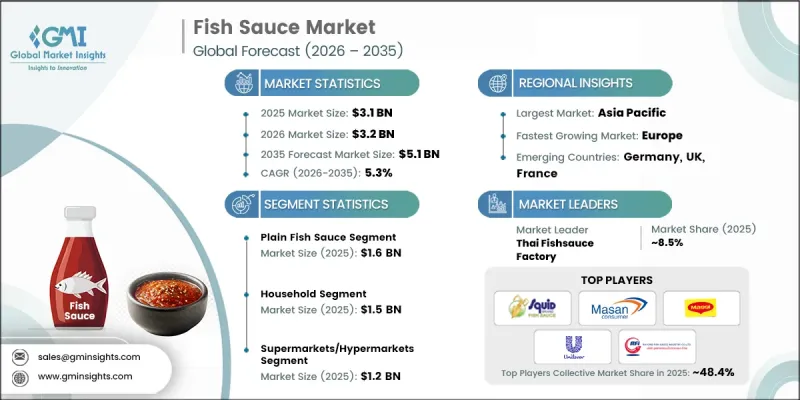
Market expansion is fueled by the growing international popularity of Southeast Asian cuisines, including Thai, Vietnamese, and Filipino dishes. Increasing numbers of global restaurants, quick-service outlets, and fusion dining concepts are creating higher demand for authentic flavoring ingredients. Fish sauce remains a core condiment in traditional recipes, marinades, and dipping sauces, supporting consistent market growth. Additionally, the processed food industry is increasingly incorporating fish sauce into ready-to-eat meals, packaged foods, seasoning blends, and sauces to deliver natural umami flavor, further driving demand. Rising consumer preference for natural and traditionally fermented condiments also contributes to market expansion, as fermentation is recognized for both flavor enhancement and potential health benefits. Convenience foods and industrial food production continue to strengthen the need for fish sauce as a reliable ingredient across multiple applications.
| Market Scope | |
|---|---|
| Start Year | 2025 |
| Forecast Year | 2026-2035 |
| Start Value | $3.1 Billion |
| Forecast Value | $5.1 Billion |
| CAGR | 5.3% |
The plain fish sauce segment generated USD 1.6 billion in 2025. Retail and foodservice sectors are witnessing heightened demand for unique, ready-to-use variants that cater to contemporary cooking trends and international cuisines. Product innovation is increasingly shaped by premiumization and health-focused development, with manufacturers launching value-added lines containing specialty ingredients and enhanced nutritional profiles. Wider availability through supermarkets, specialty stores, and online platforms is expanding market reach while attracting niche customer segments and supporting international expansion.
The household segment captured USD 1.5 billion in 2025, reflecting the condiment's broad culinary application. Fish sauce remains an essential ingredient in restaurants, home kitchens, and commercial food preparation for cooking, marinating, and sauce-making. The rising popularity of Asian cuisine, combined with modern cooking techniques that emphasize umami flavors, is driving higher adoption across households and dining establishments alike.
North America Fish Sauce Market accounted for USD 549 million in 2025. Rising consumer interest in international and fermented flavors is boosting fish sauce adoption in both home cooking and commercial kitchens. Its accessibility through supermarkets, specialty Asian stores, and e-commerce channels ensures consistent demand. Manufacturers are increasingly using fish sauce to enhance umami profiles in marinades, sauces, and ready-to-eat products, while the expansion of Asian restaurants and growing at-home cooking trends provide additional market opportunities throughout the region.
Key players operating in the Global Fish Sauce Market include Masan Consumer Corporation, Ogawa & Co., Ltd., Red Boat Fish Sauce, Teo Tak Seng Fish Sauce Factory, Nestle (Maggi Fish Sauce), Ocean's Halo (Plant-based), Kimlan Foods, Unilever PLC, Rungroj Fish Sauce Co., Ltd., Thai Fishsauce Factory, Roland Foods, Thaipreeda Group, Sozye, and Rayong Fish Sauce Industry Co. Ltd. Companies in the Fish Sauce Market are strengthening their presence by focusing on product innovation, premiumization, and sustainable sourcing. Firms are investing in R&D to develop health-focused and value-added product lines while enhancing traditional fermentation processes for superior taste. Expanding distribution through retail, online channels, and international markets ensures a wider reach. Strategic partnerships with foodservice operators and restaurants help boost brand visibility and adoption. Companies are also optimizing supply chains to maintain consistent quality and reliability. Emphasizing marketing campaigns that highlight authenticity, regional flavor profiles, and natural ingredients allows brands to capture new consumers while retaining loyalty among existing buyers.
Table of Contents
Chapter 1 Methodology & Scope
- 1.1 Market scope and definition
- 1.2 Research design
- 1.2.1 Research approach
- 1.2.2 Data collection methods
- 1.3 Data mining sources
- 1.3.1 Global
- 1.3.2 Regional/Country
- 1.4 Base estimates and calculations
- 1.4.1 Base year calculation
- 1.4.2 Key trends for market estimation
- 1.5 Primary research and validation
- 1.5.1 Primary sources
- 1.6 Forecast model
- 1.7 Research assumptions and limitations
Chapter 2 Executive Summary
- 2.1 Industry 360° synopsis
- 2.2 Key market trends
- 2.2.1 Regional
- 2.2.2 Type
- 2.2.3 Application
- 2.2.4 Distribution Channel
- 2.3 TAM Analysis, 2026-2035
- 2.4 CXO perspectives: Strategic imperatives
- 2.4.1 Executive decision points
- 2.4.2 Critical success factors
- 2.5 Future Outlook and Strategic Recommendations
Chapter 3 Industry Insights
- 3.1 Industry ecosystem analysis
- 3.1.1 Supplier Landscape
- 3.1.2 Profit Margin
- 3.1.3 Value addition at each stage
- 3.1.4 Factor affecting the value chain
- 3.1.5 Disruptions
- 3.2 Industry impact forces
- 3.2.1 Growth drivers
- 3.2.1.1 Rising popularity of Asian cuisine globally
- 3.2.1.2 Expansion of the food processing industry
- 3.2.1.3 Growing consumer interest in fermented and natural condiments
- 3.2.2 Industry pitfalls and challenges
- 3.2.2.1 Strong odor and limited consumer acceptance in some regions
- 3.2.2.2 Supply volatility of raw materials.
- 3.2.3 Market opportunities
- 3.2.3.1 Rising demand for premium and artisanal products
- 3.2.3.2 Growth of e-commerce and global food retail networks
- 3.2.1 Growth drivers
- 3.3 Growth potential analysis
- 3.4 Regulatory landscape
- 3.4.1 North America
- 3.4.2 Europe
- 3.4.3 Asia Pacific
- 3.4.4 Latin America
- 3.4.5 Middle East & Africa
- 3.5 Porter's analysis
- 3.6 PESTEL analysis
- 3.7 Price trends
- 3.7.1 By region
- 3.7.2 Product type
- 3.8 Future market trends
- 3.9 Technology and Innovation Landscape
- 3.9.1 Current technological trends
- 3.9.2 Emerging technologies
- 3.10 Patent Landscape
- 3.11 Trade statistics (HS code) (Note: the trade statistics will be provided for key countries only)
- 3.11.1 Major importing countries
- 3.11.2 Major exporting countries
- 3.12 Sustainability and environmental aspects
- 3.12.1 Sustainable practices
- 3.12.2 Waste reduction strategies
- 3.12.3 Energy efficiency in production
- 3.12.4 Eco-friendly initiatives
Chapter 4 Competitive Landscape, 2025
- 4.1 Introduction
- 4.2 Company market share analysis
- 4.2.1 By region
- 4.2.1.1 North America
- 4.2.1.2 Europe
- 4.2.1.3 Asia Pacific
- 4.2.1.4 LATAM
- 4.2.1.5 MEA
- 4.2.1 By region
- 4.3 Company matrix analysis
- 4.4 Competitive analysis of major market players
- 4.5 Competitive positioning matrix
- 4.6 Key developments
- 4.6.1 Mergers & acquisitions
- 4.6.2 Partnerships & collaborations
- 4.6.3 New product launches
- 4.6.4 Expansion plans
Chapter 5 Market Estimates and Forecast, By Type, 2022 - 2035 (USD Billion) (Units)
- 5.1 Key trends
- 5.2 Plain fish sauce
- 5.3 Spiced fish sauce
- 5.4 Premium & artisanal fish sauce
- 5.5 Organic & low-sodium variants
- 5.6 Plant-based fish sauce
- 5.7 Others
Chapter 6 Market Estimates and Forecast, By Application, 2022 - 2035 (USD Billion) (Units)
- 6.1 Key trends
- 6.2 Food service
- 6.2.1 Restaurants
- 6.2.2 Catering services
- 6.2.3 Hotels
- 6.2.4 Cloud kitchens & delivery platforms
- 6.3 Industrial
- 6.3.1 Processed foods
- 6.3.2 Sauces and marinades
- 6.3.3 Ready-to-eat meals
- 6.3.4 Packaged snacks
- 6.3.5 Plant-based food manufacturing
- 6.4 Household
- 6.4.1 Premium household
- 6.4.2 Health-conscious consumers
- 6.5 Others
Chapter 7 Market Estimates and Forecast, By Distribution Channel, 2022 - 2035 (USD Billion) (Units)
- 7.1 Key trends
- 7.2 Supermarkets/Hypermarkets
- 7.3 Specialty stores
- 7.4 Online retail
- 7.4.1 E-commerce platforms
- 7.4.2 Direct-to-consumer channels
- 7.5 Convenience stores
- 7.6 Others
Chapter 8 Market Estimates and Forecast, By Region, 2022 - 2035 (USD Billion) (Units)
- 8.1 Key trends
- 8.2 North America
- 8.2.1 U.S.
- 8.2.2 Canada
- 8.3 Europe
- 8.3.1 Germany
- 8.3.2 UK
- 8.3.3 France
- 8.3.4 Spain
- 8.3.5 Italy
- 8.3.6 Rest of Europe
- 8.4 Asia Pacific
- 8.4.1 China
- 8.4.2 India
- 8.4.3 Japan
- 8.4.4 Australia
- 8.4.5 South Korea
- 8.4.6 Rest of Asia Pacific
- 8.5 Latin America
- 8.5.1 Brazil
- 8.5.2 Mexico
- 8.5.3 Rest of Latin America
- 8.6 Middle East and Africa
- 8.6.1 Saudi Arabia
- 8.6.2 South Africa
- 8.6.3 UAE
- 8.6.4 Rest of Middle East and Africa
Chapter 9 Company Profiles
- 9.1 Ogawa & Co., Ltd.
- 9.2 Masan Consumer Corporation
- 9.3 Red Boat Fish Sauce
- 9.4 Nestle (Maggi Fish Sauce)
- 9.5 Teo Tak Seng Fish Sauce Factory
- 9.6 Rungroj Fish Sauce Co., Ltd.
- 9.7 Thaipreeda Group
- 9.8 Ocean's Halo (Plant-based)
- 9.9 Roland Foods
- 9.10 Kimlan Foods
- 9.11 Sozye
- 9.12 Unilever PLC
- 9.13 Rayong Fish Sauce Industry Co. Ltd
- 9.14 Thai Fish sauce Factory

