PUBLISHER: Global Market Insights Inc. | PRODUCT CODE: 2019059

PUBLISHER: Global Market Insights Inc. | PRODUCT CODE: 2019059
Intravenous Solutions Market Opportunity, Growth Drivers, Industry Trend Analysis, and Forecast 2026 - 2035
The Global Intravenous Solutions Market was valued at USD 14.8 billion in 2025 and is estimated to grow at a CAGR of 8.2% to reach USD 32.3 billion by 2035.
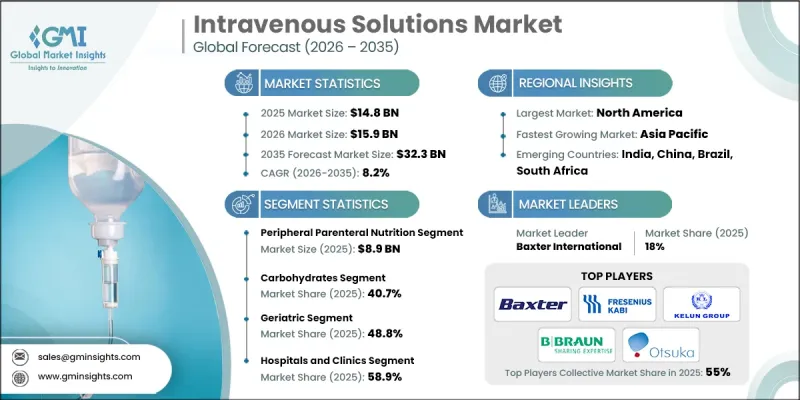
The market growth is fueled by the rising prevalence of malnutrition and an increasing need for specialized nutrition support across both emerging and developed regions. Intravenous solutions, including parenteral nutrition (PN), play a critical role in delivering essential nutrients, hydration, and electrolytes directly into the bloodstream, particularly for patients who cannot ingest or absorb nutrients orally. The demand is also driven by healthcare providers' preference for pre-mixed, ready-to-use IV solutions, which minimize the risks of contamination and preparation errors while enhancing patient safety and operational efficiency. In addition, advancements in formulation technology and increasing awareness of the importance of timely nutritional intervention have encouraged hospitals and clinics to adopt IV solutions for neonatal, critical care, oncology, and chronic disease management.
| Market Scope | |
|---|---|
| Start Year | 2025 |
| Forecast Year | 2026-2035 |
| Start Value | $14.8 Billion |
| Forecast Value | $32.3 Billion |
| CAGR | 8.2% |
The peripheral parenteral nutrition (PPN) segment generated USD 8.9 billion in 2025. PPN is widely used for patients requiring short-term nutritional support, delivering vital macronutrients like amino acids, dextrose, and lipids through peripheral veins. The solution helps restore nutrient balance, prevent further nutritional depletion, and correct deficiencies in patients with limited oral or enteral intake. Clinical studies indicate that the timely administration of PPN improves patient outcomes and satisfaction. The precise formulation of PPN ensures that patients receive the necessary micromolecules and macromolecules in the right proportion, reducing the risk of complications and supporting metabolic stability during recovery periods. Hospitals increasingly rely on PPN solutions as a safe, efficient method to maintain nutritional support in critical care and surgical settings.
The carbohydrates segment accounted for 40.7% share in 2025, establishing the segment as a key contributor. Dextrose-based IV solutions provide essential energy for patients who cannot obtain adequate calories orally or through enteral feeding. These solutions support cellular energy requirements, prevent the breakdown of lean body mass, and maintain metabolic balance in critically ill and malnourished patients. The use of carbohydrate-enriched IV fluids is particularly critical in intensive care units, surgical wards, and neonatal care, where energy demands are high and timely nutrient delivery is essential. Clinicians favor dextrose-containing solutions because they can be accurately dosed to meet individual patient needs, making them indispensable in modern parenteral nutrition therapy.
North America Intravenous Solutions Market held the largest market share in 2025, driven by advanced healthcare infrastructure, high surgical procedure volumes, and widespread use of parenteral nutrition and IV fluid therapy across multiple care settings. Hospitals, clinics, ambulatory centers, and expanding home healthcare services in the U.S. and Canada have created sustained demand for intravenous solutions. The region benefits from a strong regulatory framework, led by the U.S. FDA and Health Canada, which enforces rigorous standards for sterility, labeling, quality control, and GMP compliance. These regulations ensure patient safety, consistent product quality, and reliable supply chains. Additionally, technological adoption in hospitals, advanced clinical protocols, and integration of ready-to-use pre-mixed IV solutions enhance operational efficiency and minimize clinical errors, further consolidating North America's dominance in the intravenous solutions market.
Key players operating in the Global Intravenous Solutions Market include Baxter International, B. Braun Melsungen, Fresenius Kabi, Grifols, ICU Medical, AdvaCare Pharma, JW Life Science, Otsuka Pharmaceutical, Aculife Healthcare, Amanta Healthcare, Albert David, Axa Parenterals, and Haisco Pharmaceutical Group. Companies in the Intravenous Solutions Market strengthen their presence by focusing on developing pre-mixed, ready-to-use formulations that reduce contamination risk and enhance operational efficiency. They invest in advanced manufacturing technologies to improve sterility, stability, and shelf life. Strategic collaborations with hospitals, clinics, and home healthcare providers help expand distribution networks and increase product adoption. Market leaders also prioritize regulatory compliance, leveraging certifications from U.S. FDA, Health Canada, and other authorities to build trust and maintain quality standards. Additionally, companies emphasize product innovation, offering customized nutrient compositions tailored for neonatal, critical care, and oncology patients.
Table of Contents
Chapter 1 Research Methodology
- 1.1 Research approach
- 1.2 Quality commitments
- 1.2.1 GMI AI policy & data integrity commitment
- 1.2.1.1 Source consistency protocol
- 1.2.1 GMI AI policy & data integrity commitment
- 1.3 Research trail & confidence scoring
- 1.3.1 Research trail components
- 1.3.2 Scoring components
- 1.4 Data collection
- 1.4.1 Partial list of primary sources
- 1.5 Data mining sources
- 1.5.1 Paid sources
- 1.5.1.1 Sources, by region
- 1.5.1 Paid sources
- 1.6 Base estimates and calculations
- 1.6.1 Base year calculation for any one approach
- 1.7 Forecast model
- 1.7.1 Quantified market impact analysis
- 1.7.1.1 Mathematical impact of growth parameters on forecast
- 1.7.1 Quantified market impact analysis
- 1.8 Research transparency addendum
- 1.8.1 Source attribution framework
- 1.8.2 Quality assurance metrics
- 1.8.3 Our commitment to trust
Chapter 2 Executive Summary
- 2.1 Industry 360° synopsis
- 2.2 Key market trends
- 2.3 Type trends
- 2.4 Compositions trends
- 2.5 Age group trends
- 2.6 Application trends
- 2.7 End use trends
- 2.8 CXO perspectives: Strategic imperatives
Chapter 3 Industry Insights
- 3.1 Industry ecosystem analysis
- 3.2 Industry impact forces
- 3.2.1 Growth drivers
- 3.2.1.1 Growing cases of malnutrition
- 3.2.1.2 High prevalence of pre-term births
- 3.2.1.3 Increasing prevalence of diseases, such as gastrointestinal disorder, neurological diseases, and cancer
- 3.2.1.4 Increasing number of surgical procedures
- 3.2.2 Industry pitfalls and challenges
- 3.2.2.1 Stringent regulatory and quality requirements
- 3.2.3 Market opportunity
- 3.2.3.1 Rising shift toward home-based and outpatient infusion care
- 3.2.1 Growth drivers
- 3.3 Growth potential analysis
- 3.4 Regulatory landscape
- 3.4.1 North America
- 3.4.2 Europe
- 3.4.3 Asia Pacific
- 3.5 Technological landscape (Driven by Primary Research)
- 3.5.1 Current technologies
- 3.5.1.1 Ready-to-use (RTU) premixed solutions
- 3.5.1.2 Personalized IV nutrition formulations
- 3.5.2 Emerging technologies
- 3.5.2.1 Shift toward oral rehydration therapy
- 3.5.2.2 Multi-chamber and self-compounding bags
- 3.5.1 Current technologies
- 3.6 Future market trends (Driven by Primary Research)
- 3.7 Patent analysis (Driven by Primary Research)
- 3.8 Impact of AI and generative AI on the market (Driven by Primary Research)
- 3.9 Porter's analysis
- 3.10 PESTEL analysis
Chapter 4 Competitive Landscape, 2025
- 4.1 Introduction
- 4.2 Company market share analysis
- 4.2.1 North America
- 4.2.2 Europe
- 4.2.3 Asia Pacific
- 4.3 Company matrix analysis
- 4.4 Competitive analysis of major market players
- 4.5 Competitive positioning matrix
- 4.6 Key developments
- 4.6.1 Merger and acquisition
- 4.6.2 Partnership and collaboration
- 4.6.3 New product launches
- 4.6.4 Expansion plans
Chapter 5 Market Estimates and Forecast, By Type, 2022 - 2035 ($ Mn and Units)
- 5.1 Key trends
- 5.2 Total parenteral nutrition
- 5.3 Peripheral parenteral nutrition
Chapter 6 Market Estimates and Forecast, By Composition, 2022 - 2035 ($ Mn and Units)
- 6.1 Key trends
- 6.2 Carbohydrates
- 6.3 Vitamins and minerals
- 6.4 Single-dose amino acids
- 6.5 Parenteral lipid emulsion
- 6.6 Other compositions
Chapter 7 Market Estimates and Forecast, By Age Group, 2022 - 2035 ($ Mn and Units)
- 7.1 Key trends
- 7.2 Pediatric
- 7.3 Adults
- 7.4 Geriatric
Chapter 8 Market Estimates and Forecast, By Application, 2022 - 2035 ($ Mn)
- 8.1 Key trends
- 8.2 Nutritional support
- 8.3 Blood transfusion
- 8.4 Fluid and electrolyte balance
- 8.5 Other applications
Chapter 9 Market Estimates and Forecast, By End Use, 2022 - 2035 ($ Mn)
- 9.1 Key trends
- 9.2 Hospitals and clinics
- 9.3 Ambulatory surgery centers
- 9.4 Home care settings
Chapter 10 Market Estimates and Forecast, By Region, 2022 - 2035 ($ Mn and Units)
- 10.1 Key trends
- 10.2 North America
- 10.2.1 U.S.
- 10.2.2 Canada
- 10.3 Europe
- 10.3.1 Germany
- 10.3.2 UK
- 10.3.3 France
- 10.3.4 Spain
- 10.3.5 Italy
- 10.3.6 Netherlands
- 10.4 Asia Pacific
- 10.4.1 China
- 10.4.2 Japan
- 10.4.3 India
- 10.4.4 Australia
- 10.4.5 South Korea
- 10.5 Latin America
- 10.5.1 Brazil
- 10.5.2 Mexico
- 10.5.3 Argentina
- 10.6 Middle East and Africa
- 10.6.1 South Africa
- 10.6.2 Saudi Arabia
- 10.6.3 UAE
Chapter 11 Company Profiles
- 11.1 Aculife Healthcare
- 11.2 AdvaCare Pharma
- 11.3 Albert David
- 11.4 Amanta Healthcare
- 11.5 Axa Parenterals
- 11.6 B. Braun Melsungen
- 11.7 Baxter International
- 11.8 CSL
- 11.9 Fresenius Kabi
- 11.10 Grifols
- 11.11 Haisco Pharmaceutical Group
- 11.12 ICU Medical
- 11.13 JW Life Science
- 11.14 Kelun Industry Group
- 11.15 Otsuka Pharmaceutical

