PUBLISHER: Global Market Insights Inc. | PRODUCT CODE: 2019066

PUBLISHER: Global Market Insights Inc. | PRODUCT CODE: 2019066
Manicure and Pedicure Tools Market Opportunity, Growth Drivers, Industry Trend Analysis, and Forecast 2026 - 2035
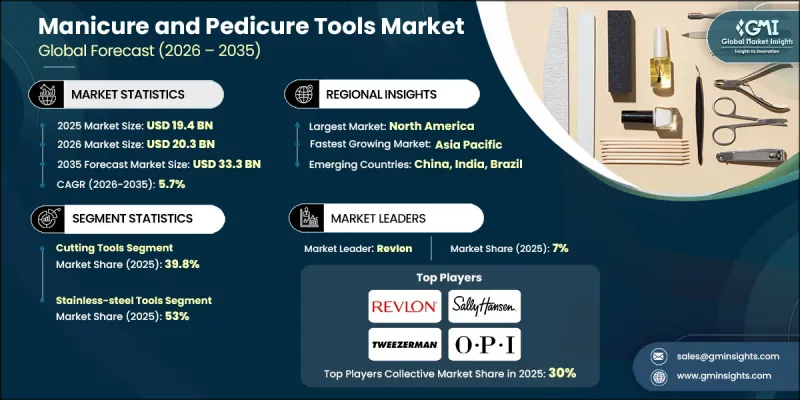
The Global Manicure and Pedicure Tools Market was valued at USD 19.4 billion in 2025 and is estimated to grow at a CAGR of 5.7% to reach USD 33.3 billion by 2035.
The market's growth is driven by continuous innovation in advanced materials, ergonomics, and precision engineering. Manufacturers are now using medical-grade stainless steel, anti-microbial coatings, and diamond dust abrasives to produce highly durable, hygienic, and precise tools. Strategic consolidations within the professional beauty and podiatry industries are further boosting the market, as companies integrate premium material suppliers, design firms, and global distribution networks to offer complete professional kits. Rising consumer preference for salon-quality tools at home, increasing beauty budgets in emerging regions, and demand for sustainable and reusable instruments are accelerating market adoption. Premiumization trends, including titanium coatings and aesthetic designs, are creating a higher-value segment in both North America and Europe, while eco-friendly wooden and stainless-steel options are gaining traction in the Asia-Pacific region.
| Market Scope | |
|---|---|
| Start Year | 2025 |
| Forecast Year | 2026-2035 |
| Start Value | $19.4 Billion |
| Forecast Value | $33.3 Billion |
| CAGR | 5.7% |
In 2025, the cutting tools segment held 39.8% share, valued at USD 7.7 billion, highlighting the ongoing demand for precision-engineered nippers, clippers, and other essential instruments in professional salons as well as home-use environments. These tools are preferred for their accuracy, long-lasting performance, and ability to maintain hygiene standards, which remain critical for both daily users and salon professionals. The growing interest in high-quality, durable equipment has reinforced the prominence of cutting tools within the overall manicure and pedicure market.
The stainless-steel tools segment held a 53% share, valued at USD 10.2 billion in 2025. Their leadership is attributed to their superior durability, compatibility with sterilization methods, and suitability for professional-grade applications. At the same time, eco-friendly alternatives such as biodegradable or sustainably sourced tools are gaining traction among environmentally conscious consumers, signaling a shift toward sustainable practices without compromising quality.
United States Manicure and Pedicure Tools Market held 64.4% share in 2025. Strong demand is driven by a dense network of professional nail salons, a widespread culture of personal grooming, and the rapid adoption of advanced ergonomic and medical-grade instruments. Emerging trends, including waterless manicures and podiatry-focused foot care solutions, have further fueled consumer preference for premium and specialized tools, sustaining the country's leadership in the market.
Key players in the Global Manicure and Pedicure Tools Market include Kai Corporation, CND, Sally Hansen, OPI, Tweezerman, Harperton, Beurer, Revlon, Zizzili Basics, Deborah Lippmann, KISS Products, Fancii, Nghia Export, Seki Edge (Green Bell), and Sephora Collection. Companies in the Manicure and Pedicure Tools Market are strengthening their foothold by investing in R&D to enhance tool precision, durability, and hygiene. Strategic partnerships with material suppliers and design firms allow the development of complete professional-grade kits. Brands are also expanding their distribution channels globally, targeting premium salon and home-use segments. Sustainability initiatives, including reusable stainless steel and eco-friendly wooden tools, are improving market perception and consumer loyalty. Product premiumization with titanium or plasma coatings and ergonomic designs helps differentiate offerings and capture higher-value customers. Aggressive marketing, influencer collaborations, and educational campaigns for professional and at-home use further reinforce brand visibility and market presence.
Table of Contents
Chapter 1 Methodology and Scope
- 1.1 Market scope and definition
- 1.2 Research design
- 1.2.1 Research approach
- 1.2.2 Data collection methods
- 1.3 Data mining sources
- 1.3.1 Global
- 1.3.2 Regional/Country
- 1.4 Base estimates and calculations
- 1.4.1 Base year calculation
- 1.4.2 Key trends for market estimation
- 1.5 Primary research and validation
- 1.5.1 Primary sources
- 1.6 Forecast model
- 1.7 Research assumptions and limitations
Chapter 2 Executive Summary
- 2.1 Industry 360° synopsis
- 2.2 Key market trends
- 2.2.1 Regional
- 2.2.2 Product Type
- 2.2.3 Material
- 2.2.4 Price
- 2.2.5 End Use
- 2.2.6 Distribution Channel
Chapter 3 Industry Insights
- 3.1 Industry ecosystem analysis
- 3.1.1 Supplier landscape
- 3.1.2 Profit margin
- 3.1.3 Value addition at each stage
- 3.1.4 Factor affecting the value chain
- 3.2 Industry impact forces
- 3.2.1 Growth drivers
- 3.2.1.1 Shift toward medical-grade professional standards
- 3.2.1.2 Ergonomic design & material innovation
- 3.2.1.3 Sustainability & eco-conscious grooming
- 3.2.2 Industry pitfalls & challenges
- 3.2.2.1 Counterfeit & low-grade material saturation
- 3.2.2.2 Stringent sterilization compliance
- 3.2.3 Opportunities
- 3.2.3.1 Subscription-based Professional Kits
- 3.2.3.2 Expansion into Med-Spa & Podiatry
- 3.2.1 Growth drivers
- 3.3 Growth potential analysis
- 3.4 Future market trends
- 3.5 Technology and innovation landscape
- 3.5.1 Current technological trends
- 3.5.2 Emerging technologies
- 3.6 Pricing Analysis (Driven by Primary Research)
- 3.6.1 Historical Price Trend Analysis (Driven by Primary Research)
- 3.6.2 Pricing Strategy by Player Type (Premium / Value / Cost-Plus) (Driven by Primary Research)
- 3.7 Patent Landscape (Driven by Primary Research)
- 3.7.1 Patent Filing Trends by Technology Area
- 3.7.2 Key Patent Holders & IP Portfolio Analysis
- 3.7.3 Geographic Distribution of Patents
- 3.7.4 Emerging Technology Patents (Smart Tools, Material Innovations)
- 3.8 Regulatory landscape
- 3.8.1 Standards and compliance requirements
- 3.8.2 Regional regulatory frameworks
- 3.8.3 Certification standards
- 3.9 Porter's analysis
- 3.10 PESTEL analysis
- 3.11 Trade Data Analysis (Driven by Primary Research)
- 3.11.1 Import/Export Volume & Value Trends (Driven by Primary Research)
- 3.11.2 Key Trade Corridors & Tariff Impact (Driven by Primary Research)
- 3.11.3 Regional Trade Balance Analysis
- 3.12 Impact of AI & Generative AI on the Market
- 3.12.1 AI-Driven Disruption of Existing Business Models
- 3.12.2 GenAI Use Cases & Adoption Roadmap by Segment
- 3.12.3 Risks, Limitations & Regulatory Considerations
- 3.13 Distribution Infrastructure & Channel Penetration Landscape (Driven by Primary Research)
- 3.13.1 Channel Coverage by Region & Format (Modern vs. Traditional Trade) (Driven by Primary Research)
- 3.13.2 Last-Mile Infrastructure Gaps & Emerging Channel Shifts (Driven by Primary Research)
- 3.13.3 E-commerce Penetration & Omnichannel Integration
- 3.13.4 Professional Distribution Network Analysis (Salon Supply Chains)
Chapter 4 Competitive Landscape, 2025
- 4.1 Introduction
- 4.2 Company market share analysis
- 4.2.1 By region
- 4.2.1.1 North America
- 4.2.1.2 Europe
- 4.2.1.3 Asia Pacific
- 4.2.1.4 Latin America
- 4.2.1.5 Middle East and Africa
- 4.2.1 By region
- 4.3 Company matrix analysis
- 4.4 Competitive analysis of major market players
- 4.5 Competitive positioning matrix
- 4.6 Key developments
- 4.6.1 Mergers & acquisitions
- 4.6.2 Partnerships & collaborations
- 4.6.3 New product launches
- 4.6.4 Expansion plans
Chapter 5 Market Estimates and Forecast, By Product Type, 2022 - 2035 (USD Billion) (Thousand Units)
- 5.1 Key trends
- 5.2 Cutting Tools
- 5.2.1 Nail Clippers
- 5.2.2 Cuticle Scissors
- 5.2.3 Nail Trimmers
- 5.2.4 Others (Nail Nippers, etc.)
- 5.3 Filing and Smoothing Tools
- 5.3.1 Nail Files
- 5.3.2 Buffing Blocks
- 5.4 Grooming and Finishing Tools
- 5.4.1 Cuticle Pushers
- 5.4.2 Cuticle Removers
- 5.4.3 Nail Buffers
- 5.4.4 Nail Polishing Tools
- 5.5 Nail Care Accessories
- 5.5.1 Nail Separators
- 5.5.2 Toe Separators
- 5.5.3 Nail Cleaning Tools
- 5.5.4 Callus Removers
- 5.5.5 Others (Nail Art Tools, UV Lamps & LED Dryers, Maintenance Oils (e.g., cuticle oils))
Chapter 6 Market Estimates and Forecast, By Material, 2022 - 2035 (USD Billion) (Thousand Units)
- 6.1 Key trends
- 6.2 Stainless Steel Tools
- 6.3 Ceramic Tools
- 6.4 Glass/Crystal Tools
- 6.5 Disposable Plastic Tools
- 6.6 Wooden Tools
- 6.7 Others (titanium tools, etc.)
Chapter 7 Market Estimates and Forecast, By Price, 2022 - 2035 (USD Billion) (Thousand Units)
- 7.1 Key trends
- 7.2 Low
- 7.3 Medium
- 7.4 High
Chapter 8 Market Estimates and Forecast, By End Use, 2022 - 2035 (USD Billion) (Thousand Units)
- 8.1 Key trends
- 8.2 Personal Use
- 8.3 Professional Use
- 8.3.1 Nail Salons
- 8.3.2 Spas
- 8.3.3 Beauty Centers
- 8.3.4 Others (dermatological centers, etc.)
Chapter 9 Market Estimates & Forecast, By Distribution Channel, 2022 - 2035 (USD Billion) (Thousand Units)
- 9.1 Key trends
- 9.2 Online
- 9.2.1 E-commerce
- 9.2.2 Company website
- 9.3 Offline
- 9.3.1 Supermarkets & Hypermarkets
- 9.3.2 Specialty Stores
- 9.3.3 Departmental Stores
- 9.3.4 Others (Pharmacies & Drugstores, etc.)
Chapter 10 Market Estimates and Forecast, By Region, 2022 - 2035 (USD Billion) (Thousand Units)
- 10.1 Key trends
- 10.2 North America
- 10.2.1 U.S.
- 10.2.2 Canada
- 10.3 Europe
- 10.3.1 Germany
- 10.3.2 UK
- 10.3.3 France
- 10.3.4 Italy
- 10.3.5 Spain
- 10.4 Asia Pacific
- 10.4.1 China
- 10.4.2 Japan
- 10.4.3 India
- 10.4.4 Australia
- 10.4.5 South Korea
- 10.5 Latin America
- 10.5.1 Brazil
- 10.5.2 Mexico
- 10.5.3 Argentina
- 10.6 Middle East and Africa
- 10.6.1 South Africa
- 10.6.2 Saudi Arabia
- 10.6.3 UAE
Chapter 11 Company Profiles
- 11.1 Beurer
- 11.2 CND
- 11.3 Deborah Lippmann
- 11.4 Fancii
- 11.5 Harperton
- 11.6 Kai Corporation
- 11.7 KISS Products
- 11.8 Nghia Export
- 11.9 OPI
- 11.10 Revlon
- 11.11 Sally Hansen
- 11.12 Seki Edge (Green Bell)
- 11.13 Sephora Collection
- 11.14 Tweezerman
- 11.15 Zizzili Basics

