PUBLISHER: Global Market Insights Inc. | PRODUCT CODE: 2019067

PUBLISHER: Global Market Insights Inc. | PRODUCT CODE: 2019067
Neuralgia Treatment Market Opportunity, Growth Drivers, Industry Trend Analysis, and Forecast 2026 - 2035
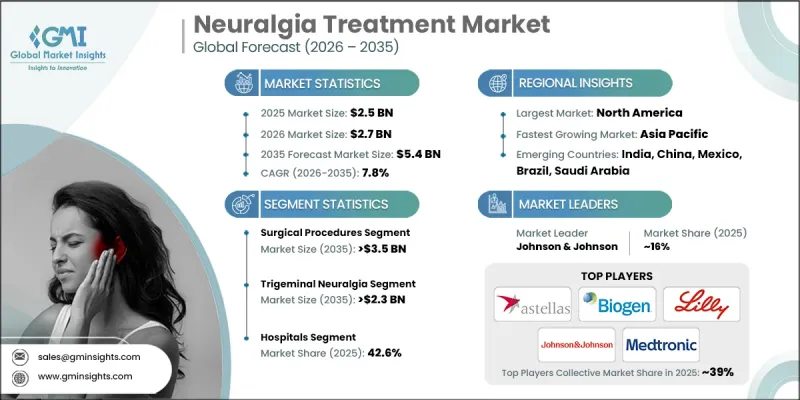
The Global Neuralgia Treatment Market was valued at USD 2.5 billion in 2025 and is estimated to grow at a CAGR of 7.8% to reach USD 5.4 billion by 2035.
Market growth is driven by the rising incidence of neurological disorders, improved awareness of neuropathic conditions, and increasing diagnosis rates. Neuralgia treatments focus on alleviating nerve-related pain through medications, minimally invasive surgical procedures, and lifestyle modifications. The aging global population further fuels demand, as older adults are more susceptible to neuropathic pain and its complications. Technological advancements in pain management, such as neuromodulation devices including spinal cord and peripheral nerve stimulators, are transforming treatment options. High-frequency and burst stimulation technologies improve pain relief while minimizing side effects, and AI-driven programming allows for personalized therapy. The rise of minimally invasive interventions increases patient compliance and satisfaction, supporting robust market expansion worldwide.
| Market Scope | |
|---|---|
| Start Year | 2025 |
| Forecast Year | 2026-2035 |
| Start Value | $2.5 Billion |
| Forecast Value | $5.4 Billion |
| CAGR | 7.8% |
Neuralgia treatments encompass both surgical and non-surgical approaches aimed at addressing chronic nerve pain. Minimally invasive procedures, advanced pharmacological interventions, and neuromodulation devices provide targeted relief and reduce the risk of complications. The integration of precise diagnostic tools, such as high-resolution imaging and nerve conduction studies, enables tailored treatment plans, enhancing patient outcomes and improving overall therapeutic efficiency.
The surgical procedures segment is projected to grow at a CAGR of 7.6%, reaching USD 3.5 billion by 2035. Advanced interventions, including microvascular decompression and nerve grafting, target underlying nerve compression or damage, providing long-term pain relief. The adoption of minimally invasive surgical techniques further strengthens this segment, offering patients effective outcomes with reduced recovery times.
The trigeminal neuralgia segment is expected to grow at a CAGR of 8%, achieving a market value of USD 2.3 billion by 2035. As one of the most prevalent forms of neuralgia, it significantly impacts a patient's quality of life. Awareness campaigns and early diagnosis initiatives are enhancing treatment uptake, while personalized approaches guided by advanced imaging and diagnostics improve therapeutic results and reduce trial-and-error in care selection.
U.S. Neuralgia Treatment Market reached USD 1.1 billion in 2025 and is anticipated to grow at a CAGR of 7.3% through 2035. Market growth is supported by advanced medical infrastructure, widespread adoption of neuromodulation technologies, minimally invasive procedures, a high prevalence of neuropathic conditions among aging populations, and favorable reimbursement policies. Substantial R&D investments by major pharmaceutical and medical device companies further reinforce U.S. leadership in this sector.
Key players in the Global Neuralgia Treatment Market include Biogen, Eli Lilly, Johnson & Johnson, Novartis, Medtronic, Pfizer, PACIRA, Siemens Healthineers, AA Pharma, and Astellas. Companies in the Neuralgia Treatment Market are strengthening their presence by focusing on innovation and R&D to develop next-generation neuromodulation devices and surgical solutions. They are expanding partnerships with hospitals, research institutes, and clinics to enhance distribution and clinical adoption. Personalized treatment solutions, including AI-driven therapy programming, improve patient outcomes and satisfaction, differentiating companies in competitive markets. Firms also invest in educational initiatives for healthcare professionals, launch awareness campaigns to boost early diagnosis, and secure regulatory approvals to facilitate global market expansion. Strategic mergers, acquisitions, and collaborations further solidify their foothold while increasing geographic reach and product portfolio diversity.
Table of Contents
Chapter 1 Research Methodology
- 1.1 Research approach
- 1.2 Quality commitments
- 1.2.1 GMI AI policy & data integrity commitment
- 1.2.1.1 Source consistency protocol
- 1.2.1 GMI AI policy & data integrity commitment
- 1.3 Research trail & confidence scoring
- 1.3.1 Research trail components
- 1.3.2 Scoring components
- 1.4 Data collection
- 1.4.1 Partial list of primary sources
- 1.5 Data mining sources
- 1.5.1 Paid sources
- 1.5.1.1 Sources, by region
- 1.5.1 Paid sources
- 1.6 Base estimates and calculations
- 1.6.1 Base year calculation for any one approach
- 1.7 Forecast model
- 1.7.1 Quantified market impact analysis
- 1.7.1.1 Mathematical impact of growth parameters on forecast
- 1.7.1 Quantified market impact analysis
- 1.8 Research transparency addendum
- 1.8.1 Source attribution framework
- 1.8.2 Quality assurance metrics
- 1.8.3 Our commitment to trust
Chapter 2 Executive Summary
- 2.1 Industry 360° synopsis
- 2.2 Key market trends
- 2.2.1 Regional trends
- 2.2.2 Treatment type trends
- 2.2.3 Application
- 2.2.4 End use trends
- 2.3 CXO perspectives: Strategic imperatives
Chapter 3 Industry Insights
- 3.1 Industry ecosystem analysis
- 3.2 Industry impact forces
- 3.2.1 Growth drivers
- 3.2.1.1 Rising prevalence of neurological disorders
- 3.2.1.2 Advancements in pain management technologies
- 3.2.1.3 Increase in awareness and diagnosis rates
- 3.2.2 Industry pitfalls and challenges
- 3.2.2.1 High cost of advanced therapies
- 3.2.3 Market opportunities
- 3.2.3.1 Advancements in biotechnology
- 3.2.1 Growth drivers
- 3.3 Growth potential analysis
- 3.4 Regulatory landscape
- 3.4.1 North America
- 3.4.2 Europe
- 3.4.3 Asia Pacific
- 3.5 Technology landscape
- 3.5.1 Current technological trends
- 3.5.2 Emerging technologies
- 3.6 Future market trends (Driven by Primary Research)
- 3.7 Impact of AI and generative AI on the market (Driven by Primary Research)
- 3.8 Customer insights (Driven by Primary Research)
- 3.9 Porter's analysis
- 3.10 PESTEL analysis
- 3.11 Gap analysis
Chapter 4 Competitive Landscape, 2025
- 4.1 Introduction
- 4.2 Company matrix analysis
- 4.3 Company market share analysis
- 4.3.1 Global
- 4.3.2 North America
- 4.3.3 Europe
- 4.3.4 Asia Pacific
- 4.4 Competitive positioning matrix
- 4.5 Competitive analysis of major market players
- 4.6 Key developments
- 4.6.1 Mergers & acquisitions
- 4.6.2 Partnerships & collaborations
- 4.6.3 New treatment type launches
- 4.6.4 Expansion plans
Chapter 5 Market Estimates and Forecast, By Treatment Type, 2022 - 2035 ($ Mn)
- 5.1 Key trends
- 5.2 Surgical procedures
- 5.2.1 Radiofrequency thermal lesioning
- 5.2.2 Stereotactic radiosurgery
- 5.2.3 Microvascular decompression
- 5.2.4 Other surgical procedures
- 5.3 Medications
- 5.3.1 Anticonvulsants
- 5.3.2 Antidepressants
- 5.3.3 Other medications
Chapter 6 Market Estimates and Forecast, By Application, 2022 - 2035 ($ Mn)
- 6.1 Key trends
- 6.2 Trigeminal neuralgia
- 6.3 Postherpetic neuralgia
- 6.4 Occipital neuralgia
- 6.5 Other applications
Chapter 7 Market Estimates and Forecast, By End Use, 2022 - 2035 ($ Mn)
- 7.1 Key trends
- 7.2 Hospitals
- 7.3 Clinics
- 7.4 Ambulatory surgical centers
- 7.5 Other end users
Chapter 8 Market Estimates and Forecast, By Region, 2022 - 2035 ($ Mn)
- 8.1 Key trends
- 8.2 North America
- 8.2.1 U.S.
- 8.2.2 Canada
- 8.3 Europe
- 8.3.1 Germany
- 8.3.2 UK
- 8.3.3 France
- 8.3.4 Spain
- 8.3.5 Italy
- 8.3.6 Netherlands
- 8.4 Asia Pacific
- 8.4.1 China
- 8.4.2 Japan
- 8.4.3 India
- 8.4.4 Australia
- 8.4.5 South Korea
- 8.5 Latin America
- 8.5.1 Brazil
- 8.5.2 Mexico
- 8.5.3 Argentina
- 8.6 Middle East and Africa
- 8.6.1 South Africa
- 8.6.2 Saudi Arabia
- 8.6.3 UAE
Chapter 9 Company Profiles
- 9.1 AA pharma
- 9.2 astellas
- 9.3 Biogen
- 9.4 Eli Lilly
- 9.5 Johnson & Johnson
- 9.6 Medtronic
- 9.7 NOVARTIS
- 9.8 PACIRA
- 9.9 Pfizer
- 9.10 Siemens Healthineers

