PUBLISHER: Global Market Insights Inc. | PRODUCT CODE: 2019068

PUBLISHER: Global Market Insights Inc. | PRODUCT CODE: 2019068
ECG Stress Test Market Opportunity, Growth Drivers, Industry Trend Analysis, and Forecast 2026 - 2035
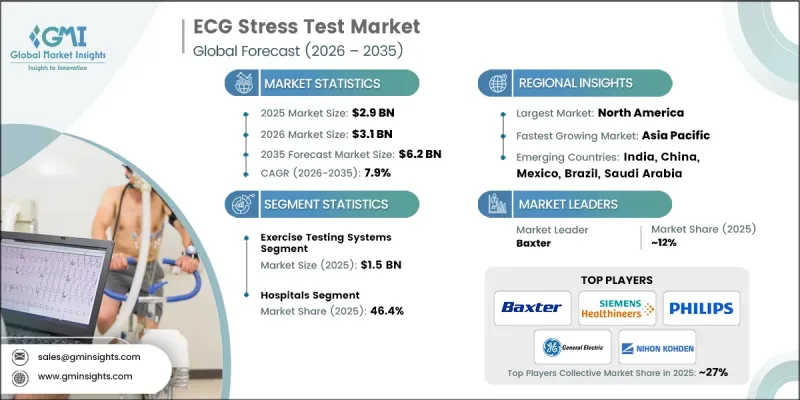
The Global ECG Stress Test Market was valued at USD 2.9 billion in 2025 and is estimated to grow at a CAGR of 7.9% to reach USD 6.2 billion by 2035.
Growth in the ECG stress test market is driven by increasing awareness regarding the importance of early detection of cardiovascular diseases and the rising number of diagnostic procedures performed worldwide. An ECG stress test is widely used to evaluate cardiac performance under physical exertion by monitoring electrical activity, helping identify abnormalities such as irregular heart rhythms and reduced blood flow. Technological advancements, including portable systems, wireless connectivity, and AI-enabled data analysis, are significantly improving diagnostic accuracy and operational efficiency. The growing elderly population, which is more prone to heart-related conditions, is further supporting demand, particularly in developed regions. Additionally, improving healthcare infrastructure and rising investments in advanced diagnostic technologies are boosting adoption in emerging economies. Government initiatives promoting preventive healthcare and early diagnosis are also contributing to increased utilization of ECG stress testing solutions, as healthcare systems aim to reduce long-term treatment costs and improve patient outcomes.
| Market Scope | |
|---|---|
| Start Year | 2025 |
| Forecast Year | 2026-2035 |
| Start Value | $2.9 Billion |
| Forecast Value | $6.2 Billion |
| CAGR | 7.9% |
The exercise testing systems segment generated USD 1.5 billion in 2025, driven by its essential role in assessing cardiac performance during physical activity. These systems are widely used to detect conditions related to reduced blood supply and abnormal heart rhythms, supporting early diagnosis and effective disease management. The increasing prevalence of cardiovascular disorders and growing awareness about preventive screening are driving the adoption of these systems across healthcare facilities.
The hospitals segment held a 46.4% share in 2025 and is expected to reach USD 3 billion by 2035. Hospitals remain the primary setting for stress testing procedures due to the availability of advanced diagnostic equipment and specialized cardiac care units. The rising number of patient visits for cardiovascular evaluation, combined with access to experienced healthcare professionals, ensures accurate diagnosis and treatment planning. Integrated healthcare services, including emergency and inpatient care, further strengthen the role of hospitals in managing cardiac conditions.
U.S. ECG Stress Test Market was valued at USD 922.6 million in 2025 and is anticipated to grow at a CAGR of 7.1% through 2035. Market growth is supported by the high prevalence of cardiovascular diseases and increasing demand for early diagnostic solutions. An aging population and lifestyle-related health risks are contributing to the rising incidence of heart conditions, driving the need for advanced diagnostic tools. The presence of well-established healthcare infrastructure and rapid adoption of innovative technologies further support market expansion.
Key players operating in the Global ECG Stress Test Market include GE (General Electric), Philips, Siemens Healthineers, Baxter, Cardinal Health, Halma, COSMED, SCHILLER, NIHON KOHDEN, MGC Diagnostics, Vyaire Medical, Neurosoft, NONIN, FUKUDA, OSI, and BIOSENSORS INTERNATIONAL. Companies in the Global ECG Stress Test Market are implementing strategic initiatives to strengthen their market presence and expand globally. Investments in research and development are enabling the introduction of advanced diagnostic systems with improved accuracy, portability, and connectivity. Firms are focusing on integrating artificial intelligence and digital health solutions to enhance data analysis and streamline workflows. Strategic partnerships with hospitals, diagnostic centers, and healthcare providers are helping expand product adoption. Additionally, companies are strengthening distribution networks and entering emerging markets to capture new growth opportunities. Emphasis on regulatory compliance, product innovation, and user-friendly designs further supports competitive positioning and long-term market growth.
Table of Contents
Chapter 1 Research Methodology
- 1.1 Research approach
- 1.2 Quality commitments
- 1.2.1 GMI AI policy & data integrity commitment
- 1.2.1.1 Source consistency protocol
- 1.2.1 GMI AI policy & data integrity commitment
- 1.3 Research trail & confidence scoring
- 1.3.1 Research trail components
- 1.3.2 Scoring components
- 1.4 Data collection
- 1.4.1 Partial list of primary sources
- 1.5 Data mining sources
- 1.5.1 Paid sources
- 1.5.1.1 Sources, by region
- 1.5.1 Paid sources
- 1.6 Base estimates and calculations
- 1.6.1 Base year calculation for any one approach
- 1.7 Forecast model
- 1.7.1 Quantified market impact analysis
- 1.7.1.1 Mathematical impact of growth parameters on forecast
- 1.7.1 Quantified market impact analysis
- 1.8 Research transparency addendum
- 1.8.1 Source attribution framework
- 1.8.2 Quality assurance metrics
- 1.8.3 Our commitment to trust
Chapter 2 Executive Summary
- 2.1 Industry 360° synopsis
- 2.2 Key market trends
- 2.2.1 Regional trends
- 2.2.2 Product type trends
- 2.2.3 End use trends
- 2.3 CXO perspectives: Strategic imperatives
Chapter 3 Industry Insights
- 3.1 Industry ecosystem analysis
- 3.2 Industry impact forces
- 3.2.1 Growth drivers
- 3.2.1.1 Increase in prevalence of cardiovascular disorders
- 3.2.1.2 Rising awareness of the benefits associated with early diagnosis of heart diseases
- 3.2.1.3 Surge in the number of tests performed by sporting athletes
- 3.2.1.4 Integration with electronic health records (EHRs)
- 3.2.2 Industry pitfalls and challenges
- 3.2.2.1 High cost of ECG stress testing systems
- 3.2.3 Market opportunities
- 3.2.3.1 Rising adoption of AI-enabled, wireless, and portable ECG stress-testing
- 3.2.1 Growth drivers
- 3.3 Growth potential analysis (Driven by Primary Research)
- 3.4 Regulatory landscape
- 3.4.1 North America
- 3.4.2 Europe
- 3.4.3 Asia Pacific
- 3.5 Technology landscape (Driven by Primary Research)
- 3.5.1 Current technological trends
- 3.5.2 Emerging technologies
- 3.6 Future market trends
- 3.7 Pricing analysis, 2025 (Driven by Primary Research)
- 3.8 Customer insights (Driven by Primary Research)
- 3.9 Impact of AI and generative AI on the market
- 3.10 Porter's analysis
- 3.11 PESTEL analysis
- 3.12 Gap analysis
Chapter 4 Competitive Landscape, 2025
- 4.1 Introduction
- 4.2 Company matrix analysis
- 4.3 Company market share analysis
- 4.3.1 Global
- 4.3.2 North America
- 4.3.3 Europe
- 4.3.4 Asia Pacific
- 4.4 Competitive positioning matrix
- 4.5 Competitive analysis of major market players
- 4.6 Key developments
- 4.6.1 Mergers & acquisitions
- 4.6.2 Partnerships & collaborations
- 4.6.3 New product launches
- 4.6.4 Expansion plans
Chapter 5 Market Estimates and Forecast, By Product Type, 2022 - 2035 ($ Mn)
- 5.1 Key trends
- 5.2 Exercise testing systems
- 5.3 Stress ECG
- 5.4 Stress blood pressure monitors
- 5.5 Pulse oximeters
Chapter 6 Market Estimates and Forecast, By End Use, 2022 - 2035 ($ Mn)
- 6.1 Key trends
- 6.2 Hospitals
- 6.3 Diagnostic centers
- 6.4 Ambulatory surgical centers
- 6.5 Other end users
Chapter 7 Market Estimates and Forecast, By Region, 2022 - 2035 ($ Mn)
- 7.1 Key trends
- 7.2 North America
- 7.2.1 U.S.
- 7.2.2 Canada
- 7.3 Europe
- 7.3.1 Germany
- 7.3.2 UK
- 7.3.3 France
- 7.3.4 Spain
- 7.3.5 Italy
- 7.3.6 Netherlands
- 7.4 Asia Pacific
- 7.4.1 China
- 7.4.2 Japan
- 7.4.3 India
- 7.4.4 Australia
- 7.4.5 South Korea
- 7.5 Latin America
- 7.5.1 Brazil
- 7.5.2 Mexico
- 7.5.3 Argentina
- 7.6 Middle East and Africa
- 7.6.1 South Africa
- 7.6.2 Saudi Arabia
- 7.6.3 UAE
Chapter 8 Company Profiles
- 8.1 Baxter
- 8.2 BIOSENSORS INTERNATIONAL
- 8.3 Cardinal Health
- 8.4 COSMED
- 8.5 FUKUDA
- 8.6 GE (General Electric)
- 8.7 Halma
- 8.8 MGC DIAGNOSTICS
- 8.9 Neurosoft
- 8.10 NIHON KOHDEN
- 8.11 NONIN
- 8.12 OSI
- 8.13 PHILIPS
- 8.14 SCHILLER
- 8.15 SIEMENS Healthineers
- 8.16 Vyaire MEDICAL

