PUBLISHER: Global Market Insights Inc. | PRODUCT CODE: 2019070

PUBLISHER: Global Market Insights Inc. | PRODUCT CODE: 2019070
Juice Concentrates Market Opportunity, Growth Drivers, Industry Trend Analysis, and Forecast 2026 - 2035
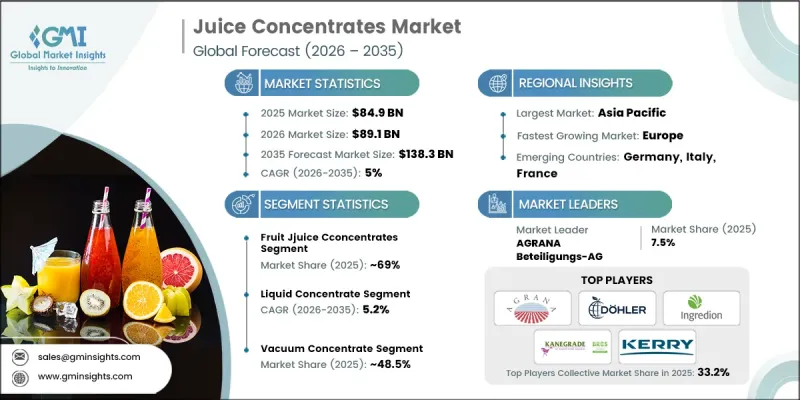
The Global Juice Concentrates Market was valued at USD 84.9 billion in 2025 and is estimated to grow at a CAGR of 5% to reach USD 138.3 billion by 2035.
The market continues to advance steadily as consumers increasingly seek beverages that combine nutritional value with convenience and versatility. Juice concentrates play a central role in beverage manufacturing by enabling producers to create a wide range of drinks while maintaining consistent taste and quality. Changing consumption patterns, rapid urban development, and a growing inclination toward natural and health-focused products are key factors supporting market expansion. These concentrates offer significant logistical and economic advantages, including extended shelf life, reduced transportation costs, and simplified storage requirements. Their ability to be reconstituted into beverages while preserving essential nutrients enhances their appeal among both manufacturers and consumers. In addition, juice concentrates contribute to improved production efficiency by minimizing raw material waste and ensuring uniform flavor profiles. Their multifunctional application across the food and beverage industries continues to strengthen their relevance in modern supply chains.
| Market Scope | |
|---|---|
| Start Year | 2025 |
| Forecast Year | 2026-2035 |
| Start Value | $84.9 Billion |
| Forecast Value | $138.3 Billion |
| CAGR | 5% |
The fruit juice concentrate segment accounted for 69% share in 2025 and is expected to grow at a CAGR of 4.8% through 2035. This segment maintains its leading position due to strong consumer preference for naturally derived flavors combined with perceived health benefits. The widespread use of fruit-based concentrates across beverage and food applications supports consistent demand. Increasing awareness of nutritional value and functional properties is further encouraging adoption, particularly in premium product categories. The segment continues to benefit from innovation in flavor development and enhanced processing techniques that improve quality and consistency.
The vacuum concentration segment held 48.5% share in 2025 and is anticipated to grow at a CAGR of 4.6% during 2026-2035. This method remains widely preferred due to its efficiency in retaining flavor integrity and nutritional content while optimizing energy consumption. Technological advancements in concentration processes are enabling manufacturers to deliver higher-quality products that meet evolving consumer expectations. Alternative techniques are also gaining attention for their ability to preserve natural characteristics and support premium product positioning, contributing to the overall diversification of processing methods within the industry.
North America Juice Concentrates Market accounted for 20% share in 2025 and continues to exhibit strong growth momentum. Increasing consumer interest in natural, clean-label, and health-oriented products is driving demand across the region. Market players are focusing on developing innovative formulations and packaging solutions that align with evolving consumer preferences. Advanced processing technologies are being adopted to enhance product quality and extend shelf life. In addition, regulatory standards are encouraging manufacturers to maintain strict quality control measures, which further strengthens consumer confidence. Rising demand for nutrient-rich formulations is also supporting the expansion of functional juice concentrate offerings.
Key players operating in the Global Juice Concentrates Market include AGRANA Beteiligungs-AG, DOHLER, Ingredion Inc., Kanegrade, Kerry Group, Lemonconcentrates, Northwest Naturals, Rachels Orchard, Sudzucker Group, SunnySyrup, Symrise, and Tree Top Ingredients. Companies operating in the juice concentrates market are enhancing their competitive position through continuous innovation, strategic expansion, and operational optimization. Manufacturers are investing in advanced processing technologies to improve product quality, preserve nutritional value, and extend shelf life. Expanding product portfolios with diverse flavor profiles and functional benefits allows companies to cater to evolving consumer preferences. Firms are also strengthening their supply chains and distribution networks to ensure efficient product availability across global markets. Strategic partnerships and acquisitions are being used to expand market reach and enhance production capabilities. In addition, a strong focus on sustainable sourcing and environmentally responsible practices is helping companies build brand credibility and long-term customer trust.
Table of Contents
Chapter 1 Methodology & Scope
- 1.1 Market scope and definition
- 1.2 Research design
- 1.2.1 Research approach
- 1.2.2 Data collection methods
- 1.3 Data mining sources
- 1.3.1 Global
- 1.3.2 Regional/Country
- 1.4 Base estimates and calculations
- 1.4.1 Base year calculation
- 1.4.2 Key trends for market estimation
- 1.5 Primary research and validation
- 1.5.1 Primary sources
- 1.6 Forecast model
- 1.7 Research assumptions and limitations
Chapter 2 Executive Summary
- 2.1 Industry 360° synopsis
- 2.2 Key market trends
- 2.2.1 Regional
- 2.2.2 Source
- 2.2.3 Type
- 2.2.4 Processing method
- 2.2.5 Application
- 2.3 TAM Analysis, 2026-2035
- 2.4 CXO perspectives: Strategic imperatives
- 2.4.1 Executive decision points
Chapter 3 Industry Insights
- 3.1 Industry ecosystem analysis
- 3.1.1 Supplier landscape
- 3.1.2 Profit margin
- 3.1.3 Value addition at each stage
- 3.1.4 Factor affecting the value chain
- 3.1.5 Disruptions
- 3.2 Industry impact forces
- 3.2.1 Growth drivers
- 3.2.2 Industry pitfalls and challenges
- 3.2.3 Market opportunities
- 3.3 Growth potential analysis
- 3.4 Regulatory landscape
- 3.4.1 North America
- 3.4.2 Europe
- 3.4.3 Asia Pacific
- 3.4.4 Latin America
- 3.4.5 Middle East & Africa
- 3.5 Porter's analysis
- 3.6 PESTEL analysis
- 3.7 Price trends
- 3.7.1 By region
- 3.7.2 By type
- 3.8 Future market trends
- 3.9 Technology and Innovation landscape
- 3.9.1 Current technological trends
- 3.9.2 Emerging technologies
- 3.10 Patent Landscape
- 3.11 Trade statistics (HS code)
- 3.11.1 Major importing countries
- 3.11.2 Major exporting countries
- 3.12 Sustainability and environmental aspects
- 3.12.1 Sustainable practices
- 3.12.2 Waste reduction strategies
- 3.12.3 Energy efficiency in production
- 3.12.4 Eco-friendly initiatives
- 3.13 Carbon footprint consideration
Chapter 4 Competitive Landscape, 2025
- 4.1 Introduction
- 4.2 Company market share analysis
- 4.2.1 By region
- 4.2.1.1 North America
- 4.2.1.2 Europe
- 4.2.1.3 Asia Pacific
- 4.2.1.4 LATAM
- 4.2.1.5 MEA
- 4.2.1 By region
- 4.3 Company matrix analysis
- 4.4 Competitive analysis of major market players
- 4.5 Competitive positioning matrix
- 4.6 Key developments
- 4.6.1 Mergers & acquisitions
- 4.6.2 Partnerships & collaborations
- 4.6.3 New Product Launches
- 4.6.4 Expansion Plans
Chapter 5 Market Estimates and Forecast, By Source, 2022-2035 (USD Billion) (Kilo Tons)
- 5.1 Key trends
- 5.2 Fruit Juice Concentrate
- 5.2.1 Orange
- 5.2.2 Apple
- 5.2.3 Pineapple
- 5.2.4 Grapes
- 5.2.5 Berries
- 5.2.6 Pear
- 5.2.7 Lemon
- 5.2.8 Other
- 5.3 Vegetable Juice Concentrate
- 5.3.1 Carrot
- 5.3.2 Cucumber
- 5.3.3 Tomato
- 5.3.4 Onion & Garlic
- 5.3.5 Beetroot
- 5.3.6 Other
Chapter 6 Market Estimates and Forecast, By Type, 2022-2035 (USD Billion) (Kilo Tons)
- 6.1 Key trends
- 6.2 Liquid concentrate
- 6.3 Powdered concentrate
- 6.4 Other
Chapter 7 Market Estimates and Forecast, By Processing Method, 2022-2035 (USD Billion) (Kilo Tons)
- 7.1 Key trends
- 7.2 Vacuum concentrate
- 7.3 Freeze concentration
- 7.4 Membrane concentration
- 7.5 Aroma recovery
- 7.6 Other
Chapter 8 Market Estimates and Forecast, By Application, 2022-2035 (USD Billion) (Kilo Tons)
- 8.1 Key trends
- 8.2 Beverages
- 8.3 Bakery & confectionery
- 8.4 Dairy
- 8.5 Other
Chapter 9 Market Estimates and Forecast, By Region, 2022-2035 (USD Billion) (Kilo Tons)
- 9.1 Key trends
- 9.2 North America
- 9.2.1 U.S.
- 9.2.2 Canada
- 9.3 Europe
- 9.3.1 Germany
- 9.3.2 UK
- 9.3.3 France
- 9.3.4 Spain
- 9.3.5 Italy
- 9.3.6 Rest of Europe
- 9.4 Asia Pacific
- 9.4.1 China
- 9.4.2 India
- 9.4.3 Japan
- 9.4.4 Australia
- 9.4.5 South Korea
- 9.4.6 Rest of Asia Pacific
- 9.5 Latin America
- 9.5.1 Brazil
- 9.5.2 Mexico
- 9.5.3 Argentina
- 9.5.4 Rest of Latin America
- 9.6 Middle East and Africa
- 9.6.1 Saudi Arabia
- 9.6.2 South Africa
- 9.6.3 UAE
- 9.6.4 Rest of Middle East and Africa
Chapter 10 Company Profiles
- 10.1 AGRANA Beteiligungs-AG
- 10.2 DOHLER
- 10.3 Ingredion Inc.
- 10.4 Kanegrade
- 10.5 Kerry Group
- 10.6 Lemonconcentrates
- 10.7 Northwest Naturals
- 10.8 Rachels Orchard
- 10.9 Sudzucker Group
- 10.10 SunnySyrup
- 10.11 Symrise
- 10.12 Tree Top Ingredients

