PUBLISHER: Global Market Insights Inc. | PRODUCT CODE: 2019071

PUBLISHER: Global Market Insights Inc. | PRODUCT CODE: 2019071
Dried Honey Market Opportunity, Growth Drivers, Industry Trend Analysis, and Forecast 2026 - 2035
The Global Dried Honey Market was valued at USD 996.4 million in 2025 and is estimated to grow at a CAGR of 8.8% to reach USD 2.3 billion by 2035.
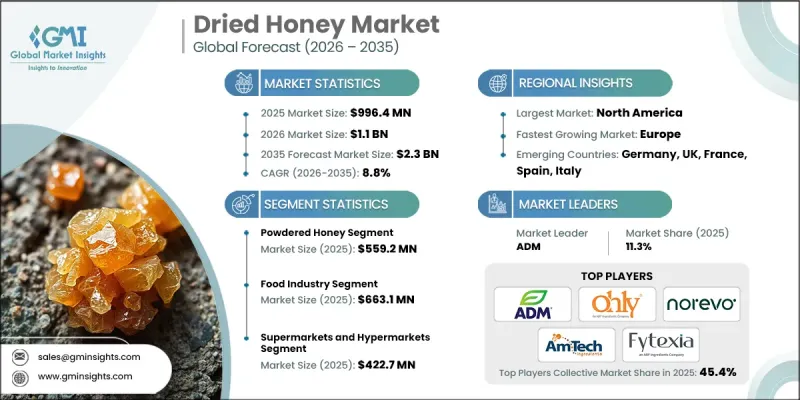
Dried honey, available in powdered or granulated forms, retains the natural sweetness and functional benefits of liquid honey while offering superior handling, consistent quality, and longer storage. It is widely used as a sweetening agent in food, beverages, dietary supplements, and baked goods where moisture control is critical. The product integrates seamlessly with dry ingredients, making it suitable for nutrition powders, cereals, confectionery, and seasoning mixes. Technological advancements in spray drying and low-temperature dehydration have improved solubility, flow properties, and particle uniformity while preserving flavor and natural compounds. These innovations enhance usability in processed foods and packaged products, allowing manufacturers to deliver consistent quality across industrial and culinary applications.
| Market Scope | |
|---|---|
| Start Year | 2025 |
| Forecast Year | 2026-2035 |
| Start Value | $996.4 Million |
| Forecast Value | $2.3 Billion |
| CAGR | 8.8% |
The powdered honey segment generated USD 559.2 million in 2025. Its ease of handling and controlled moisture content make it the preferred sweetener for bakery mixes, beverages, nutritional powders, and seasoning blends. Manufacturers offer varying solubility and honey concentration levels, enabling precise formulation for diverse product applications.
The food industry accounted for USD 663.1 million in 2025. Dried honey serves as a natural sweetener in bakery products, breakfast cereals, snack foods, beverages, and dry mix products, providing consistent flavor and ease of processing. Nutraceuticals also utilize dried honey in dietary supplements, protein powders, and wellness formulations, where its natural origin aligns with clean-label requirements.
North America Dried Honey Market is expected to see substantial growth, expanding from USD 354.7 million in 2025 to USD 856.2 million by 2035. Rising consumer preference for natural ingredients, reformulation trends in processed foods, and increasing demand for powdered sweeteners in baking, snacks, and beverages are driving market growth. Dried honey is gaining popularity in the U.S. nutrition bar, cereal, and convenience food markets as manufacturers focus on clean-label and easy-to-use formulations.
Key players operating in the Global Dried Honey Market include Ohly, ADM, Mitthi Foods, Mevive International, AVNI HERBAL & HEALTHCARE, Vedant Agro Foods, Essentra Natural, Fytexia, Norevo, and Flavor Consultants, Inc. Companies in the Global Dried Honey Market are adopting multiple strategies to strengthen their market position and expand their footprint. They characteristics and advanced drying technologies such as spray drying and low-temperature dehydration to improve solubility, flow characteristics, and flavor retention. Firms develop customizable honey powders with varying concentration levels to cater to specific food and nutraceutical applications. Strategic partnerships with food manufacturers and nutraceutical brands help integrate products into high-volume production lines. Expanding distribution networks, including e-commerce channels, ensures access to new geographic markets. Additionally, companies emphasize sustainability, clean-label offerings, and natural ingredient positioning to attract health-conscious consumers and secure long-term contracts in the food and dietary supplement sectors.
Table of Contents
Chapter 1 Methodology & Scope
- 1.1 Market scope and definition
- 1.2 Research design
- 1.2.1 Research approach
- 1.2.2 Data collection methods
- 1.3 Data mining sources
- 1.3.1 Global
- 1.3.2 Regional/Country
- 1.4 Base estimates and calculations
- 1.4.1 Base year calculation
- 1.4.2 Key trends for market estimation
- 1.5 Primary research and validation
- 1.5.1 Primary sources
- 1.6 Forecast model
- 1.7 Research assumptions and limitations
Chapter 2 Executive Summary
- 2.1 Industry 360° synopsis
- 2.2 Key market trends
- 2.2.1 Product Type
- 2.2.2 End User
- 2.2.3 Distribution Channel
- 2.2.4 Regional
- 2.3 TAM Analysis, 2026-2035
- 2.4 CXO perspectives: Strategic imperatives
- 2.5 Future outlook and strategic recommendations
Chapter 3 Industry Insights
- 3.1 Industry ecosystem analysis
- 3.1.1 Supplier landscape
- 3.1.2 Profit margin
- 3.1.3 Value addition at each stage
- 3.1.4 Factor affecting the value chain
- 3.1.5 Disruptions
- 3.2 Industry impact forces
- 3.2.1 Growth drivers
- 3.2.1.1 Increasing preference for natural sweeteners in foods globally
- 3.2.1.2 Growing use of powdered ingredients in processing foods
- 3.2.1.3 Demand for longer shelf life ingredients in applications
- 3.2.2 Pitfalls/challenge
- 3.2.2.1 Sensitivity of honey nutrients during drying processes operations
- 3.2.2.2 Higher production costs compared to liquid honey formats
- 3.2.3 Opportunities
- 3.2.3.1 Expansion of clean label and natural formulations worldwide
- 3.2.3.2 Growth in nutraceutical and supplement products segments
- 3.2.1 Growth drivers
- 3.3 Growth potential analysis
- 3.4 Regulatory landscape
- 3.4.1 North America
- 3.4.2 Europe
- 3.4.3 Asia Pacific
- 3.4.4 Latin America
- 3.4.5 Middle East & Africa
- 3.5 Porter's analysis
- 3.6 PESTEL analysis
- 3.7 Technology and innovation landscape
- 3.7.1 Current technological trends
- 3.7.2 Emerging technologies
- 3.8 Price trends
- 3.8.1 By region
- 3.8.2 By product type
- 3.9 Future market trends
- 3.10 Patent landscape
- 3.11 Trade statistics (HS code)
- 3.11.1 Major importing countries
- 3.11.2 Major exporting countries
- 3.12 Sustainability and environmental aspects
- 3.12.1 Sustainable practices
- 3.12.2 Waste reduction strategies
- 3.12.3 Energy efficiency in production
- 3.12.4 Eco-friendly initiatives
- 3.13 Carbon footprint consideration
Chapter 4 Competitive Landscape, 2025
- 4.1 Introduction
- 4.2 Company market share analysis
- 4.2.1 By region
- 4.2.1.1 North America
- 4.2.1.2 Europe
- 4.2.1.3 Asia Pacific
- 4.2.1.4 LATAM
- 4.2.1.5 MEA
- 4.2.1 By region
- 4.3 Company matrix analysis
- 4.4 Competitive analysis of major market players
- 4.5 Competitive positioning matrix
- 4.6 Key developments
- 4.6.1 Mergers & acquisitions
- 4.6.2 Partnerships & collaborations
- 4.6.3 New product launches
- 4.6.4 Expansion plans
Chapter 5 Market Estimates and Forecast, By Product Type, 2022-2035 (USD Million) (Kilo Tons)
- 5.1 Key trends
- 5.2 Powdered honey
- 5.3 Granulated honey
- 5.4 Honey crystals
Chapter 6 Market Estimates and Forecast, By End User, 2022-2035 (USD Million) (Kilo Tons)
- 6.1 Key trends
- 6.2 Food industry
- 6.3 Nutraceuticals
- 6.4 Cosmetics and personal care
- 6.5 Others
Chapter 7 Market Estimates and Forecast, By Distribution Channel, 2022-2035 (USD Million) (Kilo Tons)
- 7.1 Key trends
- 7.2 Online retail
- 7.3 Supermarkets/hypermarkets
- 7.4 Health food stores
- 7.5 Convenience stores
- 7.6 Others
Chapter 8 Market Estimates and Forecast, By Region, 2022-2035 (USD Million) (Kilo Tons)
- 8.1 Key trends
- 8.2 North America
- 8.2.1 U.S.
- 8.2.2 Canada
- 8.3 Europe
- 8.3.1 Germany
- 8.3.2 UK
- 8.3.3 France
- 8.3.4 Spain
- 8.3.5 Italy
- 8.3.6 Rest of Europe
- 8.4 Asia Pacific
- 8.4.1 China
- 8.4.2 India
- 8.4.3 Japan
- 8.4.4 Australia
- 8.4.5 South Korea
- 8.4.6 Rest of Asia Pacific
- 8.5 Latin America
- 8.5.1 Brazil
- 8.5.2 Mexico
- 8.5.3 Argentina
- 8.5.4 Rest of Latin America
- 8.6 Middle East and Africa
- 8.6.1 Saudi Arabia
- 8.6.2 South Africa
- 8.6.3 UAE
- 8.6.4 Rest of Middle East and Africa
Chapter 9 Company Profiles
- 9.1 Ohly
- 9.2 Mitthi Foods
- 9.3 AmTech Ingredients
- 9.4 ADM
- 9.5 Essentra Natural
- 9.6 Flavor Consultants, Inc.
- 9.7 Mevive International
- 9.8 Fytexia
- 9.9 Norevo
- 9.10 AVNI HERBAL & HEALTHCARE
- 9.11 Vedant Agro Foods

