PUBLISHER: Global Market Insights Inc. | PRODUCT CODE: 2019073

PUBLISHER: Global Market Insights Inc. | PRODUCT CODE: 2019073
Antiviral Drugs Market Opportunity, Growth Drivers, Industry Trend Analysis, and Forecast 2026 - 2035
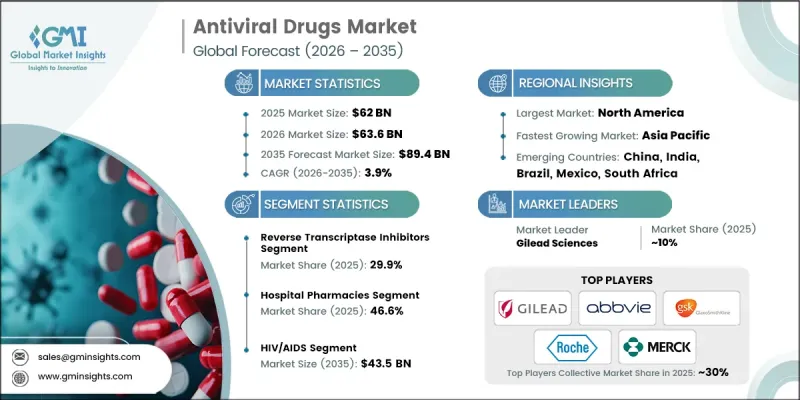
The Global Antiviral Drugs Market was valued at USD 62 billion in 2025 and is estimated to grow at a CAGR of 3.9% to reach USD 89.4 billion by 2035.
The antiviral drugs market is gaining steady traction as the demand for effective therapies to manage viral infections continues to rise. Antiviral medications are designed to inhibit the growth and replication of viruses, playing a vital role in reducing disease severity and duration while also supporting preventive care in certain cases. Increasing awareness, along with favorable government initiatives aimed at accelerating drug approvals, funding clinical research, and promoting public health education, is supporting market expansion. The rising global burden of viral infections and continuous advancements in pharmaceutical research are further strengthening growth prospects. Technological progress in drug development and increasing investments in innovative therapies are enhancing treatment outcomes and accessibility. In addition, expanding awareness programs by public and private organizations are encouraging the adoption of advanced therapeutic options. The active involvement of pharmaceutical companies in developing new antiviral treatments is also contributing to the growing demand and long-term market potential.
| Market Scope | |
|---|---|
| Start Year | 2025 |
| Forecast Year | 2026-2035 |
| Start Value | $62 Billion |
| Forecast Value | $89.4 Billion |
| CAGR | 3.9% |
The reverse transcriptase inhibitors segment accounted for 29.9% share and was valued at USD 18.6 billion in 2025. Growth in this segment is primarily driven by the increasing need for effective treatment solutions targeting viral infections that require long-term therapy. These drugs play a critical role in therapeutic regimens, offering improved treatment outcomes through enhanced bioavailability and effectiveness. Supportive government initiatives and increasing awareness programs are further boosting their adoption, contributing to sustained segment growth.
The branded segment held a share of 71.8% in 2025, supported by strong investments in research and clinical development. Branded antiviral drugs are widely preferred due to their proven safety, efficacy, and reliability in long-term treatment applications. Pharmaceutical companies continue to focus on expanding access to these therapies, which is driving their widespread adoption and reinforcing segment growth.
North America Antiviral Drugs Market accounted for 40.1% share in 2025, supported by advanced healthcare infrastructure and significant investment in research and development activities. The region continues to lead due to early adoption of innovative treatment solutions and the strong presence of major pharmaceutical companies. Continuous advancements in therapeutic development and increasing demand for effective antiviral treatments are further supporting regional growth.
Key players operating in the Global Antiviral Drugs Market include Pfizer, Merck, AbbVie, AstraZeneca, GlaxoSmithKline, Johnson & Johnson, Novartis, Gilead Sciences, Bristol-Myers Squibb, Takeda Pharmaceutical, Cipla, Dr. Reddy's Laboratories, Sun Pharmaceutical, Aurobindo Pharma, F. Hoffmann-La Roche, and Viatris. Companies in the Global Antiviral Drugs Market are focusing on strategic initiatives to strengthen their market position and expand their global footprint. Investments in research and development are enabling the introduction of advanced antiviral therapies with improved efficacy and safety profiles. Firms are actively pursuing partnerships, collaborations, and licensing agreements to accelerate drug development and commercialization. Expansion into emerging markets and strengthening distribution networks are also key priorities to enhance accessibility. Additionally, companies are focusing on regulatory approvals and innovation in drug formulations to remain competitive. Continuous efforts toward product differentiation and technological advancement are supporting long-term growth and reinforcing their presence across the global antiviral drugs industry.
Table of Contents
Chapter 1 Methodology and Scope
- 1.1 Market scope and definition
- 1.2 Research approach
- 1.3 Quality commitments
- 1.3.1 GMI AI policy and data integrity commitment
- 1.3.1.1 Source consistency protocol
- 1.3.1 GMI AI policy and data integrity commitment
- 1.4 Research trail and confidence scoring
- 1.4.1 Research trail components
- 1.4.2 Scoring components
- 1.5 Data collection
- 1.5.1 Partial list of primary sources
- 1.6 Data mining sources
- 1.6.1 Paid sources
- 1.6.1.1 Sources, by region
- 1.6.1 Paid sources
- 1.7 Base estimates and calculations
- 1.7.1 Revenue share analysis
- 1.7.2 Base year calculation
- 1.8 Forecast model
- 1.9 Research transparency addendum
- 1.9.1 Source attribution framework
- 1.9.2 Quality assurance metrics
- 1.9.3 Our commitment to trust
Chapter 2 Executive Summary
- 2.1 Industry 360° synopsis
- 2.2 Key market trends
- 2.2.1 Regional trends
- 2.2.2 Drug class trends
- 2.2.3 Indication trends
- 2.2.4 Type trends
- 2.2.5 Route of administration trends
- 2.2.6 Age group trends
- 2.2.7 Distribution channel trends
- 2.3 CXO perspectives: Strategic imperatives
Chapter 3 Industry Insights
- 3.1 Industry ecosystem analysis
- 3.2 Industry impact forces
- 3.2.1 Growth drivers
- 3.2.1.1 Rising prevalence of viral infections
- 3.2.1.2 Increasing number of product launches for HIV treatment
- 3.2.1.3 High investment in R&D activities and presence of pipeline products
- 3.2.1.4 Increasing geriatric population
- 3.2.2 Industry pitfalls and challenges
- 3.2.2.1 Emerging drug resistance
- 3.2.2.2 High development cost
- 3.2.3 Market opportunities
- 3.2.3.1 Expansion of personalized antiviral therapies
- 3.2.3.2 Growing adoption of combination and broad spectrum antiviral regimens
- 3.2.1 Growth drivers
- 3.3 Growth potential analysis
- 3.4 Regulatory landscape (Driven by Primary Research)
- 3.5 Pricing analysis (Driven by Primary Research)
- 3.6 Pipeline analysis
- 3.7 Future market trends (Driven by Primary Research)
- 3.8 Impact of AI and generative AI on the market
- 3.9 Porter's analysis
- 3.10 PESTEL analysis
Chapter 4 Competitive Landscape, 2025
- 4.1 Introduction
- 4.2 Company market share analysis
- 4.3 Company matrix analysis
- 4.4 Competitive analysis of major market players
- 4.5 Competitive positioning matrix
- 4.6 Key developments
- 4.6.1 Merger and acquisition
- 4.6.2 Partnership and collaboration
- 4.6.3 New product launches
- 4.6.4 Expansion plan
Chapter 5 Market Estimates and Forecast, By Drug Class, 2022 - 2035 ($ Mn)
- 5.1 Key trends
- 5.2 Reverse transcriptase inhibitors
- 5.3 DNA polymerase inhibitors
- 5.4 Protease inhibitors
- 5.5 Neuraminidase inhibitors
- 5.6 Other drug classes
Chapter 6 Market Estimates and Forecast, By Indication, 2022 - 2035 ($ Mn)
- 6.1 Key trends
- 6.2 HIV/AIDS
- 6.3 Hepatitis
- 6.4 Coronavirus infection
- 6.5 Herpes simplex virus (HSV)
- 6.6 Influenza
- 6.7 Other indications
Chapter 7 Market Estimates and Forecast, By Type, 2022 - 2035 ($ Mn)
- 7.1 Key trends
- 7.2 Branded
- 7.3 Generic
Chapter 8 Market Estimates and Forecast, By Route of Administration, 2022 - 2035 ($ Bn)
- 8.1 Key trends
- 8.2 Oral
- 8.3 Parenteral
- 8.4 Topical
- 8.5 Other routes of administration
Chapter 9 Market Estimates and Forecast, By Age Group, 2022 - 2035 ($ Mn)
- 9.1 Key trends
- 9.2 Geriatric
- 9.3 Adult
- 9.4 Pediatric
Chapter 10 Market Estimates and Forecast, By Distribution Channel, 2022 - 2035 ($ Mn)
- 10.1 Key trends
- 10.2 Hospital pharmacies
- 10.3 Retail pharmacies
- 10.4 Online pharmacies
Chapter 11 Market Estimates and Forecast, By Region, 2022 - 2035 ($ Mn)
- 11.1 Key trends
- 11.2 North America
- 11.2.1 U.S.
- 11.2.2 Canada
- 11.3 Europe
- 11.3.1 Germany
- 11.3.2 UK
- 11.3.3 France
- 11.3.4 Italy
- 11.3.5 Spain
- 11.3.6 Netherlands
- 11.4 Asia Pacific
- 11.4.1 China
- 11.4.2 Japan
- 11.4.3 India
- 11.4.4 Australia
- 11.4.5 South Korea
- 11.5 Latin America
- 11.5.1 Brazil
- 11.5.2 Mexico
- 11.5.3 Argentina
- 11.6 Middle East and Africa
- 11.6.1 South Africa
- 11.6.2 Saudi Arabia
- 11.6.3 UAE
Chapter 12 Company Profiles
- 12.1 AbbVie
- 12.2 AstraZeneca
- 12.3 Aurobindo Pharma
- 12.4 Bristol-Myers Squibb
- 12.5 Cipla
- 12.6 Dr. Reddy's Laboratories
- 12.7 F. Hoffmann-La Roche
- 12.8 Gilead Sciences
- 12.9 GlaxoSmithKline
- 12.10 Johnson & Johnson
- 12.11 Merck
- 12.12 Novartis
- 12.13 Pfizer
- 12.14 Sun Pharmaceutical
- 12.15 Takeda Pharmaceutical
- 12.16 Viatris

