PUBLISHER: Global Market Insights Inc. | PRODUCT CODE: 2019074

PUBLISHER: Global Market Insights Inc. | PRODUCT CODE: 2019074
Nicotine Pouches Market Opportunity, Growth Drivers, Industry Trend Analysis, and Forecast 2026 - 2035
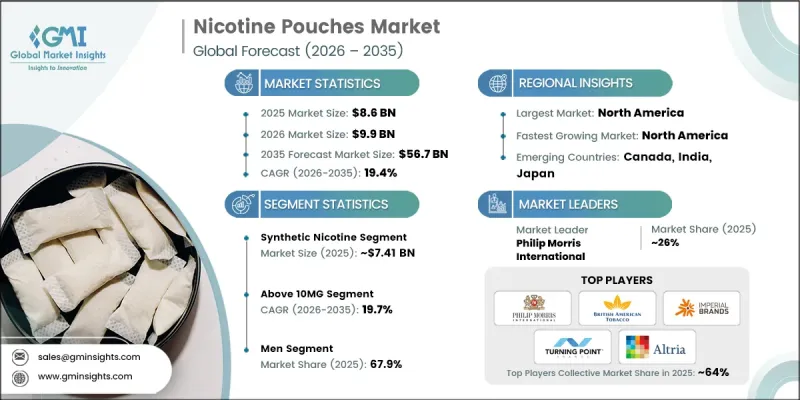
The Global Nicotine Pouches Market was valued at USD 8.6 billion in 2025 and is estimated to grow at a CAGR of 19.4% to reach USD 56.7 billion by 2035.
Market growth is fueled by a noticeable shift in consumer behavior away from traditional tobacco products toward cleaner and more convenient nicotine delivery formats. Users are increasingly seeking alternatives that eliminate combustion while offering greater control over nicotine intake. Nicotine pouches meet this demand by providing a tobacco-free solution that is discreet, easy to use, and adaptable to modern lifestyles. Rising health awareness among consumers is further encouraging the transition toward smokeless options. In addition, stricter regulations on public smoking are accelerating the adoption of portable and odor-free products. The growing availability of varied flavor profiles and portion strengths is expanding the consumer base, while improved retail accessibility is strengthening market penetration. Manufacturers are actively enhancing distribution networks and product offerings to align with evolving preferences, which continues to support strong industry expansion.
| Market Scope | |
|---|---|
| Start Year | 2025 |
| Forecast Year | 2026-2035 |
| Start Value | $8.6 Billion |
| Forecast Value | $56.7 Billion |
| CAGR | 19.4% |
The synthetic nicotine segment generated USD 7.41 billion in 2025 and is expected to grow at a CAGR of 19.5% through 2035. This segment leads the market due to its ability to deliver consistent quality and controlled nicotine levels across different product formats. Its tobacco-free nature appeals to consumers looking for alternatives that align with changing regulatory frameworks and personal preferences. Manufacturers benefit from improved formulation precision, enabling them to offer standardized products across multiple markets. The segment continues to gain traction as demand for discreet and convenient nicotine consumption methods rises globally.
The men segment accounted for 67.9% share in 2025 and is projected to grow at a CAGR of 19.5% during 2026-2035. This dominance is attributed to higher consumption patterns and a strong inclination toward smokeless nicotine products among male consumers. Demand is particularly driven by preferences for stronger formulations and consistent product performance. Product positioning, flavor development, and accessibility continue to align with this demographic, reinforcing its leading position. Convenience, portability, and discreet usage further enhance product appeal, while widespread availability across retail and online platforms supports repeat purchases and sustained demand.
U.S. Nicotine Pouches Market was valued at USD 2.4 billion in 2025 and is anticipated to grow at a CAGR of 20.3% from 2026 to 2035. Growth in the region is supported by increasing adoption among adult users seeking alternatives to conventional nicotine products. Regulatory oversight plays a significant role in shaping product innovation and marketing strategies, encouraging companies to focus on quality and compliance. High awareness levels regarding smoke-free products contribute to consistent consumer transition. Expanding retail presence, competitive pricing strategies, and continuous product innovation are further strengthening market growth. Companies are also focusing on product differentiation through improved delivery systems and enhanced user experience.
Key players operating in the Global Nicotine Pouches Market include Altria Group, British American Tobacco (BAT), Dryft, Imperial Brands PLC, Swedish Match, Killa, Moxy Pouches AB, Nicoventures, Philip Morris International (PMI), Reynolds American, Rogue International, Turning Point Brands, Inc., UPROAR, White Fox, and ZERO. Companies in the nicotine pouches market are reinforcing their competitive position through continuous product innovation, strategic expansion, and targeted marketing initiatives. Manufacturers are investing in advanced formulation technologies to deliver consistent nicotine levels and improved user comfort. Expanding product portfolios with diverse flavors and strength options allows companies to appeal to a wider consumer base. Firms are also strengthening distribution networks across both physical retail and digital platforms to improve accessibility and visibility. Strategic collaborations and acquisitions are being used to enhance market reach and operational capabilities. In addition, companies are focusing on regulatory compliance and transparent product communication to build consumer trust and sustain long-term growth.
Table of Contents
Chapter 1 Methodology & Scope
- 1.1 Market scope and definition
- 1.2 Research design
- 1.2.1 Research approach
- 1.2.2 Data collection methods
- 1.3 Data mining sources
- 1.3.1 Global
- 1.3.2 Regional/Country
- 1.4 Base estimates and calculations
- 1.4.1 Base year calculation
- 1.4.2 Key trends for market estimation
- 1.5 Primary research and validation
- 1.5.1 Primary sources
- 1.6 Forecast model
- 1.7 Research assumptions and limitations
Chapter 2 Executive Summary
- 2.1 Industry 360° synopsis
- 2.2 Key market trends
- 2.2.1 Regional
- 2.2.2 Category
- 2.2.3 Flavour Type
- 2.2.4 Type
- 2.2.5 Nicotine Content
- 2.2.6 Price
- 2.2.7 Consumer Group
- 2.2.8 Distribution channel
Chapter 3 Industry Insights
- 3.1 Industry ecosystem analysis
- 3.1.1 Supplier landscape
- 3.1.2 Profit margin
- 3.1.3 Value addition at each stage
- 3.1.4 Factor affecting the value chain
- 3.2 Industry impact forces
- 3.2.1 Growth drivers
- 3.2.1.1 Increasing consumer shift from traditional tobacco products
- 3.2.1.2 Growing awareness of reduced smoke/odor products
- 3.2.1.3 Expansion of product availability and flavors
- 3.2.2 Pitfalls & Challenges
- 3.2.2.1 Regulatory restrictions and varying government policies
- 3.2.2.2 Health perception and public scrutiny
- 3.2.3 Opportunities
- 3.2.3.1 Product innovation in formulation and delivery formats
- 3.2.3.2 Growth in emerging markets with rising adult nicotine use
- 3.2.1 Growth drivers
- 3.3 Growth potential analysis
- 3.4 Future market trends
- 3.5 Technology and innovation landscape
- 3.5.1 Current technological trends
- 3.5.2 Emerging technologies
- 3.6 Price trends
- 3.6.1 By region
- 3.6.2 By product
- 3.7 Regulatory landscape
- 3.7.1 Standards and compliance requirements
- 3.7.2 Regional regulatory frameworks
- 3.7.3 Certification standards
- 3.8 Porter's analysis
- 3.9 PESTEL analysis
Chapter 4 Competitive Landscape, 2025
- 4.1 Introduction
- 4.2 Company market share analysis
- 4.2.1 By Region
- 4.2.1.1 North America
- 4.2.1.2 Europe
- 4.2.1.3 Asia Pacific
- 4.2.1.4 Latin America
- 4.2.1.5 Middle East & Africa
- 4.2.1 By Region
- 4.3 Company matrix analysis
- 4.4 Competitive analysis of major market players
- 4.5 Competitive positioning matrix
- 4.6 Key developments
- 4.6.1 Mergers & acquisitions
- 4.6.2 Partnerships & collaborations
- 4.6.3 New product launches
- 4.6.4 Expansion plans
Chapter 5 Market Estimates & Forecast, By Category, 2022 - 2035, (USD Billion) (Thousand Units)
- 5.1 Key trends
- 5.2 Tobacco-Free
- 5.3 Synthetic Nicotine
Chapter 6 Market Estimates & Forecast, By Flavour Type, 2022 - 2035, (USD Billion) (Thousand Units)
- 6.1 Key trends
- 6.2 Flavoured
- 6.2.1 Mint
- 6.2.2 Fruit
- 6.2.3 Herbal
- 6.2.4 Others
- 6.3 Non-Flavoured
Chapter 7 Market Estimates & Forecast, By Type, 2022 - 2035, (USD Billion) (Thousand Units)
- 7.1 Key trends
- 7.2 Moist pouches
- 7.3 Dry pouches
Chapter 8 Market Estimates & Forecast, By Nicotine Content, 2022 - 2035, (USD Billion) (Thousand Units)
- 8.1 Key trends
- 8.2 Up to 5 MG
- 8.3 5MG - 10MG
- 8.4 Above 10MG
Chapter 9 Market Estimates & Forecast, By Price, 2022 - 2035, (USD Billion) (Thousand Units)
- 9.1 Key trends
- 9.2 Low
- 9.3 Medium
- 9.4 High
Chapter 10 Market Estimates & Forecast, By Consumer Group, 2022 - 2035, (USD Billion) (Thousand Units)
- 10.1 Key trends
- 10.2 Men
- 10.3 Women
Chapter 11 Market Estimates & Forecast, By Distribution Channel, 2022 - 2035, (USD Billion) (Thousand Units)
- 11.1 Key trends
- 11.2 Online
- 11.3 Offline
Chapter 12 Market Estimates & Forecast, By Region, 2022 - 2035, (USD Billion) (Thousand Units)
- 12.1 Key trends
- 12.2 North America
- 12.2.1 U.S.
- 12.2.2 Canada
- 12.3 Europe
- 12.3.1 Germany
- 12.3.2 UK
- 12.3.3 France
- 12.3.4 Italy
- 12.3.5 Spain
- 12.4 Asia Pacific
- 12.4.1 China
- 12.4.2 India
- 12.4.3 Japan
- 12.4.4 South Korea
- 12.4.5 Australia
- 12.5 Latin America
- 12.5.1 Brazil
- 12.5.2 Mexico
- 12.5.3 Argentina
- 12.6 MEA
- 12.6.1 Saudi Arabia
- 12.6.2 UAE
- 12.6.3 South Africa
Chapter 13 Company Profiles
- 13.1 Altria Group
- 13.2 British American Tobacco (BAT)
- 13.3 Dryft
- 13.4 Imperial Brands PLC
- 13.5 Swedish Match
- 13.6 Killa
- 13.7 Moxy Pouches AB
- 13.8 Nicoventures
- 13.9 Philip Morris International (PMI)
- 13.10 Reynolds American
- 13.11 Rogue International
- 13.12 Turning Point Brands, Inc.
- 13.13 UPROAR
- 13.14 White Fox
- 13.15 ZERO

