PUBLISHER: Global Market Insights Inc. | PRODUCT CODE: 2019082

PUBLISHER: Global Market Insights Inc. | PRODUCT CODE: 2019082
Food Cans Market Opportunity, Growth Drivers, Industry Trend Analysis, and Forecast 2026 - 2035
The Global Food Cans Market was valued at USD 115.9 billion in 2025 and is estimated to grow at a CAGR of 3.2% to reach USD 158.4 billion by 2035.
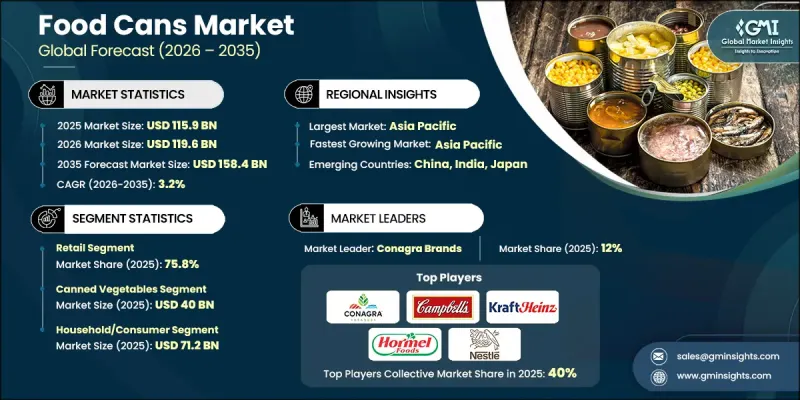
Rising demand for processed and canned foods, coupled with the rapid growth of the ready-to-eat (RTE) segment, is a key factor supporting market growth. Consumers are seeking products that offer long shelf life, easy storage, and portability, prompting manufacturers to innovate with durable and visually appealing can designs. The shift toward sustainable packaging also contributes to market expansion, as eco-friendly cans gain traction among environmentally conscious buyers. Technological advancements in can manufacturing, including enhanced materials and preservation methods, are enabling producers to offer stronger, safer, and more attractive packaging options, reinforcing the market's upward trajectory while catering to evolving consumer lifestyles.
| Market Scope | |
|---|---|
| Start Year | 2025 |
| Forecast Year | 2026-2035 |
| Start Value | $115.9 Billion |
| Forecast Value | $158.4 Billion |
| CAGR | 3.2% |
The online and e-commerce channels segment is expected to grow at a CAGR of 4.4% through 2035, as increasing internet penetration and smartphone usage allow consumers to purchase canned products for home delivery. E-commerce platforms appeal to busy, tech-savvy consumers by offering wide product selections, competitive pricing, and subscription-based promotions, driving higher online sales.
The ready-to-eat meals segment is projected to grow at a CAGR of 4.5% through 2035, fueled by demand for convenient, nutritious, and portable food solutions. Urbanization, busy lifestyles, and the need for time-saving meal options are encouraging manufacturers to produce RTE canned meals with appealing packaging, rich taste, and nutritional value.
North America Food Cans Market accounted for a 31.4% share in 2025. Growth in this region is supported by expanding retail, food processing, and RTE meal sectors. Consumers increasingly prefer packaging that is convenient, environmentally friendly, and maintains product quality over time. The market is driven by strong demand for packaged foods offering extended shelf life, nutritional value, and sustainable packaging, combined with a robust e-commerce ecosystem that enhances accessibility.
Key companies in the Global Food Cans Market include Nestle S.A., Conagra Brands, Campbell Soup Company, Del Monte Foods, Kraft Heinz Company, Hormel Foods Corporation, Dole Food Company, B&G Foods, General Mills, Grupo Calvo, Danish Crown, JBS S.A., Dongwon Industries, Rhodes Food Group, Bolton Group, Ayam Brand, and Bonduelle Group. Companies in the Food Cans Market are leveraging strategies such as innovation in can design and material selection to enhance shelf life, durability, and visual appeal. They are focusing on sustainable and recyclable packaging to address environmental concerns and strengthen brand perception. Expanding online sales channels and strategic partnerships with food manufacturers improve market reach and consumer accessibility. Additionally, firms are adopting digital marketing and subscription-based services to engage busy consumers. Portfolio diversification, including RTE meal cans and specialty product packaging, allows companies to cater to evolving dietary preferences.
Table of Contents
Chapter 1 Methodology and Scope
- 1.1 Market scope and definition
- 1.2 Research design
- 1.2.1 Research approach
- 1.2.2 Data collection methods
- 1.3 Data mining sources
- 1.3.1 Global
- 1.3.2 Regional/Country
- 1.4 Base estimates and calculations
- 1.4.1 Base year calculation
- 1.4.2 Key trends for market estimation
- 1.5 Primary research and validation
- 1.5.1 Primary sources
- 1.6 Forecast model
- 1.7 Research assumptions and limitations
Chapter 2 Executive Summary
- 2.1 Industry 360° synopsis, 2022 - 2035
- 2.2 Key market trends
- 2.2.1 Product type trends
- 2.2.2 Distribution channel trends
- 2.2.3 End use trends
- 2.2.4 Regional trends
- 2.3 TAM analysis, 2026-2035
- 2.4 CXO perspectives: Strategic imperatives
Chapter 3 Industry Insights
- 3.1 Industry ecosystem analysis
- 3.1.1 Supplier landscape
- 3.1.2 Profit margin analysis
- 3.1.3 Cost structure
- 3.1.4 Value addition at each stage
- 3.1.5 Factor affecting the value chain
- 3.1.6 Disruptions
- 3.2 Industry impact forces
- 3.2.1 Growth drivers
- 3.2.1.1 Increase in shelf-stable packaging solutions
- 3.2.1.2 Rising demand for sustainable packaging
- 3.2.1.3 Growth in the ready-to-eat (RTE) food segment
- 3.2.1.4 Increasing demand for processed and canned foods
- 3.2.1.5 Technological advancements in can design
- 3.2.2 Industry pitfalls and challenges
- 3.2.2.1 Competition from alternative packaging
- 3.2.2.2 Fluctuating raw material prices
- 3.2.3 Market opportunities
- 3.2.3.1 Expansion in emerging markets
- 3.2.3.2 Innovations in smart packaging
- 3.2.1 Growth drivers
- 3.3 Growth potential analysis
- 3.4 Regulatory landscape
- 3.4.1 North America
- 3.4.2 Europe
- 3.4.3 Asia Pacific
- 3.4.4 Latin America
- 3.4.5 Middle East & Africa
- 3.5 Porter's analysis
- 3.6 PESTEL analysis
- 3.7 Technology and innovation landscape
- 3.7.1 Current technological trends
- 3.7.2 Emerging technologies
- 3.8 Price trends
- 3.8.1 By region
- 3.8.2 By product
- 3.9 Pricing Strategies
- 3.10 Emerging Business Models
- 3.11 Compliance Requirements
- 3.12 Patent and IP analysis
Chapter 4 Competitive Landscape, 2025
- 4.1 Introduction
- 4.2 Company market share analysis
- 4.2.1 By region
- 4.2.1.1 North America
- 4.2.1.2 Europe
- 4.2.1.3 Asia Pacific
- 4.2.1.4 Latin America
- 4.2.1.5 Middle East & Africa
- 4.2.1 By region
- 4.3 Competitive benchmarking of key players
- 4.3.1 Financial performance comparison
- 4.3.1.1 Revenue
- 4.3.1.2 Profit margin
- 4.3.1.3 R&D
- 4.3.2 Product portfolio comparison
- 4.3.2.1 Product range breadth
- 4.3.2.2 Technology
- 4.3.2.3 Innovation
- 4.3.3 Geographic presence comparison
- 4.3.3.1 Global footprint analysis
- 4.3.3.2 Service network coverage
- 4.3.3.3 Market penetration by region
- 4.3.4 Competitive positioning matrix
- 4.3.4.1 Leaders
- 4.3.4.2 Challengers
- 4.3.4.3 Followers
- 4.3.4.4 Niche players
- 4.3.1 Financial performance comparison
- 4.4 Key developments
- 4.4.1 Mergers and acquisitions
- 4.4.2 Partnerships and collaborations
- 4.4.3 Technological advancements
- 4.4.4 Expansion and investment strategies
- 4.4.5 Digital transformation initiatives
- 4.5 Emerging/ startup competitors landscape
Chapter 5 Market Estimates and Forecast, By Product Type, 2022 - 2035 (USD Billion & Kilo Tons)
- 5.1 Key trends
- 5.2 Canned vegetables
- 5.2.1 Tomatoes
- 5.2.2 Corn
- 5.2.3 Beans
- 5.2.4 Peas
- 5.2.5 Mixed vegetables
- 5.2.6 Mushrooms
- 5.2.7 Others
- 5.3 Canned fish & seafood
- 5.3.1 Tuna
- 5.3.2 Salmon
- 5.3.3 Sardines
- 5.3.4 Mackerel
- 5.3.5 Anchovies
- 5.3.6 Shellfish
- 5.3.7 Others
- 5.4 Canned fruits
- 5.4.1 Peaches
- 5.4.2 Pineapple
- 5.4.3 Mixed fruits
- 5.4.4 Others
- 5.5 Canned meat
- 5.5.1 Chicken
- 5.5.2 Beef
- 5.5.3 Pork
- 5.5.4 Others
- 5.6 Ready-to-eat meals
- 5.6.1 Soups
- 5.6.2 Stews
- 5.6.3 Pasta
- 5.6.4 Others
- 5.7 Others
Chapter 6 Market Estimates and Forecast, By Distribution Channel, 2022 - 2035 (USD Billion & Kilo Tons)
- 6.1 Key trends
- 6.2 Retail
- 6.2.1 Supermarkets and hypermarkets
- 6.2.2 Convenience stores
- 6.2.3 Specialty food stores
- 6.3 Online/E-commerce
- 6.3.1 Foodservice
- 6.3.2 Restaurants
- 6.3.3 Hotels & catering
- 6.3.4 Institutional
Chapter 7 Market Estimates and Forecast, By End Use, 2022 - 2035 (USD Billion & Kilo Tons)
- 7.1 Key trends
- 7.2 Household/consumer
- 7.3 Food processing industry
- 7.4 Institutional & bulk users
Chapter 8 Market Estimates and Forecast, By Region, 2022 - 2035 (USD Billion & Kilo Tons)
- 8.1 Key trends
- 8.2 North America
- 8.2.1 U.S.
- 8.2.2 Canada
- 8.3 Europe
- 8.3.1 Germany
- 8.3.2 UK
- 8.3.3 France
- 8.3.4 Spain
- 8.3.5 Italy
- 8.3.6 Netherlands
- 8.4 Asia Pacific
- 8.4.1 China
- 8.4.2 India
- 8.4.3 Japan
- 8.4.4 Australia
- 8.4.5 South Korea
- 8.5 Latin America
- 8.5.1 Brazil
- 8.5.2 Mexico
- 8.5.3 Argentina
- 8.6 Middle East and Africa
- 8.6.1 South Africa
- 8.6.2 Saudi Arabia
- 8.6.3 UAE
Chapter 9 Company Profiles
- 9.1 Global Key Players
- 9.1.1 Conagra Brands
- 9.1.2 Campbell Soup Company
- 9.1.3 Kraft Heinz Company
- 9.1.4 Hormel Foods Corporation
- 9.1.5 Nestle S.A.
- 9.1.6 General Mills
- 9.2 Regional Key Players
- 9.2.1 North America
- 9.2.1.1 Del Monte Foods
- 9.2.1.2 B&G Foods
- 9.2.1.3 Dole Food Company
- 9.2.2 Europe
- 9.2.2.1 Grupo Calvo
- 9.2.2.2 Danish Crown
- 9.2.2.3 Rhodes Food Group
- 9.2.2.4 Bolton Group
- 9.2.2.5 Bonduelle Group
- 9.2.3 Asia Pacific
- 9.2.3.1 Dongwon Industries
- 9.2.3.2 JBS S.A.
- 9.2.1 North America
- 9.3 Niche / Disruptors
- 9.3.1 Ayam Brand

