PUBLISHER: Global Market Insights Inc. | PRODUCT CODE: 2019086

PUBLISHER: Global Market Insights Inc. | PRODUCT CODE: 2019086
Snacks Processing Machinery Market Opportunity, Growth Drivers, Industry Trend Analysis, and Forecast 2026 - 2035
The Global Snacks Processing Machinery Market was valued at USD 11.1 billion in 2025 and is estimated to grow at a CAGR of 6% to reach USD 19.7 billion by 2035.
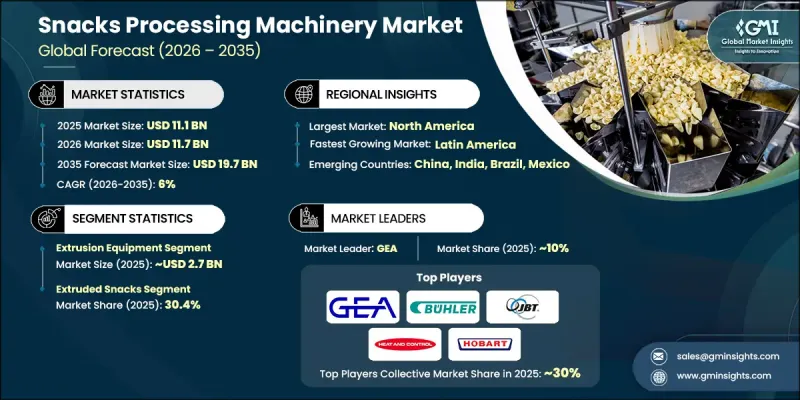
The global snacks processing machinery market is an integral part of the broader industrial machinery sector, supporting the expanding food and beverage industry. Increasing demand for convenient, diverse, and quality snack products is encouraging manufacturers to invest in advanced processing equipment. Market growth is being supported by rapid urban development, evolving retail landscapes, and strict regulatory requirements related to food safety and compliance. Equipment manufacturers are focusing on delivering flexible and energy-efficient systems that support automation and consistent product quality. Buyers are prioritizing machinery with adaptable configurations that allow quick production changes while maintaining efficiency and quality control. Continuous technological advancements are enhancing processing capabilities, enabling manufacturers to align production with modern consumption trends and operational requirements.
| Market Scope | |
|---|---|
| Start Year | 2025 |
| Forecast Year | 2026-2035 |
| Start Value | $11.1 Billion |
| Forecast Value | $19.7 Billion |
| CAGR | 6% |
The snacks processing machinery market includes a wide range of equipment designed to support various stages of production. These systems incorporate technologies for forming, processing, and finishing snack products while maintaining efficiency and consistency. Increasing focus on healthier product offerings is encouraging the development of specialized machinery that supports alternative processing methods. Advanced systems are enabling manufacturers to produce snacks that align with changing dietary preferences while maintaining high production standards and operational efficiency.
In 2025, the extrusion equipment segment generated USD 2.7 billion and is expected to grow at a CAGR of 5.3% from 2026 to 2035. This segment holds a strong position due to its operational flexibility and ability to support a wide variety of product formats. Extrusion systems allow precise control over key processing parameters, enabling manufacturers to achieve desired textures and product consistency. Their versatility supports the production of multiple snack categories, making them an essential component in modern processing operations.
The extruded snacks segment accounted for 30.4% share in 2025 and is projected to grow at a CAGR of 6.1% through 2035. This segment continues to lead due to its adaptability and alignment with evolving consumer preferences. Processing technologies used in this segment enable the development of diverse snack products with varying textures, shapes, and formulations. The ability to incorporate functional ingredients and create differentiated products further supports its strong market position.
United States Snacks Processing Machinery Market reached USD 2.8 billion in 2025 and is expected to grow at a CAGR of 5.2% between 2026 and 2035. The country's leadership is supported by a well-established food processing industry and strong demand for advanced manufacturing technologies. Continuous investment in modern equipment and production capabilities is driving market growth. A robust industrial base and ongoing technological advancements are enabling manufacturers to improve efficiency and maintain competitiveness in the global market.
Key companies operating in the Global Snacks Processing Machinery Market include A.C. Horn Manufacturing, Baker Perkins, Bettcher Industries, Brambati SpA, Buhler, Egan Food Technologies, GEA, Heat and Control, Hobart Food Equipment, Interfood Technology Ltd, JBT FoodTech, Marlen International, Provisur Technologies Inc, Reiser, and Urschel. Companies in the Global Snacks Processing Machinery Market are strengthening their market presence through continuous innovation, strategic partnerships, and expansion of product offerings. They are investing in advanced technologies to enhance automation, improve energy efficiency, and deliver consistent product quality. Collaborations with food manufacturers are enabling better alignment with production requirements and evolving consumer trends. Companies are also expanding their global footprint through distribution networks and localized manufacturing capabilities. In addition, there is a growing focus on developing flexible machinery that supports multiple product types and rapid changeovers. Integration of digital monitoring systems and predictive maintenance solutions is further helping companies improve operational efficiency and provide value-added services to customers.
Table of Contents
Chapter 1 Methodology & Scope
- 1.1 Market scope and definition
- 1.2 Research design
- 1.2.1 Research approach
- 1.2.2 Data collection methods
- 1.3 Data mining sources
- 1.3.1 Global
- 1.3.2 Regional/Country
- 1.4 Base estimates and calculations
- 1.4.1 Base year calculation
- 1.4.2 Key trends for market estimation
- 1.5 Primary research and validation
- 1.5.1 Primary sources
- 1.6 Forecast model
- 1.7 Research assumptions and limitations
Chapter 2 Executive Summary
- 2.1 Industry 360° synopsis
- 2.2 Key market trends
- 2.2.1 Regional
- 2.2.2 Equipment type
- 2.2.3 Capacity
- 2.2.4 Automation level
- 2.2.5 Application
- 2.2.6 Distribution channel
Chapter 3 Industry Insights
- 3.1 Industry ecosystem analysis
- 3.1.1 Supplier landscape
- 3.1.2 Profit margin
- 3.1.3 Value addition at each stage
- 3.1.4 Factor affecting the value chain
- 3.2 Industry impact forces
- 3.2.1 Growth drivers
- 3.2.1.1 Rising global demand for packaged and ready-to-eat snacks
- 3.2.1.2 Technological innovations and equipment advancement
- 3.2.1.3 Expanding emerging markets with growing middle-class populations
- 3.2.2 Industry pitfalls & challenges
- 3.2.2.1 High capital investment requirements
- 3.2.2.2 Stringent regulatory compliance and food safety standards
- 3.2.1 Growth drivers
- 3.3 Growth potential analysis
- 3.4 Future market trends
- 3.5 Technology and innovation landscape
- 3.5.1 Current technological trends
- 3.5.2 Emerging technologies
- 3.6 Price trends
- 3.6.1 By region
- 3.6.2 By equipment type
- 3.7 Regulatory landscape
- 3.7.1 Standards and compliance requirements
- 3.7.2 Regional regulatory frameworks
- 3.7.3 Certification standards
- 3.8 Porter's analysis
- 3.9 PESTEL analysis
- 3.10 Consumer behavior analysis
- 3.10.1 Purchasing patterns
- 3.10.2 Preference analysis
- 3.10.3 Regional variations in consumer behavior
Chapter 4 Competitive Landscape, 2025
- 4.1 Introduction
- 4.2 Company market share analysis
- 4.2.1 By Region
- 4.2.1.1 North America
- 4.2.1.2 Europe
- 4.2.1.3 Asia Pacific
- 4.2.1.4 Latin America
- 4.2.1.5 Middle East & Africa
- 4.2.1 By Region
- 4.3 Company matrix analysis
- 4.4 Competitive analysis of major market players
- 4.5 Competitive positioning matrix
- 4.6 Key developments
- 4.6.1 Mergers & acquisitions
- 4.6.2 Partnerships & collaborations
- 4.6.3 New product launches
- 4.6.4 Expansion plans
Chapter 5 Market Estimates & Forecast, By Equipment Type, 2022 - 2035, (USD Billion) (Units)
- 5.1 Key trends
- 5.2 Baking Equipment
- 5.3 Coating Equipment
- 5.4 Extrusion Equipment
- 5.5 Forming Equipment
- 5.6 Fryer and Roaster Equipment
- 5.7 Mixing Equipment
- 5.8 Packaging Equipment
- 5.9 Others
Chapter 6 Market Estimates & Forecast, By Capacity, 2022 - 2035, (USD Billion) (Units)
- 6.1 Key trends
- 6.2 Low Capacity (Up to 100 Kg/hr)
- 6.3 Mid Capacity (100 - 500 Kg/hr)
- 6.4 High Capacity (Above 500 Kg/hr)
Chapter 7 Market Estimates & Forecast, By Automation Level, 2022 - 2035, (USD Billion) (Units)
- 7.1 Key trends
- 7.2 Automatic
- 7.3 Semi-automatic
- 7.4 Manual
Chapter 8 Market Estimates & Forecast, By Application, 2022 - 2035, (USD Billion) (Units)
- 8.1 Key trends
- 8.2 Extruded Snacks
- 8.3 Chips and Crisps
- 8.4 Nuts and Seeds
- 8.5 Popcorn
- 8.6 Savory & Sweet Snacks
- 8.7 Others
Chapter 9 Market Estimates & Forecast, By Distribution Channel, 2022 - 2035, (USD Billion) (Units)
- 9.1 Key trends
- 9.2 Direct Sales
- 9.3 Indirect Sales
Chapter 10 Market Estimates & Forecast, By Region, 2022 - 2035, (USD Billion) (Units)
- 10.1 Key trends
- 10.2 North America
- 10.2.1 U.S.
- 10.2.2 Canada
- 10.3 Europe
- 10.3.1 Germany
- 10.3.2 UK
- 10.3.3 France
- 10.3.4 Italy
- 10.3.5 Spain
- 10.4 Asia Pacific
- 10.4.1 China
- 10.4.2 India
- 10.4.3 Japan
- 10.4.4 South Korea
- 10.4.5 Australia
- 10.4.6 Indonesia
- 10.4.7 Malaysia
- 10.5 Latin America
- 10.5.1 Brazil
- 10.5.2 Mexico
- 10.5.3 Argentina
- 10.6 MEA
- 10.6.1 Saudi Arabia
- 10.6.2 UAE
- 10.6.3 South Africa
Chapter 11 Company Profiles
- 11.1 A.C. Horn Manufacturing
- 11.2 Baker Perkins
- 11.3 Bettcher Industries
- 11.4 Brambati SpA
- 11.5 Buhler
- 11.6 Egan Food Technologies
- 11.7 GEA
- 11.8 Heat and Control
- 11.9 Hobart Food Equipment
- 11.10 Interfood Technology Ltd
- 11.11 JBT FoodTech
- 11.12 Marlen International
- 11.13 Provisur Technologies Inc
- 11.14 Reiser
- 11.15 Urschel

