PUBLISHER: Global Market Insights Inc. | PRODUCT CODE: 2019088

PUBLISHER: Global Market Insights Inc. | PRODUCT CODE: 2019088
Advanced Traveller Information System Market Opportunity, Growth Drivers, Industry Trend Analysis, and Forecast 2026 - 2035
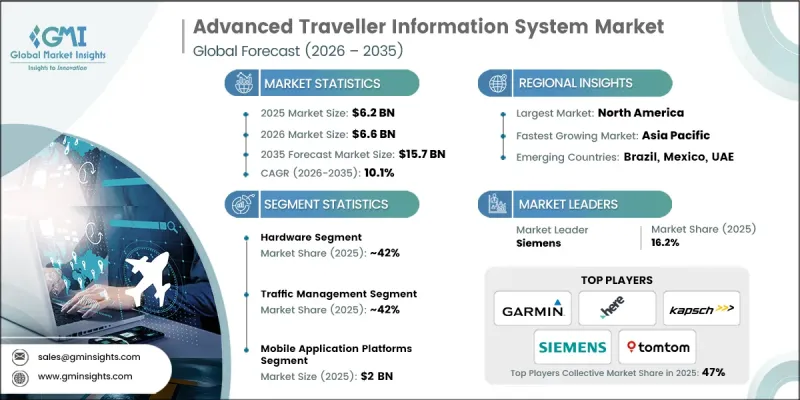
The Global Advanced Traveller Information System Market was valued at USD 6.2 billion in 2025 and is estimated to grow at a CAGR of 10.1% to reach USD 15.7 billion by 2035.
The market growth is fueled by rapid urbanization, rising commuter demand for real-time travel updates, widespread adoption of intelligent transport systems (ITS), and government efforts to enhance smart mobility solutions. Transport authorities and mobility providers are investing heavily in connected infrastructure, integrated information platforms, and real-time traffic monitoring to improve commuter experiences, optimize network efficiency, and reduce congestion. The expansion of public transit systems, demand-responsive transport, and multimodal mobility networks is increasing the need for scalable, technology-driven traveller information solutions. The market is further shaped by digitalization, sustainability mandates, and smart city initiatives, with stakeholders focusing on AI-based traffic prediction, predictive analytics, and mobile-first platforms to enhance commuter experience and network reliability globally.
| Market Scope | |
|---|---|
| Start Year | 2025 |
| Forecast Year | 2026-2035 |
| Start Value | $6.2 Billion |
| Forecast Value | $15.7 Billion |
| CAGR | 10.1% |
The hardware segment accounted for 42% share in 2025 and is expected to grow at a CAGR of 8.7% from 2026 to 2035. Hardware remains critical for real-time data collection, traffic monitoring, and connected vehicle integration, forming the backbone of traveller information systems. Components such as sensors, cameras, GPS devices, roadside units, and communication networks enable predictive routing, traffic detection, and seamless interoperability with software platforms.
The traffic management segment held a 42% share in 2025 and is projected to grow at a CAGR of 12.2% from 2026 to 2035. Traffic management solutions are essential for monitoring, controlling, and optimizing vehicle flow across urban, regional, and highway networks. The increasing demand for AI-assisted traffic forecasting, adaptive signal control, real-time congestion monitoring, and integration with mobility services is driving adoption. High data volumes, predictable infrastructure deployment, and platform interoperability support this segment's market leadership.
U.S. Advanced Traveller Information System Market held a 71% share, generating USD 1.6 billion in 2025. North America leads globally due to mature urban transport networks, extensive ITS adoption, and advanced traffic management infrastructure. Strong highway and public transit systems, combined with AI-enabled route optimization and predictive analytics, position the region as a leader in safe, efficient, and technology-driven traveller information services. Within North America, the United States maintains the largest share, supported by a concentration of transport authorities, integrated urban and interstate mobility networks, and stringent safety and environmental regulations.
Key players in the Global Advanced Traveller Information System Market include Cubic, Garmin, HERE Technologies, INRIX, Iteris, Kapsch TrafficCom, Siemens, Thales, TomTom, and Trimble. Companies in the Advanced Traveller Information System Market are strengthening their position by investing in R&D to develop AI-enabled predictive analytics, connected vehicle integration, and IoT-based traffic sensors. Strategic partnerships with transport authorities, municipal governments, and mobility service providers expand deployment and regional reach. Firms focus on software and hardware interoperability to offer end-to-end solutions and scalable platforms. Adoption of cloud-based services, mobile-first applications, and real-time traveler information solutions enhances customer engagement. Additionally, firms pursue mergers, acquisitions, and technology alliances to consolidate capabilities, enter new markets, and improve service portfolios, while participating in pilot smart city projects to showcase system reliability and efficacy.
Table of Contents
Chapter 1 Methodology & Scope
- 1.1 Research approach
- 1.2 Quality Commitments
- 1.2.1 GMI AI policy & data integrity commitment
- 1.3 Research Trail & Confidence Scoring
- 1.3.1 Research Trail Components
- 1.3.2 Scoring Components
- 1.4 Data Collection
- 1.4.1 Partial list of primary sources
- 1.5 Data mining sources
- 1.5.1 Paid sources
- 1.6 Base estimates and calculations
- 1.6.1 Base year calculation
- 1.7 Forecast model
- 1.8 Research transparency addendum
Chapter 2 Executive Summary
- 2.1 Industry 360° synopsis, 2022 - 2035
- 2.2 Key market trends
- 2.2.1 Regional
- 2.2.2 Component
- 2.2.3 Technology
- 2.2.4 Application
- 2.2.5 End Use
- 2.3 TAM Analysis, 2026-2035
- 2.4 CXO perspectives: Strategic imperatives
Chapter 3 Industry Insights
- 3.1 Industry ecosystem analysis
- 3.1.1 Supplier Landscape
- 3.1.2 Profit Margin
- 3.1.3 Cost structure
- 3.1.4 Value addition at each stage
- 3.1.5 Factor affecting the value chain
- 3.1.6 Disruptions
- 3.2 Industry impact forces
- 3.2.1 Growth drivers
- 3.2.1.1 Rising Urbanization and Commuter Demand
- 3.2.1.2 Government Initiatives and Smart City Programs
- 3.2.1.3 Technological Advancements
- 3.2.1.4 Integration of Multimodal Transport
- 3.2.2 Industry pitfalls and challenges
- 3.2.2.1 High Implementation and Maintenance Costs
- 3.2.2.2 Data Privacy and Cybersecurity Concerns
- 3.2.3 Market opportunities
- 3.2.3.1 AI-Driven Analytics and Predictive Services
- 3.2.3.2 Expansion of Mobile and Cloud-Based Traveler Platforms
- 3.2.3.3 Rising Demand for Real-Time Mobility Applications
- 3.2.3.4 Integration with Multimodal Transport Networks
- 3.2.1 Growth drivers
- 3.3 Growth potential analysis
- 3.4 Regulatory landscape
- 3.4.1 North America
- 3.4.1.1 U.S.: USDOT (U.S. Department of Transportation)
- 3.4.1.2 Canada: Transport Canada, ITS Canada Regulations
- 3.4.2 Europe
- 3.4.2.1 Germany: BMDV (Federal Ministry for Digital and Transport)
- 3.4.2.2 France: Ministry for Ecological Transition and Transport
- 3.4.2.3 UK: Department for Transport (DfT)
- 3.4.2.4 Italy: Ministry of Infrastructure and Transport
- 3.4.3 Asia Pacific
- 3.4.3.1 China: MIIT (Ministry of Industry and Information Technology)
- 3.4.3.2 Japan: MLIT (Ministry of Land, Infrastructure, Transport and Tourism)
- 3.4.3.3 South Korea: MOLIT (Ministry of Land, Infrastructure and Transport)
- 3.4.3.4 India: MoRTH (Ministry of Road Transport and Highways)
- 3.4.4 Latin America
- 3.4.4.1 Brazil: DENATRAN, National Mobility Policy
- 3.4.4.2 Mexico: Secretariat of Infrastructure
- 3.4.5 Middle East and Africa
- 3.4.5.1 UAE: Roads and Transport Authority (RTA)
- 3.4.5.2 Saudi Arabia: Ministry of Transport and Logistic Services
- 3.4.1 North America
- 3.5 Porter's analysis
- 3.6 PESTEL analysis
- 3.7 Technology and Innovation Landscape
- 3.7.1 Current technological trends
- 3.7.2 Emerging technologies
- 3.8 Pricing analysis (Driven by primary research)
- 3.8.1 Historical price trend analysis
- 3.8.2 Pricing strategy by player type (premium / value / cost-plus)
- 3.9 Cost breakdown analysis
- 3.10 Patent analysis (Driven by primary research)
- 3.11 Capacity & production landscape (Driven by primary research)
- 3.11.1 Installed capacity by region & key producer
- 3.11.2 Capacity utilization rates & expansion pipelines
- 3.12 Impact of Artificial Intelligence (AI)
- 3.12.1 AI-Driven Disruption of Existing Business Models
- 3.12.2 GenAI Use Cases & Adoption Roadmap by Segment
- 3.12.3 Risks, limitations & regulatory considerations
- 3.13 Sustainability and Environmental Aspects
- 3.13.1 Sustainable practices
- 3.13.2 Waste reduction strategies
- 3.13.3 Energy efficiency in production
- 3.13.4 Eco-friendly initiatives
- 3.13.5 Carbon footprint considerations
- 3.14 Forecast assumptions & scenario analysis (Driven by primary research)
- 3.14.1 Base Case - key macro & industry variables driving CAGR
- 3.14.2 Optimistic Scenarios - Favorable macro and industry tailwinds
- 3.14.3 Pessimistic Scenario - Macroeconomic slowdown or industry headwinds
Chapter 4 Competitive Landscape, 2025
- 4.1 Introduction
- 4.2 Company market share analysis
- 4.2.1 North America
- 4.2.2 Europe
- 4.2.3 Asia Pacific
- 4.2.4 Latin America
- 4.2.5 Middle East & Africa
- 4.3 Competitive analysis of major market players
- 4.4 Competitive positioning matrix
- 4.5 Strategic outlook matrix
- 4.6 Key developments
- 4.6.1 Mergers & acquisitions
- 4.6.2 Partnerships & collaborations
- 4.6.3 New product launches
- 4.6.4 Expansion plans and funding
Chapter 5 Market Estimates & Forecast, By Component, 2022 - 2035 ($Bn, Units)
- 5.1 Key trends
- 5.2 Software
- 5.2.1 Data Processing & Traffic Analytics Platforms
- 5.2.2 Mobile Application Software
- 5.2.3 Real-Time Routing & Navigation Algorithms
- 5.2.4 API & Data Exchange Platforms
- 5.2.5 AI-Based Predictive Traffic Modeling
- 5.3 Hardware
- 5.3.1 Sensors & Loop Detectors
- 5.3.2 GPS Devices & Navigation Units
- 5.3.3 Digital Signage & Variable Message Signs
- 5.3.4 Kiosks & Public Display Terminals
- 5.3.5 Cameras & Video Surveillance Equipment
- 5.3.6 Edge Computing & Communication Controllers
- 5.4 Services
- 5.4.1 System Integration & Implementation
- 5.4.2 Consulting & Advisory Services
- 5.4.3 Maintenance & Lifecycle Support
- 5.4.4 Data Management & Cloud Hosting Services
- 5.4.5 Managed ITS Services
Chapter 6 Market Estimates & Forecast, By Technology, 2022 - 2035 ($Bn)
- 6.1 Key trends
- 6.2 Mobile Application Platforms
- 6.3 Cloud Computing Solutions
- 6.4 GPS Navigation Systems
- 6.5 Communication Technologies
- 6.6 Digital Signage Solutions
Chapter 7 Market Estimates & Forecast, By Application, 2022 - 2035 ($Bn)
- 7.1 Key trends
- 7.2 Traffic Management
- 7.3 Route Planning & Navigation
- 7.4 Public Transport Management
- 7.5 Emergency & Road Safety Information
- 7.6 Travel Itinerary & Destination Management
Chapter 8 Market Estimates & Forecast, By End Use, 2022 - 2035 ($Bn)
- 8.1 Key trends
- 8.2 Government Agencies
- 8.3 Transport Operators
- 8.4 Individual Consumers
- 8.5 Travel & Tourism Organizations
Chapter 9 Market Estimates & Forecast, By Region, 2022 - 2035 ($Bn)
- 9.1 Key trends
- 9.2 North America
- 9.2.1 US
- 9.2.2 Canada
- 9.3 Europe
- 9.3.1 UK
- 9.3.2 Germany
- 9.3.3 France
- 9.3.4 Italy
- 9.3.5 Spain
- 9.3.6 Belgium
- 9.3.7 Netherlands
- 9.3.8 Sweden
- 9.4 Asia Pacific
- 9.4.1 China
- 9.4.2 India
- 9.4.3 Japan
- 9.4.4 Australia
- 9.4.5 Singapore
- 9.4.6 South Korea
- 9.4.7 Vietnam
- 9.4.8 Indonesia
- 9.5 Latin America
- 9.5.1 Brazil
- 9.5.2 Mexico
- 9.5.3 Argentina
- 9.6 MEA
- 9.6.1 UAE
- 9.6.2 South Africa
- 9.6.3 Saudi Arabia
Chapter 10 Company Profiles
- 10.1 Global Player
- 10.1.1 Cubic
- 10.1.2 Garmin
- 10.1.3 HERE Technologies
- 10.1.4 INRIX
- 10.1.5 Iteris
- 10.1.6 Kapsch TrafficCom
- 10.1.7 Siemens
- 10.1.8 Thales
- 10.1.9 TomTom
- 10.1.10 Trimble
- 10.2 Regional Player
- 10.2.1 Alstom
- 10.2.2 AT&T
- 10.2.3 Cisco Systems
- 10.2.4 Conduent
- 10.2.5 Denso
- 10.2.6 Hitachi
- 10.2.7 IBM
- 10.2.8 PTV
- 10.2.9 Q-Free
- 10.2.10 TransCore

