PUBLISHER: Global Market Insights Inc. | PRODUCT CODE: 2019105

PUBLISHER: Global Market Insights Inc. | PRODUCT CODE: 2019105
Apparel Market Opportunity, Growth Drivers, Industry Trend Analysis, and Forecast 2026 - 2035
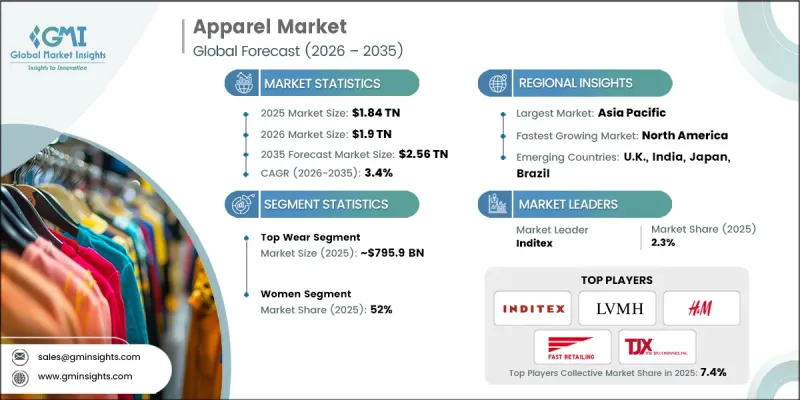
The Global Apparel Market was valued at USD 1.84 trillion in 2025 and is estimated to grow at a CAGR of 3.4% to reach USD 2.56 trillion by 2035.
Growth momentum is driven by rising consumer preference for comfortable and versatile clothing categories, including casual wear and athleisure, alongside evolving fashion influences shaped by digital platforms. Increasing disposable income levels are further strengthening purchasing capacity, while the rapid expansion of e-commerce ecosystems is improving product accessibility and global reach. Supportive policy frameworks are also playing a significant role in shaping industry dynamics, with sustainability-focused initiatives encouraging responsible production practices. Regulatory measures promoting domestic manufacturing and export growth are fostering innovation across the apparel value chain. In addition, technological advancements in fabric development, supply chain optimization, and digital retailing are transforming how apparel is designed, produced, and distributed, enabling brands to respond more effectively to shifting consumer expectations while enhancing operational efficiency across global markets.
| Market Scope | |
|---|---|
| Start Year | 2025 |
| Forecast Year | 2026-2035 |
| Start Value | $1.84 Trillion |
| Forecast Value | $2.56 Trillion |
| CAGR | 3.4% |
The apparel industry continues to evolve as innovation and shifting consumer preferences redefine market direction. Increased emphasis on sustainability is encouraging the use of environmentally responsible materials and production processes. At the same time, digital transformation is reshaping design, manufacturing, and retail operations, enabling faster turnaround times and improved customization capabilities. These developments are contributing to a more agile and responsive market environment, where brands are aligning their offerings with changing lifestyle patterns and long-term environmental considerations.
The top wear segment generated USD 795.9 billion in 2025 and is anticipated to reach USD 1.14 trillion by 2035. This segment's growth is closely linked to evolving lifestyle trends and shifting wardrobe preferences that prioritize comfort and adaptability. The increasing demand for everyday clothing that balances style and functionality is supporting consistent expansion. Additionally, demographic shifts and changing work patterns are influencing purchasing behavior, leading to sustained demand across multiple consumer groups.
The women's segment accounted for 52% share in 2025. Growth in this segment is supported by rising purchasing power and increasing demand for versatile apparel that combines comfort with modern design. Consumers are showing a stronger inclination toward sustainably produced garments, driving demand for environmentally conscious materials and ethical manufacturing practices. This shift is further reinforcing the adoption of responsible fashion approaches, including reduced environmental impact and greater transparency across supply chains, as sustainability continues to influence purchasing decisions.
United States Apparel Market held 79.7% share in 2025, supported by strong consumer spending and a well-established retail infrastructure. The regional market benefits from a diverse product landscape spanning multiple apparel categories, alongside high digital adoption and widespread use of integrated shopping experiences. The continued expansion of online retail platforms and the growing influence of digital marketing strategies are accelerating market growth. Additionally, increasing interest in inclusive and adaptable fashion categories is contributing to broader consumer engagement and sustained demand across the region.
Key players operating in the Global Apparel Market include Adidas, Dior, Fast Retailing, Gap, H&M, Hermes, Inditex, Kering, LVMH, Nike, PVH, Ralph Lauren, Tapestry, TJX, and VF. Companies in the Global Apparel Market are implementing a range of strategic initiatives to strengthen their competitive positioning and expand market share. They are investing heavily in digital transformation, including advanced e-commerce platforms and data-driven personalization tools to enhance customer engagement. Sustainability remains a central focus, with brands adopting eco-friendly materials, circular production models, and transparent sourcing practices. Strategic collaborations, product diversification, and expansion into emerging markets are helping companies broaden their customer base. In addition, firms are optimizing supply chains through automation and nearshoring to improve efficiency and reduce lead times. Strong emphasis on brand building, digital marketing, and omnichannel retailing is further enabling companies to maintain relevance in a highly dynamic and competitive global apparel landscape.
Table of Contents
Chapter 1 Methodology & Scope
- 1.1 Research approach
- 1.2 Quality Commitments
- 1.3 GMI AI policy & data integrity commitment
- 1.3.1 Source consistency protocol
- 1.4 Research Trail & Confidence Scoring
- 1.4.1 Research Trail Components
- 1.4.2 Scoring Components
- 1.5 Data Collection
- 1.5.1 Partial list of primary sources
- 1.6 Data mining sources
- 1.7 Paid sources
- 1.7.1 Sources, by region
- 1.8 Base estimates and calculations
- 1.8.1 Base year calculation for any one approach
- 1.9 Forecast model
- 1.9.1 Quantified market impact analysis
- 1.9.1.1 Mathematical impact of growth parameters on forecast
- 1.9.1 Quantified market impact analysis
- 1.10 Research transparency addendum
- 1.10.1 Source attribution framework
- 1.10.2 Quality assurance metrics
- 1.10.3 Our commitment to trust
Chapter 2 Executive Summary
- 2.1 Industry 360° synopsis
- 2.2 Key market trends
- 2.2.1 Regional
- 2.2.2 Product Type
- 2.2.3 Material
- 2.2.4 Price
- 2.2.5 Consumer Group
- 2.2.6 Distribution Channel
Chapter 3 Industry Insights
- 3.1 Industry ecosystem analysis
- 3.1.1 Supplier landscape
- 3.1.2 Profit margin
- 3.1.3 Value addition at each stage
- 3.1.4 Factor affecting the value chain
- 3.2 Industry impact forces
- 3.2.1 Growth drivers
- 3.2.1.1 Rising demand for athleisure and casual wear
- 3.2.1.2 Growth of customization and personalization
- 3.2.1.3 Increased disposable income
- 3.2.2 Industry pitfalls & challenges
- 3.2.2.1 Price volatility of raw materials
- 3.2.2.2 Rapid change in consumer preference
- 3.2.3 Opportunities
- 3.2.3.1 Sustainability-driven premium solutions
- 3.2.3.2 Rising demand from younger consumers for fast fashion
- 3.2.1 Growth drivers
- 3.3 Growth potential analysis
- 3.4 Future market trends
- 3.5 Technology and innovation landscape
- 3.5.1 Current technological trends
- 3.5.2 Emerging technologies
- 3.6 Price trends
- 3.6.1 By product type
- 3.6.2 By region
- 3.7 Regulatory landscape
- 3.7.1 Standards and compliance requirements
- 3.7.2 Regional regulatory frameworks
- 3.7.3 Certification standards
- 3.8 Trade statistics
- 3.8.1 Major importing countries
- 3.8.2 Major exporting countries
- 3.9 Porter's analysis
- 3.10 PESTEL analysis
- 3.11 Consumer behaviour analysis
- 3.11.1 Purchasing patterns
- 3.11.2 Preference analysis
- 3.11.3 Regional variations in consumer behaviour
- 3.11.4 Impact of e-commerce on buying decisions
Chapter 4 Competitive Landscape, 2025
- 4.1 Introduction
- 4.2 Company market share analysis
- 4.2.1 By region
- 4.2.1.1 North America
- 4.2.1.2 Europe
- 4.2.1.3 Asia Pacific
- 4.2.1.4 Latin America
- 4.2.1.5 Middle East and Africa
- 4.2.1 By region
- 4.3 Company matrix analysis
- 4.4 Competitive analysis of major market players
- 4.5 Competitive positioning matrix
- 4.6 Key developments
- 4.6.1 Mergers & acquisitions
- 4.6.2 Partnerships & collaborations
- 4.6.3 New product launches
- 4.6.4 Expansion plans
Chapter 5 Market Estimates & Forecast, By Product Type, 2022-2035
- 5.1 Key trends
- 5.2 Top wear
- 5.2.1 Shirts & T-shirts
- 5.2.2 Coats & jackets
- 5.2.3 Sweatshirts
- 5.2.4 Pullover & cardigans
- 5.2.5 Others (hats, gloves etc.)
- 5.3 Bottom wear
- 5.3.1 Trousers & jeans
- 5.3.2 Skirts & shorts
- 5.3.3 Joggers & leggings
- 5.3.4 Other (socks, etc.)
- 5.4 Innerwear
- 5.4.1 Bra
- 5.4.2 Briefs
- 5.4.3 Others (vests, panties, etc.)
Chapter 6 Market Estimates & Forecast, By Material, 2022-2035
- 6.1 Key trends
- 6.2 Natural
- 6.2.1 Cotton
- 6.2.2 Linen
- 6.2.3 Wool
- 6.2.4 Silk
- 6.2.5 Others (hemp, bamboo etc.)
- 6.3 Synthetic
- 6.3.1 Polyester
- 6.3.2 Nylon
- 6.3.3 Rayon
- 6.3.4 Polyamide
- 6.3.5 Others (spandex etc.)
Chapter 7 Market Estimates & Forecast, By Price, 2022-2035
- 7.1 Key trends
- 7.2 Low
- 7.3 Medium
- 7.4 High
Chapter 8 Market Estimates & Forecast, By Consumer Group, 2022-2035
- 8.1 Key trends
- 8.2 Kids
- 8.3 Men
- 8.4 Women
Chapter 9 Market Estimates & Forecast, By Distribution Channel, 2022-2035
- 9.1 Key trends
- 9.2 Online
- 9.2.1 E-Commerce
- 9.2.2 Company website
- 9.3 Offline
- 9.3.1 Supermarkets/Hypermarkets
- 9.3.2 Specialty Stores
- 9.3.3 Others (Individual stores, Departmental stores, etc.)
Chapter 10 Market Estimates & Forecast, By Region, 2022-2035
- 10.1 Key trends
- 10.2 North America
- 10.2.1 U.S.
- 10.2.2 Canada
- 10.3 Europe
- 10.3.1 Germany
- 10.3.2 France
- 10.3.3 UK
- 10.3.4 Italy
- 10.3.5 Spain
- 10.4 Asia Pacific
- 10.4.1 China
- 10.4.2 India
- 10.4.3 Japan
- 10.4.4 South Korea
- 10.4.5 Australia
- 10.5 Latin America
- 10.5.1 Brazil
- 10.5.2 Mexico
- 10.5.3 Argentina
- 10.6 MEA
- 10.6.1 South Africa
- 10.6.2 Saudi Arabia
- 10.6.3 UAE
Chapter 11 Company Profiles
- 11.1 Adidas
- 11.2 Dior
- 11.3 Fast Retailing
- 11.4 Gap
- 11.5 H&M
- 11.6 Hermes
- 11.7 Inditex
- 11.8 Kering
- 11.9 LVMH
- 11.10 Nike
- 11.11 PVH
- 11.12 Ralph Lauren
- 11.13 Tapestry
- 11.14 TJX
- 11.15 VF

