PUBLISHER: Global Market Insights Inc. | PRODUCT CODE: 2019106

PUBLISHER: Global Market Insights Inc. | PRODUCT CODE: 2019106
Racing Bike Market Opportunity, Growth Drivers, Industry Trend Analysis, and Forecast 2026 - 2035
The Global Racing Bike Market was valued at USD 7.7 billion in 2025 and is estimated to grow at a CAGR of 3.1% to reach USD 10.3 billion by 2035.
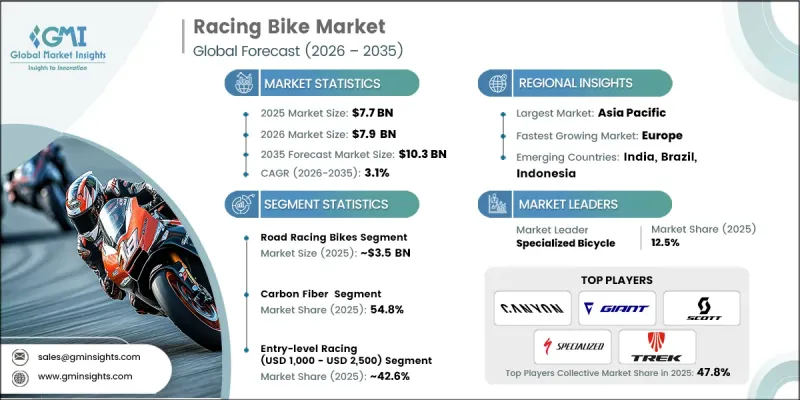
The market expansion is influenced by the growing popularity of competitive cycling events and organized races, which motivate both amateur and professional cyclists to invest in high-performance bikes. Advancements in lightweight frames, aerodynamic designs, and cutting-edge equipment are driving consumer interest in racing bicycles. Regulatory standards set by cycling authorities for technical specifications, such as weight limits and geometry, are shaping product development and ensuring that bikes are optimized for performance and safety. Rising participation in domestic and international cycling competitions, coupled with supportive initiatives from government bodies promoting cycling as a sustainable mode of transport, is further accelerating demand. The increasing interest in health, fitness, and performance-oriented sports is also contributing to sustained growth across various markets globally.
| Market Scope | |
|---|---|
| Start Year | 2025 |
| Forecast Year | 2026-2035 |
| Start Value | $7.7 Billion |
| Forecast Value | $10.3 Billion |
| CAGR | 3.1% |
The road racing bikes segment held a 45.4% share, generating USD 3.5 billion in 2025. Their popularity stems from optimized designs for high-speed performance on paved roads, appealing to both recreational and competitive cyclists. Innovations in technology, lightweight materials, and aerodynamic components have reinforced the widespread adoption of road racing bikes, making them the preferred choice for enthusiasts seeking maximum efficiency and speed.
The carbon fiber segment held 54.8% share in 2025, valued at USD 4.2 billion. Carbon fiber is preferred due to its exceptional strength-to-weight ratio, which is crucial for competitive performance. Manufacturers design carbon fiber frames to ensure superior rigidity and aerodynamics, maximizing power transfer between rider and road. This has made carbon fiber racing bikes highly desirable for events where speed, agility, and endurance are critical.
U.S. Racing Bike Market was valued at USD 1.2 billion in 2025 and is expected to grow at a CAGR of 2.3% from 2026 to 2035. The United States has a well-established cycling culture and a mature market for performance-oriented bicycles. Domestic competitive events and structured cycling programs drive consumer interest in high-performance and racing bikes. The popularity of road cycling, fitness initiatives, and recreational biking also supports demand for technologically advanced, lightweight, and durable racing bicycles.
Key players operating in the Global Racing Bike Market include BMC, Cannondale, Canyon, Cervelo, Giant, Merida, Pinarello, Scott, Specialized, and Trek. Companies in the Global Racing Bike Market are leveraging technological innovation, lightweight materials, and aerodynamic designs to strengthen their market presence. They invest in R&D to develop carbon fiber frames, advanced drivetrains, and high-performance components that cater to both professional and amateur cyclists. Strategic partnerships with competitive cycling events, sponsorships, and collaborations with professional riders help brands build credibility and visibility. Expanding online and retail distribution networks allows companies to reach global markets efficiently. Additionally, firms are focusing on customization options, limited-edition models, and integrated digital performance tracking to differentiate products, enhance user experience, and capture a loyal customer base while maintaining premium positioning in the competitive racing bike segment.
Table of Contents
Chapter 1 Methodology
- 1.1 Research approach
- 1.2 Quality Commitments
- 1.2.1 GMI AI policy & data integrity commitment
- 1.3 Research Trail & Confidence Scoring
- 1.3.1 Research Trail Components
- 1.3.2 Scoring Components
- 1.4 Data Collection
- 1.5 Data mining sources
- 1.5.1 Paid sources
- 1.6 Base estimates and calculations
- 1.6.1 Base year calculation for any one approach
- 1.7 Forecast
- 1.7.1 Quantified market impact analysis
- 1.8 Research transparency addendum
- 1.8.1 Source attribution framework
- 1.8.2 Quality assurance metrics
- 1.8.3 Our commitment to trust
Chapter 2 Executive Summary
- 2.1 Industry 360° synopsis
- 2.2 Key market trends
- 2.2.1 Regional
- 2.2.2 Bike
- 2.2.3 Frame Material
- 2.2.4 Price Range
- 2.2.5 End-Use
- 2.2.6 Distribution Channel
- 2.3 TAM analysis, 2026-2035
- 2.4 CXO perspectives: Strategic imperatives
Chapter 3 Industry Insights
- 3.1 Industry ecosystem analysis
- 3.1.1 Supplier landscape
- 3.1.2 Profit margin
- 3.1.3 Cost structure
- 3.1.4 Value addition at each stage
- 3.1.5 Factor affecting the value chain
- 3.1.6 Disruptions
- 3.2 Industry impact forces
- 3.2.1 Growth drivers
- 3.2.1.1 Growing health & fitness consciousness
- 3.2.1.2 Rising participation in competitive cycling events
- 3.2.1.3 Professional racing influence & aspirational purchases
- 3.2.1.4 Infrastructure development (bike lanes, velodrome construction)
- 3.2.2 Industry pitfalls and challenges
- 3.2.2.1 Supply chain disruptions & component shortages
- 3.2.2.2 Competition from e-bikes & alternative fitness activities
- 3.2.3 Market opportunities
- 3.2.3.1 Emerging markets with growing cycling culture
- 3.2.3.2 Women's racing segment expansion
- 3.2.3.3 Rental & bike-sharing for events
- 3.2.1 Growth drivers
- 3.3 Growth potential analysis
- 3.4 Regulatory landscape
- 3.4.1 North America
- 3.4.1.1 U.S. - Consumer Product Safety Commission (CPSC)
- 3.4.1.2 U.S. - ASTM International
- 3.4.1.3 Canada - Transport Canada
- 3.4.2 Europe
- 3.4.2.1 Germany - TUV Rheinland
- 3.4.2.2 France - AFNOR
- 3.4.3 Asia Pacific
- 3.4.3.1 China - AQSIQ
- 3.4.3.2 India - Bureau of Indian Standards (BIS)
- 3.4.4 Latin America
- 3.4.4.1 Brazil - INMETRO
- 3.4.4.2 Mexico - Secretaria de Economia
- 3.4.5 Middle East & Africa
- 3.4.5.1 UAE - ESMA
- 3.4.5.2 Saudi Arabia - Saudi Standards, Metrology and Quality Organization (SASO)
- 3.4.1 North America
- 3.5 Investment & funding analysis
- 3.6 Porter's analysis
- 3.7 PESTEL analysis
- 3.8 Technology and innovation landscape
- 3.8.1 Current technologies
- 3.8.1.1 Carbon Fiber Frames
- 3.8.1.2 Electronic Shifting (Di2 / eTap)
- 3.8.1.3 Hydraulic Disc Brakes
- 3.8.1.4 Aerodynamic Frame Design
- 3.8.2 Emerging technologies
- 3.8.2.1 Smart Connected Bikes
- 3.8.2.2 Advanced Composite Materials
- 3.8.2.3 Adaptive Aerodynamics
- 3.8.1 Current technologies
- 3.9 Pricing analysis (Driven by Primary Research)
- 3.9.1 Historical Price Trend Analysis
- 3.9.2 Pricing Strategy by Player Type (Premium / Value / Cost-plus)
- 3.10 Patent landscape (Driven by Primary Research)
- 3.11 Trade Data Analysis (Driven by Paid Database)
- 3.11.1 Import/Export Volume & Value Trends
- 3.11.2 Key Trade Corridors & Tariff Impact
- 3.12 Capacity & Production Landscape (Driven by Primary Research)
- 3.12.1 Installed Capacity by Region & Key Producer
- 3.12.2 Capacity Utilization Rates & Expansion Pipelines
- 3.13 Impact of AI & Generative AI on the Market
- 3.13.1 AI-driven disruption of existing business models
- 3.13.2 GenAI use cases & adoption roadmap by segment
- 3.13.3 Risks, limitations & regulatory considerations
- 3.14 Cost breakdown analysis
- 3.15 Consumer demographics & psychographics assessment
- 3.15.1 Age and gender distribution
- 3.15.2 Income and spending patterns
- 3.15.3 Lifestyle and fitness orientation
- 3.15.4 Geographic and urbanization factors
- 3.16 Case studies
- 3.17 Forecast assumptions & scenario analysis (Driven by Primary Research)
- 3.17.1 Base Case - key macro & industry variables driving CAGR
- 3.17.2 Optimistic Scenarios - Favorable macro and industry tailwinds
- 3.17.3 Pessimistic Scenario - Macroeconomic slowdown or industry headwinds
Chapter 4 Competitive Landscape, 2025
- 4.1 Introduction
- 4.2 Company market share analysis
- 4.2.1 North America
- 4.2.2 Europe
- 4.2.3 Asia Pacific
- 4.2.4 LATAM
- 4.2.5 MEA
- 4.3 Competitive analysis of major market players
- 4.4 Competitive positioning matrix
- 4.5 Key developments
- 4.5.1 Mergers & acquisitions
- 4.5.2 Partnerships & collaborations
- 4.5.3 New product launches
- 4.5.4 Expansion plans and funding
- 4.6 Company tier benchmarking
- 4.6.1 Tier classification criteria & qualifying thresholds
- 4.6.2 Tier positioning matrix by revenue, geography & innovation
Chapter 5 Market Estimates & Forecast, By Bike, 2022 - 2035 ($Mn, Thousand Units)
- 5.1 Key trends
- 5.2 Road racing bikes
- 5.3 Track/Velodrome bikes
- 5.4 Cyclocross bikes
- 5.5 Mountain racing bikes
- 5.6 Time Trial/Triathlon bikes
- 5.7 Gravel racing bikes
Chapter 6 Market Estimates & Forecast, By Frame Material, 2022 - 2035 ($Mn, Thousand Units)
- 6.1 Key trends
- 6.2 Carbon fiber
- 6.3 Aluminum alloy
- 6.4 Titanium
- 6.5 Steel
Chapter 7 Market Estimates & Forecast, By Price Range, 2022 - 2035 ($Mn, Thousand Units)
- 7.1 Key trends
- 7.2 Entry-level racing (USD 1,000 - USD 2,500)
- 7.3 Mid-range performance (USD 2,500 - USD 5,000)
- 7.4 High-end enthusiast (Above USD 5,000)
Chapter 8 Market Estimates & Forecast, By End-Use, 2022 - 2035 ($Mn, Thousand Units)
- 8.1 Key trends
- 8.2 Professional racing teams
- 8.3 Amateur competitive cyclists
- 8.4 Performance enthusiasts
Chapter 9 Market Estimates & Forecast, By Distribution Channel, 2022 - 2035 ($Mn, Thousand Units)
- 9.1 Key trends
- 9.2 Online
- 9.2.1 Direct-to-consumer e-commerce
- 9.2.2 Brand website
- 9.3 Offline
- 9.3.1 Brand flagship stores
- 9.3.2 Specialty bike shops
- 9.3.2.1 Independent bike retailers
- 9.3.2.2 Authorized brand dealers
- 9.3.3 Sporting goods retailers
Chapter 10 Market Estimates & Forecast, By Region, 2022 - 2035 ($Mn, Thousand Units)
- 10.1 Key trends
- 10.2 North America
- 10.2.1 US
- 10.2.2 Canada
- 10.3 Europe
- 10.3.1 Germany
- 10.3.2 UK
- 10.3.3 France
- 10.3.4 Italy
- 10.3.5 Spain
- 10.3.6 Poland
- 10.3.7 Netherlands
- 10.3.8 Norway
- 10.4 Asia Pacific
- 10.4.1 China
- 10.4.2 India
- 10.4.3 Japan
- 10.4.4 South Korea
- 10.4.5 Australia
- 10.4.6 Singapore
- 10.4.7 Malaysia
- 10.4.8 Vietnam
- 10.5 Latin America
- 10.5.1 Brazil
- 10.5.2 Mexico
- 10.5.3 Argentina
- 10.5.4 Colombia
- 10.6 MEA
- 10.6.1 South Africa
- 10.6.2 Saudi Arabia
- 10.6.3 UAE
Chapter 11 Company Profiles
- 11.1 Global players
- 11.1.1 Specialized Bicycle
- 11.1.2 Trek Bicycle
- 11.1.3 Giant Manufacturing
- 11.1.4 Canyon Bicycles
- 11.1.5 Scott Sports
- 11.1.6 Cannondale Bicycle
- 11.1.7 Merida Industry
- 11.1.8 Cervelo Cycles
- 11.1.9 Pinarello
- 11.1.10 BMC Switzerland
- 11.2 Regional players
- 11.2.1 Wilier Triestina
- 11.2.2 Look Cycle
- 11.2.3 Eddy Merckx Cycles
- 11.2.4 De Rosa
- 11.2.5 Fuji Bikes
- 11.2.6 Felt Bicycles
- 11.3 Emerging players
- 11.3.1 Factor Bikes
- 11.3.2 3T Cycling
- 11.3.3 Allied Cycle Works
- 11.3.4 Ribble Cycles

