PUBLISHER: Global Market Insights Inc. | PRODUCT CODE: 2019110

PUBLISHER: Global Market Insights Inc. | PRODUCT CODE: 2019110
Animal Disinfectants Market Opportunity, Growth Drivers, Industry Trend Analysis, and Forecast 2026 - 2035
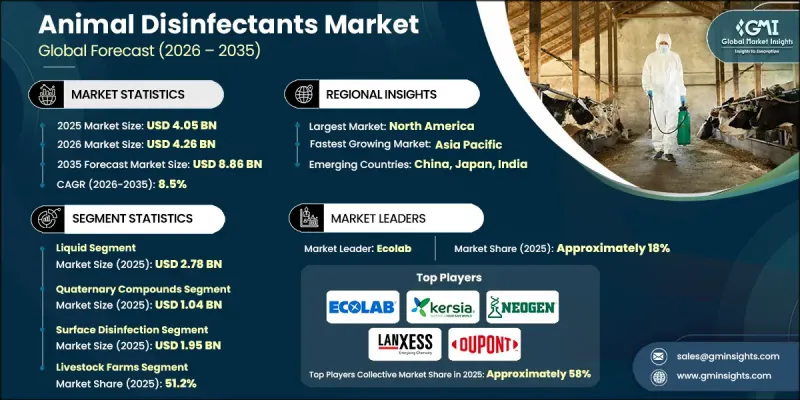
The Global Animal Disinfectants Market was valued at USD 4.05 billion in 2025 and is estimated to grow at a CAGR of 8.5% to reach USD 8.86 billion by 2035.
Market expansion is driven by the increasing focus on biosecurity, disease prevention, and hygiene management across animal care environments. Disinfectant solutions play a critical role in maintaining sanitary conditions, supporting animal health, and minimizing the risk of infection spread. Among the various product types, quaternary compounds are widely adopted due to their broad-spectrum antimicrobial performance, long-lasting residual effect, and operational convenience. These compounds are recognized for their ability to provide effective surface disinfection while maintaining material compatibility and stability. Growing concerns around disease outbreaks and stricter hygiene protocols are encouraging the use of reliable disinfectants, which is accelerating product innovation and competition in the market. In parallel, hydrogen peroxide-based solutions are gaining momentum due to their strong antimicrobial properties and adaptability across different applications. Continuous investment in formulation improvements and application technologies is enhancing product efficiency, safety, and ease of use, supporting the overall advancement of the animal disinfectants market.
| Market Scope | |
|---|---|
| Start Year | 2025 |
| Forecast Year | 2026-2035 |
| Start Value | $4.05 Billion |
| Forecast Value | $8.86 Billion |
| CAGR | 8.5% |
The liquid segment generated USD 2.78 billion in 2025 and is expected to grow at a CAGR of 8.6% from 2026 to 2035. Its strong market position is supported by ease of application, efficient dilution, and the ability to achieve consistent surface coverage. These formulations are compatible with commonly used delivery systems, enabling effective large-scale sanitation. In contrast, powder disinfectants remain relevant in environments where storage convenience, transport efficiency, and cost considerations are critical. While liquid formats are projected to grow at a faster pace due to operational advantages, powder-based solutions continue to support specific use cases, ensuring a balanced demand across different product forms.
The quaternary compounds segment reached USD 1.04 billion in 2025 and is anticipated to grow at a CAGR of 8.5% through 2035. Its dominance is attributed to its effectiveness across a wide range of microorganisms, compatibility with various surfaces, and suitability for routine sanitation practices. Other disinfectant categories, including iodine-based, chlorine-based, hydrogen peroxide, organic acids, and chlorhexidine formulations, address specific requirements based on environmental conditions, targeted pathogens, and safety considerations. Increasing attention to formulation safety, residue management, and targeted application is supporting steady demand across both conventional and emerging disinfectant solutions.
North America Animal Disinfectants Market accounted for USD 1.32 billion in 2025. The region demonstrates a well-established adoption of disinfectant products, supported by organized animal care systems and advanced veterinary infrastructure. The United States plays a leading role in regional demand, driven by large-scale animal production systems that prioritize hygiene and disease control measures. Canada contributes to market growth through consistent implementation of regulated animal health practices and adherence to biosecurity standards across commercial operations.
Key companies operating in the Global Animal Disinfectants Market include Lanxess AG, Evonik Industries AG, Solvay Group, Kersia Group, Ecolab (including CID LINES), Neogen Corporation, Kemin Industries, DuPont Animal Health, Christeyns, Antec International, Virox Technologies, and STOCKMEIER Group. Companies in the Animal Disinfectants Market are focusing on innovation, strategic alliances, and geographic expansion to strengthen their competitive position. They are investing in research and development to create advanced formulations with improved efficacy, safety, and environmental compatibility. Collaborations with distributors and animal health organizations are helping expand market reach and enhance product adoption. Manufacturers are also optimizing production processes and supply chains to ensure cost efficiency and consistent product availability. In addition, companies are emphasizing regulatory compliance and quality assurance to build trust and credibility.
Table of Contents
Chapter 1 Methodology
- 1.1 Market scope and definition
- 1.2 Research design
- 1.2.1 Research approach
- 1.2.2 Data collection methods
- 1.3 Data mining sources
- 1.3.1 Global
- 1.3.2 Regional/Country
- 1.4 Base estimates and calculations
- 1.4.1 Base year calculation
- 1.4.2 Key trends for market estimation
- 1.5 Primary research and validation
- 1.5.1 Primary sources
- 1.6 Forecast model
- 1.7 Research assumptions and limitations
Chapter 2 Executive Summary
- 2.1 Industry 360° synopsis
- 2.2 Key market trends
- 2.2.1 Regional
- 2.2.2 Form
- 2.2.3 Type
- 2.2.4 Application Method
- 2.2.5 End Use
- 2.3 TAM Analysis, 2026-2035
- 2.4 CXO perspectives: Strategic imperatives
Chapter 3 Industry Insights
- 3.1 Industry ecosystem analysis
- 3.1.1 Supplier Landscape
- 3.1.2 Profit Margin
- 3.1.3 Value addition at each stage
- 3.1.4 Factor affecting the value chain
- 3.1.5 Disruptions
- 3.2 Industry impact forces
- 3.2.1 Growth drivers
- 3.2.2 Industry pitfalls and challenges
- 3.2.3 Market opportunities
- 3.3 Growth potential analysis
- 3.4 Regulatory landscape
- 3.4.1 North America
- 3.4.2 Europe
- 3.4.3 Asia Pacific
- 3.4.4 Latin America
- 3.4.5 Middle East & Africa
- 3.5 Porter's analysis
- 3.6 PESTEL analysis
- 3.7 Price trends
- 3.7.1 By region
- 3.7.2 By product
- 3.8 Future market trends
- 3.9 Technology and Innovation landscape
- 3.9.1 Current technological trends
- 3.9.2 Emerging technologies
- 3.10 Patent Landscape
- 3.11 Trade statistics
- 3.11.1 Major importing countries
- 3.11.2 Major exporting countries
- 3.12 Sustainability and Environmental Aspects
- 3.12.1 Sustainable Practices
- 3.12.2 Waste Reduction Strategies
- 3.12.3 Energy Efficiency in Production
- 3.12.4 Eco-friendly Initiatives
- 3.13 Carbon Footprint Considerations
Chapter 4 Competitive Landscape, 2025
- 4.1 Introduction
- 4.2 Company market share analysis
- 4.2.1 By region
- 4.2.1.1 North America
- 4.2.1.2 Europe
- 4.2.1.3 Asia Pacific
- 4.2.1.4 LATAM
- 4.2.1.5 MEA
- 4.2.1 By region
- 4.3 Company matrix analysis
- 4.4 Competitive analysis of major market players
- 4.5 Competitive positioning matrix
- 4.6 Key developments
- 4.6.1 Mergers & acquisitions
- 4.6.2 Partnerships & collaborations
- 4.6.3 New Product Launches
- 4.6.4 Expansion Plans
Chapter 5 Market Estimates and Forecast, By Form, 2022- 2035 (USD Billion, Kilo Tons)
- 5.1 Key trends
- 5.2 Liquid
- 5.3 Powder
Chapter 6 Market Estimates and Forecast, By Type, 2022- 2035 (USD Billion, Kilo Tons)
- 6.1 Key trends
- 6.2 Quaternary Compounds
- 6.3 Iodine
- 6.4 Hydrogen Peroxide
- 6.5 Phenolic Acids
- 6.6 Chlorine
- 6.7 Chlorine Dioxide
- 6.8 Lactic Acid
- 6.9 Chlorhexidine
- 6.10 Glycolic Acid
- 6.11 Others
Chapter 7 Market Estimates and Forecast, By Application Method, 2022 - 2035 (USD Billion, Kilo Tons)
- 7.1 Key trends
- 7.2 Surface Disinfection
- 7.3 Aerial/Fogging Disinfection
- 7.4 Water Treatment
- 7.5 Equipment Sanitization
Chapter 8 Market Estimates and Forecast, By End Use, 2022 - 2035 (USD Billion, Kilo Tons)
- 8.1 Key trends
- 8.2 Livestock Farms
- 8.3 Veterinary Clinics
- 8.4 Research Laboratories
- 8.5 Others
Chapter 9 Market Estimates and Forecast, By Region, 2022 - 2035 (USD Billion, Kilo Tons)
- 9.1 Key trends
- 9.2 North America
- 9.2.1 U.S.
- 9.2.2 Canada
- 9.3 Europe
- 9.3.1 Germany
- 9.3.2 UK
- 9.3.3 France
- 9.3.4 Italy
- 9.3.5 Spain
- 9.3.6 Rest of Europe
- 9.4 Asia Pacific
- 9.4.1 China
- 9.4.2 India
- 9.4.3 Japan
- 9.4.4 Australia
- 9.4.5 South Korea
- 9.4.6 Rest of Asia Pacific
- 9.5 Latin America
- 9.5.1 Brazil
- 9.5.2 Mexico
- 9.5.3 Argentina
- 9.5.4 Rest of Latin America
- 9.6 Middle East & Africa
- 9.6.1 Saudi Arabia
- 9.6.2 South Africa
- 9.6.3 UAE
- 9.6.4 Rest of Middle East & Africa
Chapter 10 Company Profiles
- 10.1 Kersia Group
- 10.2 Antec International
- 10.3 Virox Technologies
- 10.4 Ecolab (includes CID LINES)
- 10.5 Christeyns
- 10.6 Evonik Industries AG
- 10.7 Lanxess AG
- 10.8 Solvay Group
- 10.9 STOCKMEIER Group
- 10.10 DuPont Animal Health
- 10.11 Neogen Corporation
- 10.12 Kemin Industries

