PUBLISHER: Global Market Insights Inc. | PRODUCT CODE: 2019112

PUBLISHER: Global Market Insights Inc. | PRODUCT CODE: 2019112
Underwater Bikes Market Opportunity, Growth Drivers, Industry Trend Analysis, and Forecast 2026 - 2035
The Global Underwater Bikes Market was valued at USD 32.8 million in 2025 and is estimated to grow at a CAGR of 3.1% to reach USD 44.3 million by 2035.
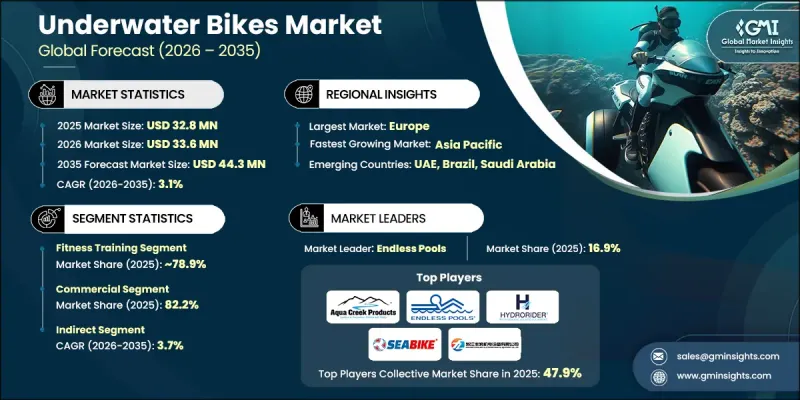
The increasing popularity of underwater bikes is being driven by their ability to provide low-impact exercise while improving cardiovascular health, muscle tone, and overall wellness. These devices, designed to be pedaled underwater, are increasingly adopted in fitness centers, rehabilitation facilities, and aquatic gyms because they offer a safe, joint-friendly alternative to conventional exercise equipment. Consumers are recognizing the value of aquatic workouts for injury recovery and gentle strength training. Rising awareness of fitness, combined with government and private health initiatives promoting wellness programs, has also helped elevate underwater cycling as a mainstream activity. Additionally, manufacturers are expanding online and offline distribution channels to reach consumers in emerging markets, while technological innovations and high-quality materials enhance user experience and durability, further boosting market adoption.
| Market Scope | |
|---|---|
| Start Year | 2025 |
| Forecast Year | 2026-2035 |
| Start Value | $32.8 Million |
| Forecast Value | $44.3 Million |
| CAGR | 3.1% |
The fitness training segment generated USD 25.9 million, holding a 78.9% share in 2025. Fitness enthusiasts and rehabilitation centers prefer underwater bikes due to water resistance, which promotes muscle engagement without stressing joints. These bikes are particularly useful for seniors and individuals with mobility challenges, providing cardiovascular benefits, strength toning, and calorie burning in a controlled aquatic environment. Increased awareness through health campaigns and fitness influencers has also contributed to the rising adoption of water cycling as part of mainstream wellness culture.
The commercial segment accounted for 82.2% share in 2025 and is expected to grow at a CAGR of 3.4% through 2035. Hotels, resorts, fitness centers, and aquatic facilities invest in underwater bikes to offer structured fitness programs, rehabilitation sessions, and recreational experiences. Commercially designed bikes with advanced features and durability are preferred for high-traffic facilities. The integration of specialized bikes in wellness programs enhances customer retention and adds value to premium services in spas, gyms, and rehabilitation centers, driving consistent demand.
U.S. Underwater Bikes Market reached USD 12.2 million in 2025 and is projected to grow at a CAGR of 2.6% from 2026 to 2035. Growth in the region is driven by well-established wellness and rehabilitation programs, strong consumer spending on fitness, and the increasing popularity of aquatic exercise for heart health, mobility, and muscle engagement. Organizations supporting aquatic exercise provide guidelines and training protocols, indirectly encouraging the adoption of underwater bikes in fitness, therapy, and sports medicine settings.
Key players operating in the Global Underwater Bikes Market include Aqua Body Strong, Aqua Creek, Endless Pools, Evoke Fitness, EWAC Medical, Hydrorider, POOLBIKING, SEABIKE, Waterflex, and Zhejiang Fenglang. Companies in the Underwater Bikes Market are focusing on expanding distribution channels and strengthening e-commerce presence to reach emerging and untapped markets. They are investing in R&D to enhance bike durability, ergonomics, and water resistance, ensuring a premium user experience. Strategic partnerships with fitness centers, aquatic gyms, and rehabilitation facilities are helping firms integrate products into structured wellness programs. Brands are also emphasizing awareness campaigns, product demonstrations, and professional endorsements to build credibility and drive adoption. Additionally, companies are differentiating their offerings through innovative designs, adjustable resistance systems, and customizable features that cater to diverse age groups, fitness levels, and rehabilitation requirements, strengthening their foothold in the competitive underwater bikes industry.
Table of Contents
Chapter 1 Methodology
- 1.1 Research approach
- 1.2 Quality commitments
- 1.2.1 GMI AI policy & data integrity commitment
- 1.3 Research trail & confidence scoring
- 1.3.1 Research trail components
- 1.3.2 Scoring components
- 1.4 Data collection
- 1.4.1 Partial list of primary sources
- 1.5 Data mining sources
- 1.5.1 Paid sources
- 1.6 Base estimates and calculations
- 1.6.1 Base year calculation
- 1.7 Forecast model
- 1.8 Research transparency addendum
Chapter 2 Executive Summary
- 2.1 Industry 360° synopsis
- 2.2 Key market trends
- 2.2.1 Regional
- 2.2.2 Application
- 2.2.3 End Use
- 2.2.4 Distribution Channel
- 2.3 TAM analysis, 2026-2035
- 2.4 CXO perspectives: Strategic imperatives
Chapter 3 Industry Insights
- 3.1 Industry ecosystem analysis
- 3.1.1 Supplier landscape
- 3.1.2 Profit margin
- 3.1.3 Cost structure
- 3.1.4 Value addition at each stage
- 3.1.5 Factor affecting the value chain
- 3.1.6 Disruptions
- 3.2 Industry impact forces
- 3.2.1 Growth drivers
- 3.2.1.1 Rising health & wellness consciousness driving aquatic fitness adoption
- 3.2.1.2 Growth in adventure tourism & underwater recreation activities
- 3.2.1.3 Advancements in underwater bike designs and technology
- 3.2.1.4 Increasing investment in luxury resorts & aquatic wellness facilities
- 3.2.2 Industry pitfalls and challenges
- 3.2.2.1 Safety concerns & regulatory challenges in open-water applications
- 3.2.2.2 Competition from alternative water sports & fitness equipment
- 3.2.3 Market opportunities
- 3.2.3.1 Untapped potential in rehabilitation & therapeutic applications
- 3.2.3.2 Expansion of rental models through coastal tourism operators
- 3.2.3.3 Growing demand in corporate wellness & hotel amenity programs
- 3.2.1 Growth drivers
- 3.3 Growth potential analysis
- 3.4 Regulatory landscape
- 3.4.1 North America
- 3.4.1.1 U.S. Consumer Product Safety Commission (CPSC)
- 3.4.1.2 Food and Drug Administration (FDA)
- 3.4.1.3 Health Canada
- 3.4.2 Europe
- 3.4.2.1 European Commission (EC)
- 3.4.2.2 European Committee for Standardization (CEN)
- 3.4.3 Asia Pacific
- 3.4.3.1 State Administration for Market Regulation (SAMR)
- 3.4.3.2 Bureau of Indian Standards (BIS)
- 3.4.3.3 Japanese Industrial Standards Committee (JISC)
- 3.4.4 Latin America
- 3.4.4.1 ANVISA
- 3.4.4.2 INMETRO
- 3.4.5 Middle East & Africa
- 3.4.5.1 Saudi Food and Drug Authority (SFDA)
- 3.4.5.2 Gulf Standardization Organization (GSO)
- 3.4.1 North America
- 3.5 Investment & funding analysis
- 3.6 Porter's analysis
- 3.7 PESTEL analysis
- 3.8 Technology and innovation landscape
- 3.8.1 Current technological trends
- 3.8.1.1 Corrosion-Resistant Materials
- 3.8.1.2 Adjustable Resistance Mechanisms
- 3.8.1.3 Compact & Portable Designs
- 3.8.2 Emerging technologies
- 3.8.2.1 Sensor-Based Performance Monitoring
- 3.8.2.2 Hydrodynamic Optimization
- 3.8.1 Current technological trends
- 3.9 Pricing analysis (Driven by Primary Research)
- 3.9.1 Historical price trend analysis
- 3.9.2 Pricing strategy by player type (Premium / Value / Cost-plus)
- 3.10 Trade data analysis (Driven by Paid Database)
- 3.10.1 Import/export volume & value trends
- 3.10.2 Key trade corridors & tariff impact
- 3.11 Capacity & Production Landscape (Driven by Primary Research)
- 3.11.1 Installed Capacity by Region & Key Producer
- 3.11.2 Capacity Utilization Rates & Expansion Pipelines
- 3.12 Patent landscape (Driven by Primary Research)
- 3.13 Sustainability and environmental impact
- 3.13.1 Environmental impact assessment
- 3.13.2 Social impact & community benefits
- 3.13.3 Governance & corporate responsibility
- 3.13.4 Sustainable finance & investment trends
- 3.14 Impact of AI on the underwater bikes market
- 3.14.1 AI-driven disruption of existing business models
- 3.14.2 GenAI use cases & adoption roadmap by segment
- 3.14.3 Risks, limitations & regulatory considerations
- 3.15 Marketing & branding strategies
- 3.15.1 Product positioning & differentiation
- 3.15.2 Pricing & promotional strategies
- 3.15.3 Distribution & channel strategies
- 3.15.4 Brand collaboration & co-branding initiatives
- 3.16 Tourism & leisure industry synergies
- 3.16.1 Integration in hotels & resorts
- 3.16.2 Wellness & spa programs
- 3.16.3 Adventure & recreational tourism
- 3.16.4 Event-based marketing & fitness tourism
- 3.17 Case studies
- 3.18 Forecast assumptions & scenario analysis (Driven by primary research)
- 3.18.1 Base Case - key macro & industry variables driving CAGR
- 3.18.2 Optimistic Scenarios - Favorable macro and industry tailwinds
- 3.18.3 Pessimistic Scenario - Macroeconomic slowdown or industry headwinds
Chapter 4 Competitive Landscape, 2025
- 4.1 Introduction
- 4.2 Company market share analysis
- 4.2.1 North America
- 4.2.2 Europe
- 4.2.3 Asia Pacific
- 4.2.4 LATAM
- 4.2.5 MEA
- 4.3 Competitive analysis of major market players
- 4.4 Competitive positioning matrix
- 4.5 Key developments
- 4.5.1 Mergers & acquisitions
- 4.5.2 Partnerships & collaborations
- 4.5.3 New product launches
- 4.5.4 Expansion plans and funding
Chapter 5 Market Estimates & Forecast, By Application, 2022 - 2035 ($Mn, Units)
- 5.1 Key trends
- 5.2 Recreational
- 5.3 Fitness Training
- 5.4 Research
Chapter 6 Market Estimates & Forecast, By End Use, 2022 - 2035 ($Mn, Units)
- 6.1 Key trends
- 6.2 Personal
- 6.3 Commercial
- 6.3.1 Gyms & fitness centers
- 6.3.2 Hotels, resorts & spas
- 6.3.3 Dive operators & marine tour companies
- 6.3.4 Rehabilitation centers
Chapter 7 Market Estimates & Forecast, By Distribution Channel, 2022 - 2035 ($Mn, Units)
- 7.1 Key trends
- 7.2 Direct
- 7.3 Indirect
- 7.3.1 Authorized distributors
- 7.3.2 Independent fitness equipment stores
- 7.3.3 Third-party e-commerce marketplaces
Chapter 8 Market Estimates & Forecast, By Region, 2022 - 2035 ($Mn, Units)
- 8.1 Key trends
- 8.2 North America
- 8.2.1 US
- 8.2.2 Canada
- 8.3 Europe
- 8.3.1 Germany
- 8.3.2 UK
- 8.3.3 France
- 8.3.4 Italy
- 8.3.5 Spain
- 8.3.6 Russia
- 8.3.7 Netherlands
- 8.3.8 Nordics
- 8.4 Asia Pacific
- 8.4.1 China
- 8.4.2 India
- 8.4.3 Japan
- 8.4.4 South Korea
- 8.4.5 Australia
- 8.4.6 Singapore
- 8.4.7 Indonesia
- 8.4.8 Thailand
- 8.5 Latin America
- 8.5.1 Brazil
- 8.5.2 Mexico
- 8.5.3 Argentina
- 8.5.4 Colombia
- 8.6 MEA
- 8.6.1 South Africa
- 8.6.2 Saudi Arabia
- 8.6.3 UAE
Chapter 9 Company Profiles
- 9.1 Global players
- 9.1.1 Waterflex
- 9.1.2 Hydrorider
- 9.1.3 SEABIKE
- 9.1.4 POOLBIKING
- 9.1.5 Aqua Body Strong
- 9.1.6 Hexagone Manufacture
- 9.2 Regional players
- 9.2.1 Aqua Creek
- 9.2.2 EWAC medical
- 9.2.3 AquaNess
- 9.2.4 Endless Pools
- 9.3 Emerging players
- 9.3.1 Evoke Fitness
- 9.3.2 Zhejiang Fenglang
- 9.3.3 AQUAMAXX

