
PUBLISHER: Global Market Insights Inc. | PRODUCT CODE: 2019116

PUBLISHER: Global Market Insights Inc. | PRODUCT CODE: 2019116
Titanium Dioxide Nanomaterials Market Opportunity, Growth Drivers, Industry Trend Analysis, and Forecast 2026 - 2035
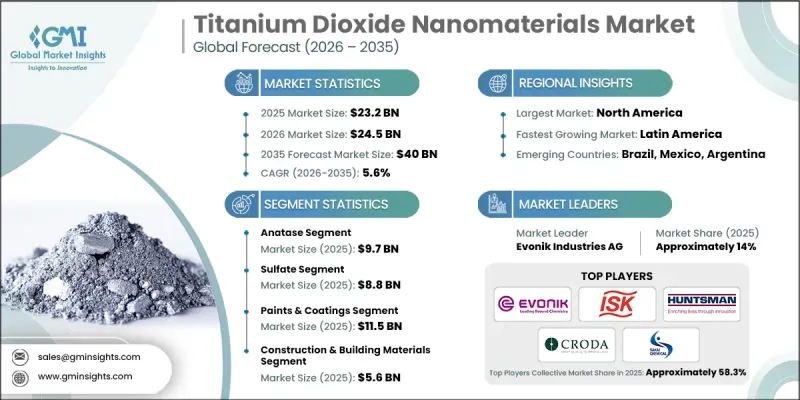
The Global Titanium Dioxide Nanomaterials Market was valued at USD 23.2 billion in 2025 and is estimated to grow at a CAGR of 5.6% to reach USD 40 billion by 2035.
Growth in the titanium dioxide nanomaterials market is primarily supported by increasing demand from advanced technology industries that rely on high-performance materials. The unique properties of nano-scale titanium dioxide, including high surface reactivity and enhanced photocatalytic efficiency, are driving its adoption across a wide range of applications. These materials play a critical role in improving device efficiency, supporting innovation in high-tech manufacturing environments. In addition, rising interest in sustainable materials and energy-efficient technologies is reinforcing demand. Expanding investments in research and development, along with the growing importance of nanotechnology across multiple industries, are further strengthening market growth. As industries continue to seek materials that combine performance, durability, and environmental compatibility, the titanium dioxide nanomaterials market is expected to maintain a strong and consistent growth trajectory over the forecast period.
| Market Scope | |
|---|---|
| Start Year | 2025 |
| Forecast Year | 2026-2035 |
| Start Value | $23.2 Billion |
| Forecast Value | $40 Billion |
| CAGR | 5.6% |
The titanium dioxide nanomaterials market is also benefiting from its increasing utilization across healthcare and advanced material science applications. These nanomaterials are widely recognized for their stability, compatibility with biological systems, and suitability for high-precision environments. Their integration into innovative solutions is enabling the development of advanced technologies that require reliable and efficient material performance. Additionally, environmental considerations are playing a significant role in shaping demand, as industries adopt materials that support pollution control and sustainability objectives. The ability of these nanomaterials to enhance functional performance across diverse applications is contributing to their growing acceptance in industrial processes.
The anatase segment accounted for USD 9.7 billion in 2025, reflecting its strong position within the titanium dioxide nanomaterials market. This segment continues to gain traction due to its superior functional characteristics, particularly in applications requiring high catalytic efficiency. Its effectiveness in enabling advanced material performance supports its widespread adoption across various industrial processes. Meanwhile, the rutile segment maintains a stable presence due to its durability and performance advantages in applications that require long-term stability and resistance to environmental factors. The differentiation between crystalline structures continues to influence product selection based on application-specific requirements.
The paints and coatings segment generated USD 11.5 billion in 2025, highlighting its dominant role in the titanium dioxide nanomaterials market. This segment benefits from the material's ability to enhance product durability, improve surface protection, and deliver consistent performance in demanding environments. The incorporation of nano-scale materials supports improved product quality and extended lifespan, making them highly valuable across industrial applications. The plastics segment also continues to demonstrate steady growth, supported by increasing demand for materials that enhance product strength, stability, and overall performance.
North America Titanium Dioxide Nanomaterials Market accounted for USD 8.2 billion in 2025 and remains a key region within the titanium dioxide nanomaterials market. The region's growth is supported by strong technological capabilities, advanced manufacturing infrastructure, and ongoing innovation in material science. Increasing adoption of high-performance materials across industrial applications is contributing to sustained demand. The presence of well-established production facilities and continued investment in research activities are further strengthening the regional market. Expanding industrial applications and the growing emphasis on sustainable material solutions are expected to maintain growth momentum over the forecast period.
Key players involved in the Global Titanium Dioxide Nanomaterials Market include Evonik Industries AG, Sigma-Aldrich, ISHIHARA SANGYO KAISHA LTD, Huntsman International LLC, Croda International Plc, American Elements, Sakai Chemical Industry Co. Ltd, Titan Kogyo Ltd, Cinkarna Celje d.d., ACS Material, and Techinstro. Companies operating in the Global Titanium Dioxide Nanomaterials Market are focusing on enhancing their market position through continuous innovation, strategic collaborations, and expansion of production capabilities. Manufacturers are investing in research and development to improve material properties and develop advanced formulations that meet evolving industry requirements. Strengthening supply chain networks and expanding global distribution channels are key strategies to increase market reach. Firms are also emphasizing sustainability by developing environmentally friendly products and improving production processes. Partnerships with research institutions and technology providers are enabling the development of high-performance applications. Additionally, companies are prioritizing product quality, consistency, and cost efficiency to maintain competitiveness and address the growing demand for advanced nanomaterials across multiple industries.
Table of Contents
Chapter 1 Methodology & Scope
- 1.1 Market scope and definition
- 1.2 Research design
- 1.2.1 Research approach
- 1.2.2 Data collection methods
- 1.3 Data mining sources
- 1.3.1 Global
- 1.3.2 Regional/Country
- 1.4 Base estimates and calculations
- 1.4.1 Base year calculation
- 1.4.2 Key trends for market estimation
- 1.5 Primary research and validation
- 1.5.1 Primary sources
- 1.6 Forecast model
- 1.7 Research assumptions and limitations
Chapter 2 Executive Summary
- 2.1 Industry 360° synopsis
- 2.2 Key market trends
- 2.2.1 Regional
- 2.2.2 Grade
- 2.2.3 Process
- 2.2.4 Application
- 2.2.5 End Use Industry
- 2.3 TAM Analysis, 2026-2035
- 2.4 CXO perspectives: Strategic imperatives
- 2.4.1 Executive decision points
- 2.4.2 Critical success factors
- 2.5 Future Outlook and Strategic Recommendations
Chapter 3 Industry Insights
- 3.1 Industry ecosystem analysis
- 3.1.1 Supplier Landscape
- 3.1.2 Profit Margin
- 3.1.3 Value addition at each stage
- 3.1.4 Factor affecting the value chain
- 3.1.5 Disruptions
- 3.2 Industry impact forces
- 3.2.1 Growth drivers
- 3.2.1.1 Increasing demand in electronics and optoelectronics.
- 3.2.1.2 Growing applications in healthcare and biotechnology.
- 3.2.1.3 Environmental sustainability and stringent regulations.
- 3.2.2 Industry pitfalls and challenges
- 3.2.2.1 Health and environmental concerns regarding nanoparticle exposure.
- 3.2.2.2 High Production Costs and Scale-Up Challenges.
- 3.2.3 Market opportunities
- 3.2.3.1 Expanding Photocatalytic and Environmental Applications
- 3.2.3.2 Rising Penetration in Energy Storage and Solar Technologies
- 3.2.1 Growth drivers
- 3.3 Growth potential analysis
- 3.4 Regulatory landscape
- 3.4.1 North America
- 3.4.2 Europe
- 3.4.3 Asia Pacific
- 3.4.4 Latin America
- 3.4.5 Middle East & Africa
- 3.5 Porter's analysis
- 3.6 PESTEL analysis
- 3.7 Price trends
- 3.7.1 By region
- 3.7.2 Product type
- 3.8 Future market trends
- 3.9 Technology and Innovation Landscape
- 3.9.1 Current technological trends
- 3.9.2 Emerging technologies
- 3.10 Patent Landscape
- 3.11 Trade statistics (HS code) (Note: the trade statistics will be provided for key countries only)
- 3.11.1 Major importing countries
- 3.11.2 Major exporting countries
- 3.12 Sustainability and environmental aspects
- 3.12.1 Sustainable practices
- 3.12.2 Waste reduction strategies
- 3.12.3 Energy efficiency in production
- 3.12.4 Eco-friendly initiatives
Chapter 4 Competitive Landscape, 2025
- 4.1 Introduction
- 4.2 Company market share analysis
- 4.2.1 By region
- 4.2.1.1 North America
- 4.2.1.2 Europe
- 4.2.1.3 Asia Pacific
- 4.2.1.4 LATAM
- 4.2.1.5 MEA
- 4.2.1 By region
- 4.3 Company matrix analysis
- 4.4 Competitive analysis of major market players
- 4.5 Competitive positioning matrix
- 4.6 Key developments
- 4.6.1 Mergers & acquisitions
- 4.6.2 Partnerships & collaborations
- 4.6.3 New product launches
- 4.6.4 Expansion plans
Chapter 5 Market Estimates and Forecast, By Grade, 2022 - 2035 (USD billion) (Kilo Tons)
- 5.1 Key trends
- 5.2 Rutile
- 5.3 Anatase
- 5.4 Mixed Phase
Chapter 6 Market Estimates and Forecast, By Application, 2022 - 2035 (USD billion) (Kilo Tons)
- 6.1 Key trends
- 6.2 Chloride
- 6.3 Sulfate
- 6.4 Sol-Gel Process
- 6.5 Hydrothermal Process
Chapter 7 Market Estimates and Forecast, By Application, 2022 - 2035 (USD billion) (Kilo Tons)
- 7.1 Key trends
- 7.2 Paints & Coatings
- 7.3 Plastic
- 7.4 Paper and Pulp
- 7.5 Printing Inks
- 7.6 Other
Chapter 8 Market Estimates and Forecast, By End Use Industry, 2022 - 2035 (USD billion) (Kilo Tons)
- 8.1 Key trends
- 8.2 Construction & Building Materials
- 8.2.1 Residential Construction
- 8.2.2 Commercial & Infrastructure
- 8.3 Automotive & Transportation
- 8.3.1 Passenger Vehicles
- 8.3.2 Commercial Vehicles
- 8.4 Healthcare & Pharmaceuticals
- 8.4.1 Medical Devices
- 8.4.2 Pharmaceutical Formulations
- 8.4.3 Antimicrobial Applications
- 8.5 Consumer Goods
- 8.5.1 Personal Care Products
- 8.5.2 Household Products
- 8.6 Electronics & Electrical
- 8.6.1 Consumer Electronics
- 8.6.2 Industrial Electronics
- 8.7 Energy & Utilities
- 8.7.1 Solar Energy
- 8.7.2 Energy Storage
- 8.8 Others
- 8.8.1 Agriculture
- 8.8.2 Aerospace
- 8.9 Defense
Chapter 9 Market Estimates and Forecast, By Region, 2022 - 2035 (USD billion) (Kilo Tons)
- 9.1 Key trends
- 9.2 North America
- 9.2.1 U.S.
- 9.2.2 Canada
- 9.3 Europe
- 9.3.1 Germany
- 9.3.2 UK
- 9.3.3 France
- 9.3.4 Spain
- 9.3.5 Italy
- 9.3.6 Rest of Europe
- 9.4 Asia Pacific
- 9.4.1 China
- 9.4.2 India
- 9.4.3 Japan
- 9.4.4 Australia
- 9.4.5 South Korea
- 9.4.6 Rest of Asia Pacific
- 9.5 Latin America
- 9.5.1 Brazil
- 9.5.2 Mexico
- 9.5.3 Rest of Latin America
- 9.6 Middle East and Africa
- 9.6.1 Saudi Arabia
- 9.6.2 South Africa
- 9.6.3 UAE
- 9.6.4 Rest of Middle East and Africa
Chapter 10 Company Profiles
- 10.1 Evonik Industries AG
- 10.2 Sigma-Aldrich
- 10.3 ISHIHARA SANGYO KAISHA, LTD
- 10.4 Huntsman International LLC
- 10.5 Croda International Plc
- 10.6 American Elements
- 10.7 Sakai Chemical Industry Co., Ltd
- 10.8 Titan Kogyo, Ltd
- 10.9 Cinkarna Celje d.d.
- 10.10 ACS Material
- 10.11 Techinstro

