PUBLISHER: Global Market Insights Inc. | PRODUCT CODE: 2019123

PUBLISHER: Global Market Insights Inc. | PRODUCT CODE: 2019123
Veterinary X-ray Market Opportunity, Growth Drivers, Industry Trend Analysis, and Forecast 2026 - 2035
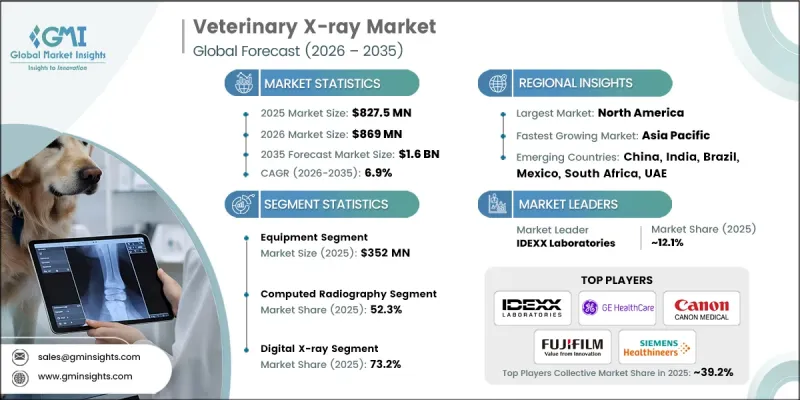
The Global Veterinary X-ray Market was valued at USD 827.5 million in 2025 and is estimated to grow at a CAGR of 6.9% to reach USD 1.6 billion by 2035.
The market growth is fueled by the rising global population of companion animals, increasing adoption of pets, growing demand for veterinary diagnostic services, and higher disposable incomes in emerging economies. Expansion of advanced veterinary medical facilities, the availability of cutting-edge diagnostic equipment, growth in the number of veterinary hospitals and clinics, and increasing uptake of pet insurance have all contributed to market development. Additionally, the growing prevalence of chronic animal health issues, including obesity, osteoarthritis, respiratory disorders, dental problems, and gastrointestinal conditions, is driving demand for diagnostic imaging solutions, further supporting the industry's steady growth and prompting clinics to adopt sophisticated X-ray technologies to deliver accurate and timely diagnoses.
| Market Scope | |
|---|---|
| Start Year | 2025 |
| Forecast Year | 2026-2035 |
| Start Value | $827.5 Million |
| Forecast Value | $1.6 Billion |
| CAGR | 6.9% |
Veterinary X-ray systems are essential diagnostic tools that employ electromagnetic radiation to generate detailed images of animals' bones, organs, and soft tissues. These systems help veterinarians detect fractures, tumors, foreign bodies, dental issues, and other abnormalities efficiently and painlessly, facilitating precise medical assessments and treatment planning across multiple species.
The equipment segment reached USD 352 million in 2025, due to the increasing need for advanced imaging solutions in veterinary healthcare. The rise in pet ownership and heightened spending on animal health has further propelled demand for high-quality diagnostic devices.
The computed radiography (CR) systems held a 52.3% share in 2025. CR systems are widely preferred in veterinary practices due to their affordability, ease of integration, and low maintenance costs compared with direct radiography (DR) systems. Smaller veterinary clinics particularly favor CR systems for their longer lifespan and cost-efficient upgrade from traditional film-based X-ray machines, providing dependable imaging solutions without excessive investment.
North America Veterinary X-ray Market held a 38.7% share in 2025. Strong pet ownership rates, coupled with the presence of advanced veterinary care services, drive high adoption of X-ray systems. The region's growing expenditure on animal healthcare, extensive veterinary infrastructure, and high adoption of pet insurance further reinforce market growth and support widespread utilization of diagnostic imaging technologies.
Key players in the Global Veterinary X-ray Market include Canon Medical Systems, Carestream Health, Fujifilm Holdings Corporation, GE Healthcare, Heska Corporation, IDEXX Laboratories, MinXray, Avante Animal Health, Agfa-Gevaert Group, Konica Minolta, Onex Corporation, Sedecal, Examion, Sound, SignalPET, Siemens Healthineers. Key strategies adopted by companies in the Global Veterinary X-ray Market include investing in research and development to design innovative, high-resolution imaging systems tailored for veterinary use. Firms are focusing on cost-effective solutions that cater to both large and small clinics while ensuring accuracy and reliability. Partnerships with veterinary hospitals and clinics expand market access and product adoption, while marketing initiatives highlight the diagnostic precision and efficiency of their systems. Companies also pursue geographic expansion, offering after-sales support, maintenance services, and training programs for veterinary staff. Adoption of digital imaging technologies and portable X-ray units helps strengthen market presence and enhance customer loyalty.
Table of Contents
Chapter 1 Methodology and Scope
- 1.1 Market scope and definition
- 1.2 Research approach
- 1.3 Quality commitments
- 1.3.1 GMI AI policy and data integrity commitment
- 1.3.1.1 Source consistency protocol
- 1.3.1 GMI AI policy and data integrity commitment
- 1.4 Research trail and confidence scoring
- 1.4.1 Research trail components
- 1.4.2 Scoring components
- 1.5 Data collection
- 1.5.1 Partial list of primary sources
- 1.6 Data mining sources
- 1.6.1 Paid sources
- 1.6.1.1 Sources, by region
- 1.6.1 Paid sources
- 1.7 Base estimates and calculations
- 1.7.1 Revenue share analysis
- 1.7.2 Base year calculation
- 1.8 Forecast model
- 1.9 Research transparency addendum
- 1.9.1 Source attribution framework
- 1.9.2 Quality assurance metrics
- 1.9.3 Our commitment to trust
Chapter 2 Executive Summary
- 2.1 Industry 360° synopsis
- 2.2 Key market trends
- 2.2.1 Business trends
- 2.2.2 Regional trends
- 2.2.3 Product trends
- 2.2.4 Technology trends
- 2.2.5 Type trends
- 2.2.6 Mobility trends
- 2.2.7 Animal type trends
- 2.2.8 Application trends
- 2.2.9 End use trends
- 2.3 CXO perspectives: Strategic imperatives
Chapter 3 Industry Insights
- 3.1 Industry ecosystem analysis
- 3.2 Industry impact forces
- 3.2.1 Growth drivers
- 3.2.1.1 Increasing demand for pet insurance and increasing spending on animal healthcare
- 3.2.1.2 Rise in companion animal ownership
- 3.2.1.3 Technological developments in veterinary diagnostic imaging
- 3.2.1.4 Increasing use of radiography in veterinary orthopedics, dentistry, and traumatology
- 3.2.2 Industry pitfalls and challenges
- 3.2.2.1 High cost of veterinary X-ray equipment
- 3.2.2.2 Exposure to radiation
- 3.2.3 Market opportunities
- 3.2.3.1 Rising adoption of portable and handheld veterinary imaging systems
- 3.2.3.2 Integration of artificial intelligence in veterinary imaging analysis
- 3.2.1 Growth drivers
- 3.3 Growth potential analysis
- 3.4 Regulatory landscape (Driven by Primary Research)
- 3.4.1 North America
- 3.4.1.1 U.S.
- 3.4.1.2 Canada
- 3.4.2 Europe
- 3.4.3 Asia Pacific
- 3.4.1 North America
- 3.5 Technology and innovation landscape
- 3.5.1 Current technological trends
- 3.5.2 Emerging technologies (Driven by Primary Research)
- 3.6 Pricing analysis (Driven by Primary Research)
- 3.7 Future market trends (Driven by Primary Research)
- 3.8 Impact of AI/Gen AI on the market
- 3.9 Porter's analysis
- 3.10 PESTEL analysis
Chapter 4 Competitive Landscape, 2025
- 4.1 Introduction
- 4.2 Company market share analysis
- 4.2.1 North America
- 4.2.2 Europe
- 4.2.3 Asia Pacific
- 4.3 Company matrix analysis
- 4.4 Competitive analysis of major market players
- 4.5 Competitive positioning matrix
- 4.6 Key developments
- 4.6.1 Merger and acquisition
- 4.6.2 Partnership and collaboration
- 4.6.3 New product launches
- 4.6.4 Expansion plans
Chapter 5 Market Estimates and Forecast, By Product, 2022 - 2035 ($ Mn)
- 5.1 Key trends
- 5.2 Equipment
- 5.3 Accessories/consumables
- 5.4 Software
Chapter 6 Market Estimates and Forecast, By Technology, 2022 - 2035 ($ Mn)
- 6.1 Key trends
- 6.2 Computed radiography systems
- 6.3 Direct radiography systems
- 6.4 Film-based radiography systems
Chapter 7 Market Estimates and Forecast, By Type, 2022 - 2035 ($ Mn)
- 7.1 Key trends
- 7.2 Digital X-ray systems
- 7.3 Analog X-ray systems
Chapter 8 Market Estimates and Forecast, By Mobility, 2022 - 2035 ($ Mn)
- 8.1 Key trends
- 8.2 Stationary X-ray systems
- 8.3 Portable X-ray systems
Chapter 9 Market Estimates and Forecast, By Animal Type, 2022 - 2035 ($ Mn)
- 9.1 Key trends
- 9.2 Small companion animals
- 9.2.1 Dogs
- 9.2.2 Cats
- 9.2.3 Other small companion animals
- 9.3 Large animals
- 9.3.1 Horse
- 9.3.2 Cattle
- 9.3.3 Other large animals
- 9.4 Other animals
Chapter 10 Market Estimates and Forecast, By Application, 2022 - 2035 ($ Mn)
- 10.1 Key trends
- 10.2 Orthopedics/traumatology
- 10.3 Respiratory
- 10.4 Dental application
- 10.5 Other applications
Chapter 11 Market Estimates and Forecast, By End Use, 2022 - 2035 ($ Mn)
- 11.1 Key trends
- 11.2 Veterinary hospitals and clinics
- 11.3 Diagnostic imaging centers
- 11.4 Other end users
Chapter 12 Market Estimates and Forecast, By Region, 2022 - 2035 ($ Mn)
- 12.1 Key trends
- 12.2 North America
- 12.2.1 U.S.
- 12.2.2 Canada
- 12.3 Europe
- 12.3.1 Germany
- 12.3.2 UK
- 12.3.3 France
- 12.3.4 Italy
- 12.3.5 Spain
- 12.3.6 Netherlands
- 12.4 Asia Pacific
- 12.4.1 China
- 12.4.2 Japan
- 12.4.3 India
- 12.4.4 Australia
- 12.4.5 South Korea
- 12.5 Latin America
- 12.5.1 Brazil
- 12.5.2 Mexico
- 12.5.3 Argentina
- 12.6 Middle East and Africa
- 12.6.1 South Africa
- 12.6.2 Saudi Arabia
- 12.6.3 UAE
Chapter 13 Company Profiles
- 13.1 Avante Animal Health
- 13.2 Agfa-Gevaert Group
- 13.3 Carestream Health
- 13.4 Canon Medical Systems
- 13.5 Examion
- 13.6 Fujifilm Holdings Corporation
- 13.7 GE Healthcare
- 13.8 Heska Corporation
- 13.9 IDEXX Laboratories
- 13.10 Konica Minolta
- 13.11 MinXray
- 13.12 Onex Corporation
- 13.13 Sedecal
- 13.14 Sound
- 13.15 Siemens Healthineers
- 13.16 SignalPET

