PUBLISHER: Global Market Insights Inc. | PRODUCT CODE: 2019127

PUBLISHER: Global Market Insights Inc. | PRODUCT CODE: 2019127
Surface Treatments Market Opportunity, Growth Drivers, Industry Trend Analysis, and Forecast 2026 - 2035
The Global Surface Treatments Market was valued at USD 45.6 billion in 2025 and is estimated to grow at a CAGR of 5.8% to reach USD 80.1 billion by 2035.
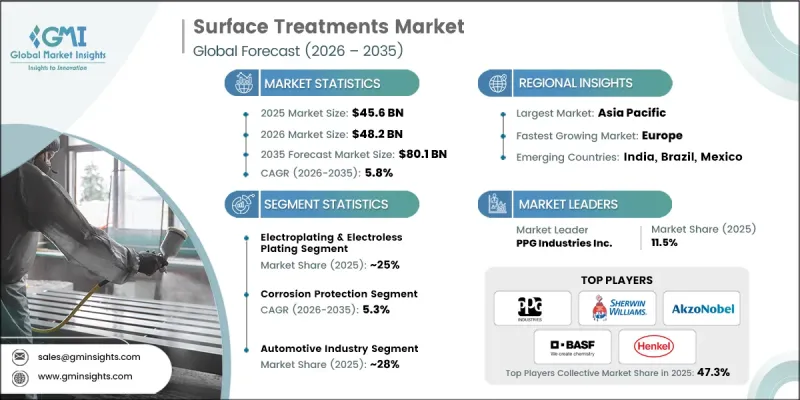
Surface treatments are designed to improve the functional and aesthetic properties of metals, polymers, and composites, offering benefits such as corrosion resistance, wear protection, adhesion, and enhanced appearance. These technologies extend component lifespans and maintain reliable performance under harsh environmental conditions. Modern applications include coatings, sealants, hydrophobic layers, and advanced processes such as plasma treatments, laser texturing, and nanocoatings, which provide high customization and performance. Demand is particularly strong in high-precision sectors such as aerospace, electronics, and automotive, where even minor surface variations can impact functionality. Sustainability is increasingly influencing adoption, with water-based, bio-sourced, and eco-friendly treatments becoming standard practice in construction, automotive, and industrial applications.
| Market Scope | |
|---|---|
| Start Year | 2025 |
| Forecast Year | 2026-2035 |
| Start Value | $45.6 Billion |
| Forecast Value | $80.1 Billion |
| CAGR | 5.8% |
The corrosion protection segment held a 30% share in 2025 and is projected to grow at a CAGR of 5.3% through 2035. Surface treatments in this segment, including coatings, plating, and conversion layers, are essential for automotive, marine, and industrial applications exposed to aggressive conditions. These treatments reduce maintenance costs while extending component lifetimes. Wear resistance is equally critical, particularly for aerospace, defense, and industrial machinery applications, where friction, mechanical stress, and high-speed operations demand durable surfaces. These treatments ensure operational reliability and long-term performance.
The automotive segment held a 28% share in 2025 and is expected to grow at a CAGR of 5.9% by 2035. Automotive applications rely heavily on corrosion protection, wear resistance, and aesthetic enhancements. Surface treatments help extend vehicle lifespan, support lightweight materials for energy efficiency, and improve visual appeal. Similar demands exist in aerospace and defense, where high-performance coatings must withstand extreme temperatures, friction, and environmental stress. Technologies commonly applied in such demanding applications include thermal spray, physical vapor deposition (PVD), and laser surface engineering.
North America Surface Treatments Market accounted for 22% share in 2025, driven by industrial maturity, innovation, and a growing emphasis on sustainable solutions. The U.S. leads the region, supported by advanced manufacturing, widespread use of high-performance materials, and a strong network of national and global surface treatment providers. Extensive research and development initiatives focus on aerospace, automotive, electronics, and healthcare applications, where surface treatments enhance durability, corrosion resistance, and specialized functionality.
Key players operating in the Global Surface Treatments Market include PPG Industries Inc., The Sherwin-Williams Company, AkzoNobel N.V., BASF SE (Surface Technologies Division), Henkel AG & Co. KGaA, Axalta Coating Systems Ltd., RPM International Inc., Jotun A/S, Kansai Paint Co., Ltd., and Nippon Paint Holdings Co., Ltd. Companies in the Surface Treatments Market are strengthening their presence through continuous innovation, strategic partnerships, and geographic expansion. They are investing in research and development to develop high-performance, eco-friendly coatings and advanced surface technologies. Product diversification allows firms to address industry-specific requirements across automotive, aerospace, electronics, and construction sectors. Businesses are also enhancing service capabilities, offering tailored solutions, maintenance support, and technical consulting to build long-term client relationships. Strategic collaborations with material suppliers and technology providers improve market reach and accelerate the adoption of advanced solutions.
Table of Contents
Chapter 1 Methodology & Scope
- 1.1 Market scope and definition
- 1.2 Research design
- 1.2.1 Research approach
- 1.2.2 Data collection methods
- 1.3 Data mining sources
- 1.3.1 Global
- 1.3.2 Regional/Country
- 1.4 Base estimates and calculations
- 1.4.1 Base year calculation
- 1.4.2 Key trends for market estimation
- 1.5 Primary research and validation
- 1.5.1 Primary sources
- 1.6 Forecast model
- 1.7 Research assumptions and limitations
Chapter 2 Executive Summary
- 2.1 Industry 360° synopsis
- 2.2 Key market trends
- 2.2.1 Technology type trends
- 2.2.2 Application trends
- 2.2.3 End user trends
- 2.2.4 Regional
- 2.3 TAM Analysis, 2026-2035
- 2.4 CXO perspectives: Strategic imperatives
- 2.4.1 Executive decision points
- 2.4.2 Critical success factors
- 2.5 Future Outlook and Strategic Recommendations
Chapter 3 Industry Insights
- 3.1 Industry ecosystem analysis
- 3.1.1 Supplier landscape
- 3.1.2 Profit margin
- 3.1.3 Value addition at each stage
- 3.1.4 Factor affecting the value chain
- 3.1.5 Disruptions
- 3.2 Industry impact forces
- 3.2.1 Growth drivers
- 3.2.1.1 Demand for corrosion and wear resistance
- 3.2.1.2 Pressure for sustainability and eco-friendly solutions
- 3.2.1.3 Advancements in surface engineering technologies
- 3.2.2 Industry pitfalls and challenges
- 3.2.2.1 High cost of advanced surface technologies
- 3.2.2.2 Environmental and regulatory compliance challenges
- 3.2.3 Market opportunities
- 3.2.3.1 Growing demand for lightweight and high-performance materials
- 3.2.3.2 Rise of emerging markets and infrastructure developments
- 3.2.1 Growth drivers
- 3.3 Growth potential analysis
- 3.4 Regulatory landscape
- 3.4.1 North America
- 3.4.2 Europe
- 3.4.3 Asia Pacific
- 3.4.4 Latin America
- 3.4.5 Middle East & Africa
- 3.5 Porter's analysis
- 3.6 PESTEL analysis
- 3.7 Price trends
- 3.7.1 By region
- 3.7.2 By technology type
- 3.8 Future market trends
- 3.9 Technology and Innovation landscape
- 3.9.1 Current technological trends
- 3.9.2 Emerging technologies
- 3.10 Patent Landscape
- 3.11 Trade statistics (HS code)
- 3.11.1 Major importing countries
- 3.11.2 Major exporting countries
- 3.12 Sustainability and environmental aspects
- 3.12.1 Sustainable practices
- 3.12.2 Waste reduction strategies
- 3.12.3 Energy efficiency in production
- 3.12.4 Eco-friendly initiatives
- 3.13 Carbon footprint consideration
Chapter 4 Competitive Landscape, 2025
- 4.1 Introduction
- 4.2 Company market share analysis
- 4.2.1 By region
- 4.2.1.1 North America
- 4.2.1.2 Europe
- 4.2.1.3 Asia Pacific
- 4.2.1.4 LATAM
- 4.2.1.5 MEA
- 4.2.1 By region
- 4.3 Company matrix analysis
- 4.4 Competitive analysis of major market players
- 4.5 Competitive positioning matrix
- 4.6 Key developments
- 4.6.1 Mergers & acquisitions
- 4.6.2 Partnerships & collaborations
- 4.6.3 New Product Launches
- 4.6.4 Expansion Plans
Chapter 5 Market Estimates and Forecast, By Technology Type, 2022-2035 (USD Million) (Kilo Tons)
- 5.1 Key trends
- 5.2 Electroplating and electroless plating
- 5.3 Anodizing and chemical conversion coatings
- 5.4 Thermal spraying technologies
- 5.5 Physical vapor deposition (PVD)
- 5.6 Chemical vapor deposition (CVD)
- 5.7 Plasma surface treatment
- 5.8 Laser surface engineering
- 5.9 Emerging technologies
Chapter 6 Market Estimates and Forecast, By Application, 2022-2035 (USD Million) (Kilo Tons)
- 6.1 Key trends
- 6.2 Corrosion protection
- 6.3 Wear resistance enhancement
- 6.4 Decorative and aesthetic finishes
- 6.5 Electrical and electronic properties
- 6.6 Biocompatibility and medical applications
- 6.7 Thermal management
- 6.8 Optical properties enhancement
Chapter 7 Market Estimates and Forecast, By End User, 2022-2035 (USD Million) (Kilo Tons)
- 7.1 Key trends
- 7.2 Automotive industry
- 7.3 Aerospace and defense
- 7.4 Electronics and semiconductors
- 7.5 Industrial machinery and equipment
- 7.6 Medical devices and healthcare
- 7.7 Energy and power generation
- 7.8 Construction and architecture
- 7.9 Marine and offshore
Chapter 8 Market Estimates and Forecast, By Region, 2022-2035 (USD Million) (Kilo Tons)
- 8.1 Key trends
- 8.2 North America
- 8.2.1 U.S.
- 8.2.2 Canada
- 8.3 Europe
- 8.3.1 Germany
- 8.3.2 UK
- 8.3.3 France
- 8.3.4 Spain
- 8.3.5 Italy
- 8.3.6 Rest of Europe
- 8.4 Asia Pacific
- 8.4.1 China
- 8.4.2 India
- 8.4.3 Japan
- 8.4.4 Australia
- 8.4.5 South Korea
- 8.4.6 Rest of Asia Pacific
- 8.5 Latin America
- 8.5.1 Brazil
- 8.5.2 Mexico
- 8.5.3 Argentina
- 8.5.4 Rest of Latin America
- 8.6 Middle East and Africa
- 8.6.1 Saudi Arabia
- 8.6.2 South Africa
- 8.6.3 UAE
- 8.6.4 Rest of Middle East and Africa
Chapter 9 Company Profiles
- 9.1 PPG Industries Inc.
- 9.2 The Sherwin-Williams Company
- 9.3 AkzoNobel N.V.
- 9.4 BASF SE (Surface Technologies Division)
- 9.5 Henkel AG & Co. KGaA
- 9.6 Axalta Coating Systems Ltd.
- 9.7 RPM International Inc.
- 9.8 Jotun A/S
- 9.9 Kansai Paint Co., Ltd.
- 9.10 Nippon Paint Holdings Co., Ltd.

