PUBLISHER: Global Market Insights Inc. | PRODUCT CODE: 2019132

PUBLISHER: Global Market Insights Inc. | PRODUCT CODE: 2019132
Automotive Touch Screen Control System Market Opportunity, Growth Drivers, Industry Trend Analysis, and Forecast 2026 - 2035
The Global Automotive Touch Screen Control System Market was valued at USD 8.8 billion in 2025 and is estimated to grow at a CAGR of 4.9% to reach USD 14.4 billion by 2035.
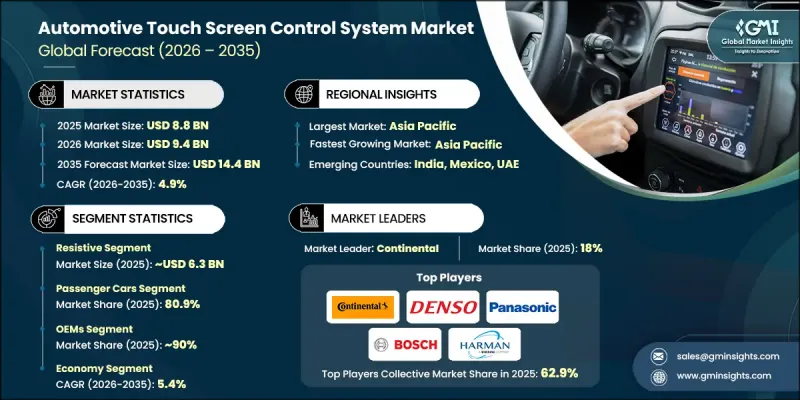
The automotive touch screen control system market is expanding due to the growing integration of multifunctional displays that centralize vehicle operations. Modern vehicles increasingly rely on touchscreen interfaces to manage a wide range of functions, improving convenience and streamlining dashboard design. The automotive touch screen control system market is also benefiting from the ongoing shift toward digital cockpit architectures, where centralized displays serve as the primary interface for accessing vehicle data, connectivity, and real-time information. In addition, advancements in user interface design and system integration are enhancing overall driving experiences. As automakers continue to focus on simplifying control systems while maintaining performance and usability, the automotive touch screen control system market is expected to witness consistent growth across global automotive segments.
| Market Scope | |
|---|---|
| Start Year | 2025 |
| Forecast Year | 2026-2035 |
| Start Value | $8.8 Billion |
| Forecast Value | $14.4 Billion |
| CAGR | 4.9% |
The automotive touch screen control system market is gaining further traction as artificial intelligence technologies enhance system functionality and user interaction. Automakers are incorporating intelligent features to improve usability, safety, and overall driving experience. At the same time, concerns related to driver distraction are encouraging the development of hybrid interface solutions that combine touch functionality with tactile elements. These systems integrate features such as haptic response and gesture-based controls to provide intuitive operation while maintaining safety. Increasing vehicle production is also contributing to rising demand, as manufacturers continue to integrate advanced control systems into modern vehicles.
The resistive segment accounted for 70.8% share in 2025, generating USD 6.3 billion. This segment remains widely adopted due to its cost efficiency and reliable performance across various operating conditions. The automotive touch screen control system market benefits from the compatibility of resistive technology with existing vehicle systems, along with its ability to function effectively under different usage conditions. These advantages continue to support steady demand for resistive touch solutions.
The OEM segment is projected to reach USD 13.3 billion by 2035. Growth in this segment is driven by the increasing integration of touchscreen systems during the vehicle manufacturing process. Automakers are embedding advanced display systems and centralized control interfaces directly into vehicle architecture, which is driving demand for OEM-supplied solutions. Strong collaboration between automotive manufacturers and technology providers is further enabling customization, improved system integration, and enhanced user interface design, strengthening the role of OEMs in the market.
U.S. Automotive Touch Screen Control System Market reached USD 2 billion in 2025 and is expected to grow at a CAGR of 3.9% from 2026 to 2035. The automotive touch screen control system market in the United States continues to expand due to strong demand for technologically advanced vehicles and increasing preference for digital interfaces. Consumers are showing growing interest in enhanced infotainment systems, larger displays, and seamless connectivity features. Continuous investments in human-machine interface technologies are further accelerating adoption, as touchscreen systems become a standard feature across a wide range of vehicles.
Key companies operating in the Global Automotive Touch Screen Control System Market include Continental, Denso, Panasonic, Robert Bosch, Alps Alpine, Analog Devices, Fujitsu, Pioneer, Samsung (HARMAN), and Visteon. Companies in the Global Automotive Touch Screen Control System Market are strengthening their market position through continuous innovation and strategic collaborations. Leading players are investing in advanced display technologies, AI-driven interfaces, and improved user experience design to differentiate their offerings. Partnerships with automakers are enabling seamless integration of hardware and software systems, enhancing overall product performance. Companies are also focusing on expanding production capabilities to meet increasing demand while optimizing costs. In addition, emphasis on developing hybrid interface solutions that combine touch, gesture, and tactile feedback is improving usability and safety. Geographic expansion and portfolio diversification are further helping companies capture new opportunities and reinforce their competitive presence in the global automotive touch screen control system market.
Table of Contents
Chapter 1 Methodology
- 1.1 Research approach
- 1.2 Quality commitments
- 1.2.1 GMI AI policy & data integrity commitment
- 1.3 Research trail & confidence scoring
- 1.3.1 Research trail components
- 1.3.2 Scoring components
- 1.4 Data collection
- 1.4.1 Partial list of primary sources
- 1.5 Data mining sources
- 1.5.1 Paid sources
- 1.6 Base estimates and calculations
- 1.6.1 Base year calculation
- 1.7 Forecast model
- 1.8 Research transparency addendum
Chapter 2 Executive Summary
- 2.1 Industry 360° synopsis
- 2.2 Key market trends
- 2.2.1 Regional
- 2.2.2 Technology
- 2.2.3 Screen Size
- 2.2.4 Application
- 2.2.5 Vehicle
- 2.2.6 Vehicle Class
- 2.2.7 Sales Channel
- 2.3 TAM analysis, 2026-2035
- 2.4 CXO perspectives: Strategic imperatives
Chapter 3 Industry Insights
- 3.1 Industry ecosystem analysis
- 3.1.1 Supplier landscape
- 3.1.2 Profit margin
- 3.1.3 Cost structure
- 3.1.4 Value addition at each stage
- 3.1.5 Factor affecting the value chain
- 3.1.6 Disruptions
- 3.2 Industry impact forces
- 3.2.1 Growth drivers
- 3.2.1.1 Rising consumer demand for connected & smart vehicles
- 3.2.1.2 OEM focus on digital cockpit & enhanced user experience
- 3.2.1.3 Integration with smartphone ecosystems (CarPlay, Android Auto)
- 3.2.1.4 Government mandates for ADAS & safety features driving display integration
- 3.2.2 Industry pitfalls and challenges
- 3.2.2.1 Driver distraction & safety concerns from touchscreen overreliance
- 3.2.2.2 High integration costs for OEMs in economy vehicle segments
- 3.2.3 Market opportunities
- 3.2.3.1 Aftermarket retrofitting demand in aging vehicle fleet
- 3.2.3.2 AI-powered personalization & adaptive interfaces
- 3.2.3.3 Expansion in commercial & fleet vehicle segments
- 3.2.3.4 Emerging markets with growing vehicle production
- 3.2.1 Growth drivers
- 3.3 Growth potential analysis
- 3.4 Regulatory landscape
- 3.4.1 North America
- 3.4.1.1 National Highway Traffic Safety Administration
- 3.4.1.2 Federal Communications Commission
- 3.4.1.3 SAE International
- 3.4.1.4 Canadian Standards Association
- 3.4.2 Europe
- 3.4.2.1 European Commission Directorate-General for Mobility and Transport
- 3.4.2.2 European Telecommunications Standards Institute
- 3.4.2.3 European Committee for Standardization
- 3.4.2.4 European Committee for Electrotechnical Standardization
- 3.4.3 Asia Pacific
- 3.4.3.1 Ministry of Land Infrastructure Transport and Tourism
- 3.4.3.2 Ministry of Industry and Information Technology
- 3.4.3.3 Automotive Research Association of India
- 3.4.3.4 Korea Transportation Safety Authority
- 3.4.4 Latin America
- 3.4.4.1 Instituto Nacional de Metrologia Qualidade e Tecnologia
- 3.4.4.2 Instituto Nacional de Tecnologia Industrial
- 3.4.4.3 Comision Nacional de Seguridad de Transito
- 3.4.4.4 Instituto Colombiano de Normas Tecnicas y Certificacion
- 3.4.5 Middle East & Africa
- 3.4.5.1 Gulf Standardization Organization
- 3.4.5.2 Saudi Standards Metrology and Quality Organization
- 3.4.5.3 Emirates Authority for Standardization and Metrology
- 3.4.5.4 African Organisation for Standardisation
- 3.4.1 North America
- 3.5 Investment & Funding Analysis
- 3.6 Porter's analysis
- 3.7 PESTEL analysis
- 3.8 Technology and innovation landscape
- 3.8.1 Current technologies
- 3.8.1.1 Multimedia infotainment integration
- 3.8.1.2 TFT-LCD display integration
- 3.8.1.3 Haptic feedback touch interfaces
- 3.8.2 Emerging technologies
- 3.8.2.1 OLED automotive touch displays
- 3.8.2.2 Advanced AI voice assistants
- 3.8.2.3 MicroLED automotive displays
- 3.8.2.4 In-Cell touch display technology
- 3.8.1 Current technologies
- 3.9 Pricing analysis (Driven by Primary Research)
- 3.9.1 Historical price trend analysis
- 3.9.2 Pricing strategy by player type (Premium / Value / Cost-plus)
- 3.10 Patent landscape (Driven by Primary Research)
- 3.11 Trade data analysis (Driven by Paid Database)
- 3.11.1 Import/Export volume & value trends
- 3.11.2 Key trade corridors & tariff impact
- 3.12 Capacity & production landscape (Driven by Primary Research)
- 3.12.1 Installed capacity by region & key producer
- 3.12.2 Capacity utilization rates & expansion pipelines
- 3.13 Impact of AI & generative AI on the market
- 3.13.1 AI-driven disruption of existing business models
- 3.13.2 GenAI use cases & adoption roadmap by segment
- 3.13.3 Risks, limitations & regulatory considerations
- 3.14 EVs, ADAS & autonomous impacts
- 3.14.1 EV-Specific touchscreen requirements & design variations
- 3.14.2 ADAS integration & control interface evolution
- 3.14.3 Autonomous vehicle HMI paradigm shift
- 3.14.4 Battery status & energy management interface design
- 3.15 Voice, Gesture, and Multimodal Interfaces
- 3.15.1 Voice command integration & natural language processing adoption
- 3.15.2 Gesture recognition technology
- 3.15.3 Multimodal interaction systems (Touch + Voice + Gesture)
- 3.15.4 Haptic feedback & tactile response technologies
- 3.16 Case studies
- 3.17 Forecast assumptions & scenario analysis (Driven by Primary Research)
- 3.17.1 Base Case - key macro & industry variables driving CAGR
- 3.17.2 Optimistic Scenarios - Favorable macro and industry tailwinds
- 3.17.3 Pessimistic Scenario - Macroeconomic slowdown or industry headwinds
Chapter 4 Competitive Landscape, 2025
- 4.1 Introduction
- 4.2 Company market share analysis
- 4.2.1 North America
- 4.2.2 Europe
- 4.2.3 Asia Pacific
- 4.2.4 LATAM
- 4.2.5 MEA
- 4.3 Competitive analysis of major market players
- 4.4 Competitive positioning matrix
- 4.5 Key developments
- 4.5.1 Mergers & acquisitions
- 4.5.2 Partnerships & collaborations
- 4.5.3 New product launches
- 4.5.4 Expansion plans and funding
- 4.6 Company tier benchmarking
- 4.6.1 Tier classification criteria & qualifying thresholds
- 4.6.2 Tier positioning matrix by revenue, geography & innovation
Chapter 5 Market Estimates & Forecast, By Technology, 2022 - 2035 ($Mn, Thousand Units)
- 5.1 Key trends
- 5.2 Resistive
- 5.2.1 Single-Touch Resistive Systems
- 5.2.2 Multi-Touch Resistive Systems
- 5.3 Capacitive
- 5.3.1 Surface Capacitive
- 5.3.2 Projected Capacitive (PCAP)
- 5.4 Infrared
- 5.5 Optical Imaging
Chapter 6 Market Estimates & Forecast, By Screen Size, 2022 - 2035 ($Mn, Thousand Units)
- 6.1 Key trends
- 6.2 Below 9 inches
- 6.3 9 to 15 inches
- 6.4 Above 15 inches
Chapter 7 Market Estimates & Forecast, By Application, 2022 - 2035 ($Mn)
- 7.1 Key trends
- 7.2 Infotainment Systems
- 7.2.1 Audio & Entertainment
- 7.2.2 Connectivity & Smartphone Integration
- 7.2.3 Rear-Seat Entertainment
- 7.3 Navigation Systems
- 7.4 Climate Control
- 7.5 Driver Assistance Features
- 7.6 Vehicle Diagnostics
Chapter 8 Market Estimates & Forecast, By Vehicle, 2022 - 2035 ($Mn, Thousand Units)
- 8.1 Key trends
- 8.2 Passenger cars
- 8.2.1 Hatchback
- 8.2.2 Sedan
- 8.2.3 SUV
- 8.3 Commercial vehicles
- 8.3.1 Light Commercial Vehicles (LCV)
- 8.3.2 Medium Commercial Vehicles (MCV)
- 8.3.3 Heavy Commercial Vehicles (HCV)
Chapter 9 Market Estimates & Forecast, By Vehicle Class, 2022 - 2035 ($Mn, Thousand Units)
- 9.1 Key trends
- 9.2 Economy
- 9.3 Mid-range
- 9.4 Luxury/Premium
Chapter 10 Market Estimates & Forecast, By Sales Channel, 2022 - 2035 ($Mn, Thousand Units)
- 10.1 Key trends
- 10.2 OEM
- 10.3 Aftermarket
Chapter 11 Market Estimates & Forecast, By Region, 2022 - 2035 ($Mn, Thousand Units)
- 11.1 Key trends
- 11.2 North America
- 11.2.1 US
- 11.2.2 Canada
- 11.3 Europe
- 11.3.1 Germany
- 11.3.2 UK
- 11.3.3 France
- 11.3.4 Italy
- 11.3.5 Spain
- 11.3.6 Belgium
- 11.3.7 Netherlands
- 11.4 Asia Pacific
- 11.4.1 China
- 11.4.2 India
- 11.4.3 Japan
- 11.4.4 South Korea
- 11.4.5 Australia
- 11.4.6 Singapore
- 11.4.7 Malaysia
- 11.4.8 Vietnam
- 11.4.9 Thailand
- 11.5 Latin America
- 11.5.1 Brazil
- 11.5.2 Mexico
- 11.5.3 Argentina
- 11.5.4 Colombia
- 11.6 MEA
- 11.6.1 South Africa
- 11.6.2 Saudi Arabia
- 11.6.3 UAE
Chapter 12 Company Profiles
- 12.1 Global players
- 12.1.1 Continental
- 12.1.2 Robert Bosch
- 12.1.3 Samsung (HARMAN)
- 12.1.4 Panasonic
- 12.1.5 Denso
- 12.1.6 Visteon
- 12.1.7 Alps Alpine
- 12.1.8 Fujitsu
- 12.1.9 Analog Devices
- 12.1.10 Pioneer
- 12.2 Regional players
- 12.2.1 Hyundai Mobis
- 12.2.2 Nippon Seiki
- 12.2.3 Goodix
- 12.2.4 O-film
- 12.2.5 Methode Electronics
- 12.2.6 FocalTech
- 12.3 Emerging players
- 12.3.1 TouchNetix
- 12.3.2 XYT electronic
- 12.3.3 Orient Display
- 12.3.4 Dawar

