
PUBLISHER: Global Market Insights Inc. | PRODUCT CODE: 2019138

PUBLISHER: Global Market Insights Inc. | PRODUCT CODE: 2019138
Carglumic Acid Market Opportunity, Growth Drivers, Industry Trend Analysis, and Forecast 2026 - 2035
The Global Carglumic Acid Market was valued at USD 175 million in 2025 and is estimated to grow at a CAGR of 6.8% to reach USD 341.6 million by 2035.
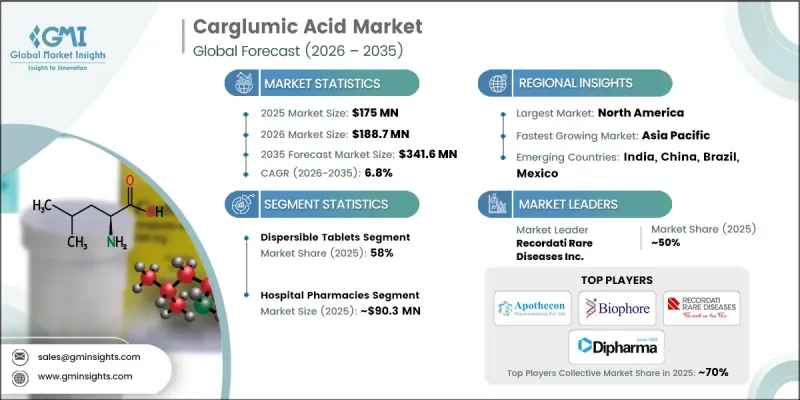
Growth in the carglumic acid market is driven by the rising incidence of metabolic disorders, increasing prevalence of N-acetylglutamate synthase deficiency, and a growing number of cancer-related complications associated with elevated ammonia levels. Expanding newborn screening initiatives and continuous improvements in genetic diagnostic technologies are enabling earlier detection and timely intervention, thereby supporting demand. Increasing awareness among healthcare professionals and patients, along with growing investments in research and development, is further accelerating market expansion. Additionally, the gradual penetration of advanced therapies into emerging markets is creating new growth opportunities. Carglumic acid plays a vital role in managing metabolic imbalances by supporting the removal of excess ammonia from the bloodstream, making it an essential treatment option in specialized care settings. As diagnostic capabilities continue to improve, the number of identified patients is increasing, which is expected to drive sustained demand for effective therapeutic solutions.
| Market Scope | |
|---|---|
| Start Year | 2025 |
| Forecast Year | 2026-2035 |
| Start Value | $175 Million |
| Forecast Value | $341.6 Million |
| CAGR | 6.8% |
The dispersible tablets segment accounted for 58% share in 2025, supported by its ease of administration and patient-friendly formulation. This dosage form is particularly beneficial for individuals who face difficulty swallowing conventional tablets, thereby improving treatment adherence across diverse patient groups. Favorable reimbursement frameworks for rare disease therapies are also contributing to segment growth. The convenience of dosing and enhanced compliance associated with dispersible tablets continue to support their widespread adoption.
The hospital pharmacies segment generated USD 90.3 million in 2025, maintaining its position as the primary distribution channel. These facilities are well-equipped to manage complex therapeutic regimens and ensure timely access to specialized medications. The presence of trained healthcare professionals supports safe administration, monitoring, and management of potential side effects, reinforcing the importance of hospital pharmacies in delivering carglumic acid treatments effectively.
U.S. Carglumic Acid Market was valued at USD 66.5 million in 2025, driven by rising healthcare expenditure and a strong focus on specialty care and rare disease management. Increased investment in advanced therapeutic options and improved access to healthcare services are supporting market growth. Additionally, the growing burden of conditions associated with elevated ammonia levels is contributing to higher demand, further strengthening the market outlook in the region.
Key companies operating in the Global Carglumic Acid Market include Recordati Rare Diseases Inc., Dipharma, Apothecon Pharmaceuticals, Biophore India Pharmaceuticals, Eton Pharmaceuticals, KAVYA PHARMA, MANUS AKTTEVA BIOPHARMA, Merck KGaA, NOVITIUM PHARMA, NURAY CHEMICALS, and Suven Life Sciences. Companies in the Global Carglumic Acid Market are focusing on strategic initiatives to enhance their competitive positioning and expand global reach. Investments in research and development are enabling the introduction of improved formulations and advanced therapeutic options. Firms are also expanding geographically to tap into emerging markets with increasing healthcare access. Strategic collaborations with healthcare providers and research institutions are strengthening clinical capabilities and improving patient outreach. Additionally, companies are emphasizing regulatory approvals and compliance to ensure smooth product commercialization. Efforts to enhance manufacturing efficiency, optimize supply chains, and increase product availability are further supporting growth, while patient awareness programs and physician engagement initiatives help drive adoption and long-term market expansion.
Table of Contents
Chapter 1 Research Methodology
- 1.1 Research approach
- 1.2 Quality commitments
- 1.2.1 GMI AI policy & data integrity commitment
- 1.2.1.1 Source consistency protocol
- 1.2.1 GMI AI policy & data integrity commitment
- 1.3 Research trail & confidence scoring
- 1.3.1 Research trail components
- 1.3.2 Scoring components
- 1.4 Data collection
- 1.4.1 Partial list of primary sources
- 1.5 Data mining sources
- 1.5.1 Paid sources
- 1.5.1.1 Sources, by region
- 1.5.1 Paid sources
- 1.6 Base estimates and calculations
- 1.6.1 Base year calculation
- 1.7 Forecast model
- 1.7.1 Quantified market impact analysis
- 1.7.1.1 Mathematical impact of growth parameters on forecast
- 1.7.1 Quantified market impact analysis
- 1.8 Research transparency addendum
- 1.8.1 Source attribution framework
- 1.8.2 Quality assurance metrics
- 1.8.3 Our commitment to trust
Chapter 2 Executive Summary
- 2.1 Industry 360° synopsis
- 2.2 Key market trends
- 2.2.1 Regional trends
- 2.2.2 Dosage form trends
- 2.2.3 Distribution channel trends
- 2.3 CXO perspectives: Strategic imperatives
Chapter 3 Industry Insights
- 3.1 Industry ecosystem analysis
- 3.2 Industry impact forces
- 3.2.1 Growth drivers
- 3.2.1.1 Growing prevalence of N-acetylglutamate Synthase (NAGS) Syndrome and cancer cases
- 3.2.1.2 Increasing incidences of metabolic diseases
- 3.2.1.3 Rise in awareness coupled with surging R&D activities by key industry players
- 3.2.2 Industry pitfalls and challenges
- 3.2.2.1 Adverse effects associated with carglumic acid medication
- 3.2.3 Opportunities
- 3.2.3.1 Development of improved formulations
- 3.2.1 Growth drivers
- 3.3 Growth potential analysis
- 3.4 Regulatory landscape (Driven by Primary Research)
- 3.4.1 North America
- 3.4.2 Europe
- 3.4.3 Asia Pacific
- 3.5 Technology and innovation landscape
- 3.5.1 Current technological trends
- 3.5.2 Emerging technologies
- 3.6 Future market trends (Driven by Primary Research)
- 3.7 Policy landscape
- 3.8 Impact of AI & generative AI on the market
- 3.8.1 AI-Driven disruption of existing business models
- 3.8.2 GenAI use cases & adoption roadmap by segment
- 3.9 Gap analysis
- 3.10 Porter's analysis
- 3.11 PESTEL analysis
Chapter 4 Competitive Landscape, 2025
- 4.1 Introduction
- 4.2 Company matrix analysis
- 4.3 Company market share analysis
- 4.3.1 Global
- 4.3.2 North America
- 4.3.3 Europe
- 4.4 Competitive analysis of major market players
- 4.5 Competitive positioning matrix
- 4.6 Key developments
- 4.6.1 Mergers & acquisitions
- 4.6.2 Partnerships & collaborations
- 4.6.3 New product launches
- 4.6.4 Expansion plans
Chapter 5 Market Estimates and Forecast, By Dosage Form, 2022 - 2035 ($ Mn)
- 5.1 Key trends
- 5.2 Orally disintegrating tablets
- 5.3 Dispersible tablets
- 5.4 Other dosage forms
Chapter 6 Market Estimates and Forecast, By Distribution Channel, 2022 - 2035 ($ Mn)
- 6.1 Key trends
- 6.2 Hospital pharmacies
- 6.3 Retail pharmacies
- 6.4 Online pharmacies
Chapter 7 Market Estimates and Forecast, By Region, 2022 - 2035 ($ Mn)
- 7.1 Key trends
- 7.2 North America
- 7.2.1 U.S.
- 7.2.2 Canada
- 7.3 Europe
- 7.3.1 Germany
- 7.3.2 UK
- 7.3.3 France
- 7.3.4 Spain
- 7.3.5 Italy
- 7.3.6 Netherlands
- 7.4 Asia Pacific
- 7.4.1 China
- 7.4.2 Japan
- 7.4.3 India
- 7.4.4 Australia
- 7.4.5 South Korea
- 7.5 Latin America
- 7.5.1 Brazil
- 7.5.2 Mexico
- 7.5.3 Argentina
- 7.6 MEA
- 7.6.1 South Africa
- 7.6.2 Saudi Arabia
- 7.6.3 UAE
Chapter 8 Company Profiles
- 8.1 Apothecon Pharmaceuticals
- 8.2 Biophore India Pharmaceuticals
- 8.3 Dipharma
- 8.4 Eton Pharmaceuticals
- 8.5 KAVYA PHARMA
- 8.6 MANUS AKTTEVA BIOPHARMA
- 8.7 Merck KGaA
- 8.8 NOVITIUM PHARMA
- 8.9 NURAY CHEMICALS
- 8.10 Recordati Rare Diseases Inc.
- 8.11 Suven Life Sciences

