PUBLISHER: Global Market Insights Inc. | PRODUCT CODE: 2019147

PUBLISHER: Global Market Insights Inc. | PRODUCT CODE: 2019147
Shortwave Infrared (SWIR) Market Opportunity, Growth Drivers, Industry Trend Analysis, and Forecast 2026 - 2035
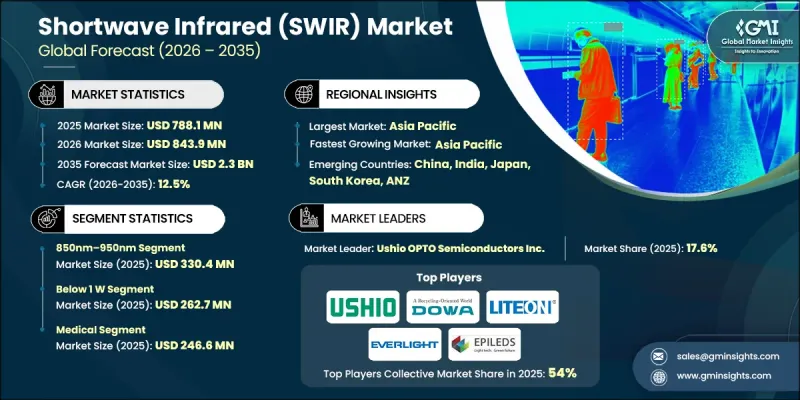
The Global Shortwave Infrared (SWIR) Market was valued at USD 788.1 million in 2025 and is estimated to grow at a CAGR of 12.5% to reach USD 2.3 billion by 2035.
Growth is driven by rising demand for high-performance imaging technologies across automation, inspection, and surveillance environments. Organizations are investing in next-generation imaging systems to improve visibility, accuracy, and process reliability under complex conditions. Continuous advancements in sensor engineering, optics, and data processing are enabling more compact, efficient, and intelligent systems. The integration of artificial intelligence and machine vision capabilities is further transforming SWIR solutions by enabling real-time analytics and automated decision-making. As industries prioritize quality control, safety, and productivity, the adoption of SWIR technologies continues to accelerate. Additionally, increasing digital transformation across industrial ecosystems is creating new opportunities for high-resolution imaging solutions, strengthening the role of SWIR systems in modern applications.
| Market Scope | |
|---|---|
| Start Year | 2025 |
| Forecast Year | 2026-2035 |
| Start Value | $788.1 Million |
| Forecast Value | $2.3 Billion |
| CAGR | 12.5% |
The adoption of SWIR imaging systems is expanding rapidly due to their ability to deliver superior visibility compared to conventional imaging technologies. These systems provide enhanced contrast and improved detection capabilities, allowing operators to identify details that may not be visible through standard imaging approaches. Their performance advantages are driving increased utilization across industrial processes, monitoring systems, and advanced inspection environments. Ongoing innovations in imaging components, including improved sensors and advanced processing algorithms, are enhancing image clarity and operational efficiency. The growing integration of SWIR with intelligent systems is also enabling faster data interpretation and improved automation outcomes, contributing to the broader expansion of this technology across multiple industries.
The 850nm-950nm segment generated USD 330.4 million in 2025, maintaining a leading position within the market. This segment continues to gain traction due to its balanced performance characteristics, offering effective imaging capabilities suitable for a wide range of applications. Its ability to deliver reliable results across varying operational conditions supports its widespread adoption. As industries demand consistent and high-quality imaging solutions, this wavelength range remains a preferred choice due to its versatility and performance efficiency.
The below 1 W segment accounted for USD 262.7 million in 2025, holding a dominant share due to its suitability for low-power applications. Systems within this category are designed to deliver efficient performance while maintaining compact form factors and reduced energy consumption. These characteristics make them highly suitable for portable and space-constrained environments. The segment continues to benefit from advancements in miniaturization and manufacturing efficiency, which support broader adoption. As demand for energy-efficient and reliable imaging solutions increases, this segment is expected to maintain its strong position in the market.
North America Shortwave Infrared (SWIR) Market held a 32.3% share in 2025, reflecting its strong position in technology development and adoption. The region benefits from a well-established ecosystem of technology developers, component manufacturers, and system integrators focused on continuous innovation. Strong investment in research and development, along with increasing demand for advanced imaging technologies, is supporting regional growth. The presence of sophisticated industrial infrastructure and a focus on technological advancement further contribute to the expansion of SWIR solutions across various applications.
Key companies operating in the Global Shortwave Infrared (SWIR) Market include Excelitas Technologies Corporation, ON Semiconductor, Vishay Intertechnology, ROHM Semiconductor, Lumileds, Lite-On Inc., Kingbright, Lextar Electronics Corporation, Everlight Electronics Co Ltd, Epistar Corporation, Ushio OPTO Semiconductors Inc., Marktech Optoelectronics, Brightek (Europe) Limited, DOWA Electronics Materials Co., Ltd., High Power Lighting Corporation, EPILEDS, and Wurth Electronics Inc. Companies in the Shortwave Infrared (SWIR) Market are focusing on innovation-driven strategies to strengthen their competitive position and expand market reach. They are investing heavily in research and development to improve sensor performance, enhance imaging capabilities, and reduce system size and cost. Strategic collaborations with technology partners and system integrators are enabling companies to deliver integrated and application-specific solutions. Many players are also expanding their manufacturing capabilities to meet growing demand while ensuring consistent product quality. Additionally, firms are leveraging advancements in artificial intelligence and machine vision to develop smarter imaging systems. Strengthening global distribution networks and targeting emerging markets further supports long-term growth and market penetration.
Table of Contents
Chapter 1 Methodology and Scope
- 1.1 Market scope and definition
- 1.2 Research design
- 1.2.1 Research approach
- 1.2.2 Data collection methods
- 1.3 Data mining sources
- 1.3.1 Global
- 1.3.2 Regional/Country
- 1.4 Base estimates and calculations
- 1.4.1 Base year calculation
- 1.4.2 Key trends for market estimation
- 1.5 Primary research and validation
- 1.5.1 Primary sources
- 1.6 Forecast model
- 1.7 Research assumptions and limitations
Chapter 2 Executive Summary
- 2.1 Industry 360° synopsis
- 2.2 Key market trends
- 2.2.1 Business trends
- 2.2.2 Spectral range trends
- 2.2.3 Power output trends
- 2.2.4 Application trends
- 2.2.5 End-use trends
- 2.2.6 Regional trends
- 2.3 CXO perspectives: Strategic imperatives
Chapter 3 Industry Insights
- 3.1 Industry ecosystem analysis
- 3.1.1 Supplier Landscape
- 3.1.2 Profit Margin
- 3.1.3 Cost structure
- 3.1.4 Value addition at each stage
- 3.1.5 Factor affecting the value chain
- 3.1.6 Disruptions
- 3.2 Industry impact forces
- 3.2.1 Growth drivers
- 3.2.1.1 Rising Adoption in Industrial Automation and Quality Inspection
- 3.2.1.2 Increased Integration with AI and Advanced Image Processing
- 3.2.1.3 Expansion in Defense and Security Surveillance Applications
- 3.2.1.4 Growing Use in Semiconductor and Electronics Inspection
- 3.2.1.5 Advancements in SWIR Sensor Materials and Miniaturization
- 3.2.2 Industry pitfalls and challenges
- 3.2.2.1 High Cost of SWIR Sensors and Imaging Systems
- 3.2.2.2 Complexity of System Integration and Calibration
- 3.2.3 Market opportunities
- 3.2.3.1 Integration of SWIR with AI-Driven Vision Systems and Smart Manufacturing
- 3.2.3.2 Expansion of SWIR Applications in Environmental Monitoring and Precision Agriculture
- 3.2.1 Growth drivers
- 3.3 Growth potential analysis
- 3.4 Regulatory landscape
- 3.4.1 North America
- 3.4.2 Europe
- 3.4.3 Asia Pacific
- 3.4.4 Latin America
- 3.4.5 Middle East and Africa
- 3.5 Porter's analysis
- 3.6 PESTEL analysis
- 3.7 Technology and Innovation landscape
- 3.7.1 Current technological trends
- 3.7.2 Emerging technologies
- 3.8 Emerging Business Models
- 3.9 Compliance Requirements
- 3.10 Patent and IP analysis
- 3.11 Geopolitical and trade dynamics
Chapter 4 Competitive Landscape, 2025
- 4.1 Introduction
- 4.2 Company market share analysis
- 4.2.1 By region
- 4.2.1.1 North America
- 4.2.1.2 Europe
- 4.2.1.3 Asia Pacific
- 4.2.1.4 Latin America
- 4.2.1.5 Middle East & Africa
- 4.2.2 Market Concentration Analysis
- 4.2.1 By region
- 4.3 Competitive Benchmarking of key Players
- 4.3.1 Financial Performance Comparison
- 4.3.1.1 Revenue
- 4.3.1.2 Profit Margin
- 4.3.1.3 R&D
- 4.3.2 Product Portfolio Comparison
- 4.3.2.1 Product Range Breadth
- 4.3.2.2 Technology
- 4.3.2.3 Innovation
- 4.3.3 Geographic Presence Comparison
- 4.3.3.1 Global Footprint Analysis
- 4.3.3.2 Service Network Coverage
- 4.3.3.3 Market Penetration by Region
- 4.3.4 Competitive Positioning Matrix
- 4.3.4.1 Leaders
- 4.3.4.2 Challengers
- 4.3.4.3 Followers
- 4.3.4.4 Niche Players
- 4.3.1 Financial Performance Comparison
- 4.4 Key developments, 2022-2025
- 4.4.1 Mergers and Acquisitions
- 4.4.2 Partnerships and Collaborations
- 4.4.3 Technological Advancements
- 4.4.4 Expansion and Investment Strategies
- 4.4.5 Sustainability Initiatives
- 4.4.6 Digital Transformation Initiatives
- 4.5 Emerging/ Startup Competitors Landscape
Chapter 5 Market Estimates and Forecast, By Spectral Range, 2022 - 2035 (USD Mn)
- 5.1 Key trends
- 5.2 700nm-850nm
- 5.3 850nm-950nm
- 5.4 950nm-1020nm
- 5.5 1020nm-2500nm
Chapter 6 Market Estimates and Forecast, By Power Output, 2022 - 2035 (USD Mn)
- 6.1 Key trends
- 6.2 Below 1 W
- 6.3 1 W - 5 W
- 6.4 Above 5 W
Chapter 7 Market Estimates and Forecast, By Application, 2022 - 2035 (USD Mn)
- 7.1 Key trends
- 7.2 Medical
- 7.2.1 Blood analysis
- 7.2.2 Tissue imaging
- 7.2.3 Pulse Oximetry
- 7.2.4 Others
- 7.3 Solar simulator
- 7.3.1 Photovoltaic testing
- 7.3.2 Material testing
- 7.3.3 Spacecraft testing
- 7.3.4 Others
- 7.4 Machine vision
- 7.4.1 Defect detection
- 7.4.2 Material sorting
- 7.4.3 Barcode scanning
- 7.4.4 Others
- 7.5 Optical sorting
- 7.5.1 Food sorting
- 7.5.2 Recycling sorting
- 7.5.3 Mining and mineral sorting
- 7.5.4 Plastics sorting
- 7.5.5 Others
- 7.6 Biometrics
- 7.6.1 Vein pattern recognition
- 7.6.2 Facial recognition
- 7.6.3 Iris scanning
- 7.6.4 Others
- 7.7 Imaging
- 7.7.1 Art inspection and restoration
- 7.7.2 Forensic imaging
- 7.7.3 Agricultural imaging
- 7.7.4 Others
- 7.8 Lighting
- 7.8.1 Remote sensing
- 7.8.2 Environmental monitoring
- 7.8.3 Forest fire detection
- 7.8.4 Water quality assessment
- 7.8.5 Others
- 7.9 Surveillance
- 7.9.1 Low-light surveillance
- 7.9.2 Perimeter security
- 7.9.3 Facial recognition in darkness
- 7.9.4 Others
Chapter 8 Market Estimates and Forecast, By End-User, 2022 - 2035 (USD Mn)
- 8.1 Key trends
- 8.2 Aerospace & defense
- 8.3 Automotive
- 8.4 BFSI
- 8.5 Consumer electronics
- 8.6 Education
- 8.7 Healthcare
- 8.8 Industrial
- 8.9 Retail
- 8.10 Others
Chapter 9 Market Estimates and Forecast, By Region, 2022 - 2035 (USD Mn)
- 9.1 Key trends
- 9.2 North America
- 9.2.1 U.S.
- 9.2.2 Canada
- 9.3 Europe
- 9.3.1 Germany
- 9.3.2 UK
- 9.3.3 France
- 9.3.4 Italy
- 9.3.5 Spain
- 9.3.6 Netherlands
- 9.4 Asia Pacific
- 9.4.1 China
- 9.4.2 India
- 9.4.3 Japan
- 9.4.4 ANZ
- 9.4.5 South Korea
- 9.5 Latin America
- 9.5.1 Brazil
- 9.5.2 Mexico
- 9.5.3 Argentina
- 9.6 Middle East and Africa
- 9.6.1 South Africa
- 9.6.2 Saudi Arabia
- 9.6.3 UAE
Chapter 10 Company Profiles
- 10.1 Brightek (Europe) Limited
- 10.2 DOWA Electronics Materials Co., Ltd.
- 10.3 EPILEDS
- 10.4 Epistar Corporation
- 10.5 Everlight Electronics Co Ltd
- 10.6 Excelitas Technologies Corporation
- 10.7 High Power Lighting Corporation
- 10.8 Kingbright
- 10.9 Lextar Electronics Corporation
- 10.10 Lite-On Inc.
- 10.11 Lumileds
- 10.12 Marktech Optoelectronics
- 10.13 ON Semiconductor
- 10.14 ROHM Semiconductor
- 10.15 Ushio OPTO Semiconductors Inc.
- 10.16 Vishay Intertechnology
- 10.17 Wurth Electronics Inc.

