PUBLISHER: Global Market Insights Inc. | PRODUCT CODE: 2019155

PUBLISHER: Global Market Insights Inc. | PRODUCT CODE: 2019155
Pet Cosmetic Market Opportunity, Growth Drivers, Industry Trend Analysis, and Forecast 2026 - 2035
The Global Pet Cosmetic Market was valued at USD 2.2 billion in 2025 and is projected to grow at a CAGR of 7.1% to reach USD 3.9 billion by 2035.
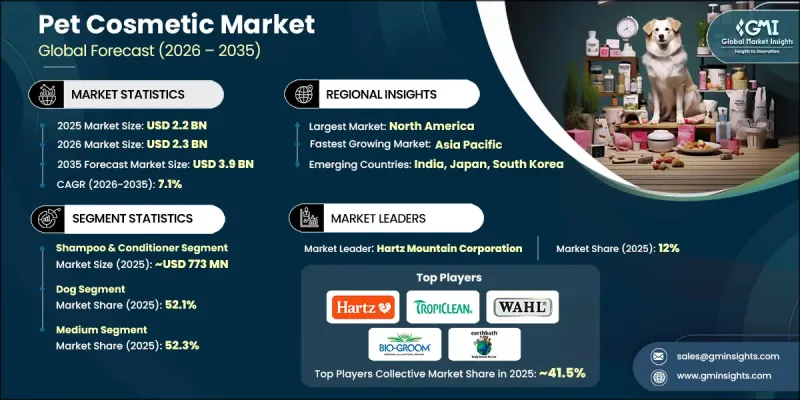
Growth is driven by a shift in consumer behavior, where pet care is increasingly viewed as an essential part of overall household spending. Pet owners are dedicating more resources toward maintaining cleanliness and appearance, making grooming routines more structured and consistent. Urbanization is further encouraging the adoption of hygiene-focused practices, particularly in indoor living environments. Time constraints associated with modern lifestyles are also influencing demand for efficient and easy-to-use grooming solutions. Additionally, increasing awareness of pet skin health and hygiene is attracting new consumers to specialized cosmetic products. The expansion of organized retail channels and the rapid growth of e-commerce platforms are further accelerating market development. Digital platforms enable informed decision-making through product comparisons, reviews, and pricing insights, while subscription-based purchasing and home delivery services are boosting repeat sales and improving overall product accessibility.
| Market Scope | |
|---|---|
| Start Year | 2025 |
| Forecast Year | 2026-2035 |
| Start Value | $2.2 Billion |
| Forecast Value | $3.9 Billion |
| CAGR | 7.1% |
The shampoo and conditioner segment generated USD 773 million in 2025 and is anticipated to grow at a CAGR of 7.7% from 2026 to 2035. This segment continues to lead the pet cosmetic market due to its essential role in maintaining hygiene and coat health. These products are widely used for regular grooming routines, offering convenience, ease of use, and compatibility with different coat and skin needs. Their consistent demand is supported by frequent usage patterns and their importance in ensuring overall cleanliness and comfort for pets. A wide variety of formulations and accessibility across retail channels further strengthen their dominant market position.
The dog segment held 52.1% share in 2025 and is expected to grow at a CAGR of 7.2% between 2026 and 2035. This segment leads the market due to higher adoption rates and greater grooming requirements compared to other pet categories. Regular maintenance needs, including hygiene and coat care, drive strong demand for cosmetic products within this segment. Increasing awareness of pet care and rising spending on grooming solutions continue to support segment growth. The need for consistent upkeep reinforces the dominant position of dogs in the overall market landscape.
U.S Pet Cosmetic Market was valued at USD 636.1 million in 2025 and is expected to grow at a CAGR of 7.2% from 2026 to 2035. Market growth is supported by high pet ownership levels and strong consumer spending on grooming and hygiene products. There is a growing preference for premium and specialized solutions that support skin and coat health. Expanding online retail platforms are improving access to a diverse range of products, while increasing the availability of professional grooming services further supports demand. Recurring purchase models and subscription-based offerings are also contributing to higher consumption frequency. Additionally, digital influence and evolving consumer preferences are shaping demand for branded and specialized pet care products.
Key companies operating in the Global Pet Cosmetic Market include TropiClean, Wahl Clipper Corporation, Bio-Groom, Earthbath, Hartz Mountain Corporation, Chris Christensen, Isle of Dogs, Petkin, Espree Animal Products, Himalaya Drug Company, Biocrown Biotechnology, Lambert Kay (PBI-Gordon), Innovacyn, Wildwash, and Earthwhile Endeavours. Companies in the Pet Cosmetic Market are strengthening their market position by focusing on product innovation, premiumization, and expanding distribution channels. Many brands are developing specialized formulations that address specific skin and coat needs while aligning with evolving consumer preferences. Businesses are also enhancing their online presence through e-commerce platforms and direct-to-consumer strategies to improve accessibility and customer engagement. Strategic partnerships and collaborations are being used to expand market reach and strengthen brand visibility. Additionally, companies are leveraging digital marketing and targeted campaigns to attract new customers and retain existing ones.
Table of Contents
Chapter 1 Methodology & Scope
- 1.1 Market scope and definition
- 1.2 Research design
- 1.2.1 Research approach
- 1.2.2 Data collection methods
- 1.3 Data mining sources
- 1.3.1 Global
- 1.3.2 Regional/Country
- 1.4 Base estimates and calculations
- 1.4.1 Base year calculation
- 1.4.2 Key trends for market estimation
- 1.5 Primary research and validation
- 1.5.1 Primary sources
- 1.6 Forecast model
- 1.7 Research assumptions and limitations
Chapter 2 Executive Summary
- 2.1 Industry 360° synopsis
- 2.2 Key market trends
- 2.2.1 Regional
- 2.2.2 Type
- 2.2.3 Pet type
- 2.2.4 Price
- 2.2.5 End users
- 2.2.6 Distribution channel
Chapter 3 Industry Insights
- 3.1 Industry ecosystem analysis
- 3.1.1 Supplier landscape
- 3.1.2 Profit margin
- 3.1.3 Value addition at each stage
- 3.1.4 Factor affecting the value chain
- 3.2 Industry impact forces
- 3.2.1 Growth drivers
- 3.2.1.1 Increasing pet humanization and premium grooming
- 3.2.1.2 Rising awareness regarding pet hygiene and skin health
- 3.2.1.3 Expansion of pet specialty stores and e-commerce platforms
- 3.2.2 Pitfalls & Challenges
- 3.2.2.1 Concerns regarding chemical ingredients and product safety
- 3.2.2.2 High cost of premium pet cosmetic products
- 3.2.3 Opportunities
- 3.2.3.1 Development of organic and natural pet cosmetic formulations
- 3.2.3.2 Introduction of breed-specific and dermatology-focused products
- 3.2.1 Growth drivers
- 3.3 Growth potential analysis
- 3.4 Future market trends
- 3.5 Technology and innovation landscape
- 3.5.1 Current technological trends
- 3.5.2 Emerging technologies
- 3.6 Regulatory landscape
- 3.6.1 Standards and compliance requirements
- 3.6.2 Regional regulatory frameworks
- 3.6.3 Certification standards
- 3.7 Porter's analysis
- 3.8 PESTEL analysis
- 3.9 Pricing Analysis (Driven by Primary Research)
- 3.9.1 Historical Price Trend Analysis (Driven by Primary Research)
- 3.9.2 Pricing Strategy by Player Type (Premium / Value / Mass Market) (Driven by Primary Research)
- 3.9.3 Price Variation by Distribution Channel
- 3.9.4 Regional Price Benchmarking
- 3.10 Trade Data Analysis (HS code 3307.90) (Driven by paid data base)
- 3.10.1 Import/Export Volume & Value Trends (Driven by paid data base)
- 3.10.2 Key Trade Corridors & Tariff Impact (Driven by paid data base)
- 3.10.3 Cross-Border E-commerce Dynamics
- 3.10.4 Regional Trade Agreement Implications
- 3.11 Distribution Infrastructure & Channel Penetration Landscape (Driven by Primary Research)
- 3.11.1 Channel Coverage by Region & Format (Modern vs. Traditional Trade) (Driven by Primary Research)
- 3.11.2 Last-Mile Infrastructure Gaps & Emerging Channel Shifts (Driven by Primary Research)
- 3.11.3 Omnichannel Integration & Direct-to-Consumer Maturity
- 3.11.4 Professional Channel Network Density (Grooming salons, vet clinics)
Chapter 4 Competitive Landscape, 2025
- 4.1 Introduction
- 4.2 Company market share analysis
- 4.2.1 By Region
- 4.2.1.1 North America
- 4.2.1.2 Europe
- 4.2.1.3 Asia Pacific
- 4.2.1.4 Latin America
- 4.2.1.5 Middle East & Africa
- 4.2.1 By Region
- 4.3 Company matrix analysis
- 4.4 Competitive analysis of major market players
- 4.5 Competitive positioning matrix
- 4.6 Key developments
- 4.6.1 Mergers & acquisitions
- 4.6.2 Partnerships & collaborations
- 4.6.3 New product launches
- 4.6.4 Expansion plans
Chapter 5 Market Estimates & Forecast, By Product Type, 2022 - 2035, (USD Million) (Thousand Units)
- 5.1 Key trends
- 5.2 Shampoo & conditioner
- 5.3 Skin powder
- 5.4 Perfume
- 5.5 Eye care lotion
- 5.6 Moisturizing balm
- 5.7 Others (toothpaste, cleaning wipes etc.)
Chapter 6 Market Estimates & Forecast, By Pet Type, 2022 - 2035, (USD Million) (Thousand Units)
- 6.1 Key trends
- 6.2 Dog
- 6.3 Cat
- 6.4 Others (horses etc.)
Chapter 7 Market Estimates & Forecast, By Price, 2022 - 2035, (USD Million) (Thousand Units)
- 7.1 Key trends
- 7.2 Low
- 7.3 Medium
- 7.4 High
Chapter 8 Market Estimates & Forecast, By End Users, 2022 - 2035, (USD Million) (Thousand Units)
- 8.1 Key trends
- 8.2 Individual pet owner
- 8.3 Professional pet groomers
Chapter 9 Market Estimates & Forecast, By Distribution Channel, 2022 - 2035, (USD Million) (Thousand Units)
- 9.1 Key trends
- 9.2 Online
- 9.2.1 Company websites
- 9.2.2 E-commerce websites
- 9.3 Offline
- 9.3.1 Supermarket/Hypermarket
- 9.3.2 Pet stores
- 9.3.3 Others (pet clinics etc.)
Chapter 10 Market Estimates & Forecast, By Region, 2022 - 2035, (USD Million) (Thousand Units)
- 10.1 Key trends
- 10.2 North America
- 10.2.1 U.S.
- 10.2.2 Canada
- 10.3 Europe
- 10.3.1 Germany
- 10.3.2 UK
- 10.3.3 France
- 10.3.4 Italy
- 10.3.5 Spain
- 10.4 Asia Pacific
- 10.4.1 China
- 10.4.2 India
- 10.4.3 Japan
- 10.4.4 South Korea
- 10.4.5 Australia
- 10.5 Latin America
- 10.5.1 Brazil
- 10.5.2 Mexico
- 10.5.3 Argentina
- 10.6 MEA
- 10.6.1 Saudi Arabia
- 10.6.2 UAE
- 10.6.3 South Africa
Chapter 11 Company Profiles
- 11.1 Biocrown Biotechnology
- 11.2 Bio-Groom
- 11.3 Chris Christensen
- 11.4 Earthbath
- 11.5 Earthwhile Endeavours
- 11.6 Espree Animal Products
- 11.7 Hartz Mountain Corporation
- 11.8 Himalaya Drug Company
- 11.9 Innovacyn
- 11.10 Isle of Dogs
- 11.11 Lambert Kay (PBI-Gordon)
- 11.12 Petkin
- 11.13 TropiClean
- 11.14 Wahl Clipper Corporation
- 11.15 Wildwash

