PUBLISHER: Global Market Insights Inc. | PRODUCT CODE: 2019160

PUBLISHER: Global Market Insights Inc. | PRODUCT CODE: 2019160
Membrane Oxygenators Market Opportunity, Growth Drivers, Industry Trend Analysis, and Forecast 2026 - 2035
The Global Membrane Oxygenators Market was valued at USD 133.8 million in 2025 and is estimated to grow at a CAGR of 2.4% to reach USD 167.5 million by 2035.
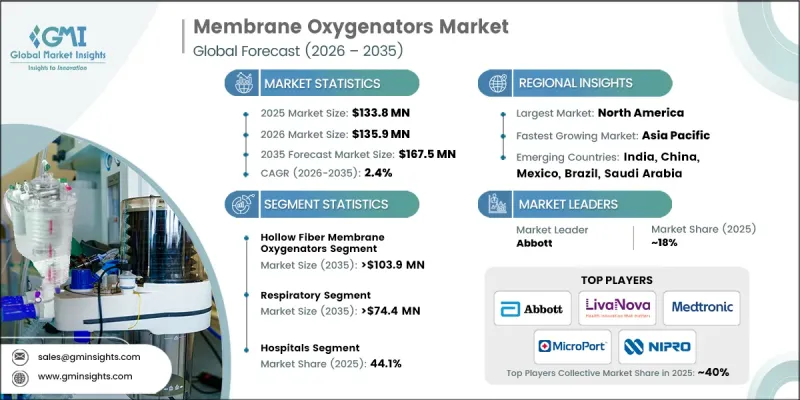
The market is expanding due to the rising incidence of respiratory and cardiac disorders, including conditions such as ARDS, cardiogenic shock, and myocarditis. Membrane oxygenators serve a critical role in extracorporeal life support, facilitating gas exchange by removing carbon dioxide and delivering oxygen to the blood. Advanced designs utilizing hollow fiber and flat sheet membranes are essential in managing respiratory and cardiac failure, particularly during ECMO procedures. Increasing adoption of ECMO in critical care, supported by growing healthcare spending and enhanced infrastructure in developing regions, is driving demand. Government initiatives to improve access to ECMO training, alongside the development of portable and user-friendly devices, are broadening the application of membrane oxygenators, particularly in neonatal and pediatric care. Enhanced efficiency, safety, and adaptability are key drivers shaping market growth globally.
| Market Scope | |
|---|---|
| Start Year | 2025 |
| Forecast Year | 2026-2035 |
| Start Value | $133.8 Million |
| Forecast Value | $167.5 Million |
| CAGR | 2.4% |
The hollow fiber membrane oxygenators segment is expected to grow at a CAGR of 2.7% to reach USD 103.9 million by 2035. Hollow fiber systems are preferred for their compact design, superior gas exchange efficiency, and compatibility with critical care procedures, including cardiopulmonary bypass and ECMO. Technological advancements enhancing biocompatibility and reducing blood trauma further strengthen their adoption, particularly in neonatal and pediatric applications, where patient size and safety are critical.
The hospitals segment held a 44.1% share in 2025. Hospitals remain primary users of membrane oxygenators due to their role in managing critical conditions such as ARDS, cardiogenic shock, and post-cardiac surgery care. The increasing number of cardiovascular and respiratory cases, combined with specialized infrastructure and trained staff, supports the rising demand for ECMO procedures. Integration of advanced ECMO systems in ICUs improves patient outcomes, reinforcing the critical role of hospitals in market expansion.
U.S. Membrane Oxygenators Market was valued at USD 44.4 million in 2025. A rising prevalence of respiratory and cardiovascular diseases, an aging population, and increasing chronic health conditions are driving the adoption of ECMO procedures that rely on membrane oxygenators. A strong healthcare infrastructure, the proliferation of ECMO centers, and technological improvements in portable and efficient oxygenators support demand, especially in neonatal and pediatric care applications.
Prominent players in the Global Membrane Oxygenators Market include Abbott, BRAILE, Chalice, CytoSorbents, EUROSETS, Fresenius, GETINGE, LivaNova, Medtronic, MicroPort, NIPRO, PrecisionMedical, RECTUS MEDICAL, TERUMO, and XENIOS. Companies in the Global Membrane Oxygenators Market adopt strategies such as investing in R&D to improve membrane biocompatibility and gas exchange efficiency, expanding product lines to include portable and neonatal-friendly oxygenators, and forming strategic partnerships with hospitals and ECMO centers to strengthen distribution channels. They also focus on regulatory compliance and clinical validation to enhance credibility and market trust. Targeted marketing campaigns, training programs for healthcare professionals, and participation in global medical expos help boost brand recognition. In addition, companies pursue mergers and acquisitions to consolidate technological capabilities, reduce competition, and expand their regional footprint across North America, Europe, and Asia-Pacific, ensuring long-term market presence and sustained growth.
Table of Contents
Chapter 1 Research Methodology
- 1.1 Research approach
- 1.2 Quality commitments
- 1.2.1 GMI AI policy & data integrity commitment
- 1.2.1.1 Source consistency protocol
- 1.2.1 GMI AI policy & data integrity commitment
- 1.3 Research trail & confidence scoring
- 1.3.1 Research trail components
- 1.3.2 Scoring components
- 1.4 Data collection
- 1.4.1 Partial list of primary sources
- 1.5 Data mining sources
- 1.5.1 Paid sources
- 1.5.1.1 Sources, by region
- 1.5.1 Paid sources
- 1.6 Base estimates and calculations
- 1.6.1 Base year calculation for any one approach
- 1.7 Forecast model
- 1.7.1 Quantified market impact analysis
- 1.7.1.1 Mathematical impact of growth parameters on forecast
- 1.7.1 Quantified market impact analysis
- 1.8 Research transparency addendum
- 1.8.1 Source attribution framework
- 1.8.2 Quality assurance metrics
- 1.8.3 Our commitment to trust
Chapter 2 Executive Summary
- 2.1 Industry 360° synopsis
- 2.2 Key market trends
- 2.2.1 Regional trends
- 2.2.2 Type trends
- 2.2.3 Application trends
- 2.2.4 Age group trends
- 2.2.5 End use trends
- 2.3 CXO perspectives: Strategic imperatives
Chapter 3 Industry Insights
- 3.1 Industry ecosystem analysis
- 3.2 Industry impact forces
- 3.2.1 Growth drivers
- 3.2.1.1 Rising cardiovascular disease prevalence
- 3.2.1.2 Growing demand for extracorporeal membrane oxygenation (ECMO)
- 3.2.1.3 High incidence of acute respiratory distress syndrome (ARDS)
- 3.2.1.4 Rise in organ transplant procedures
- 3.2.1.5 Surging applications in pediatric and neonatal care
- 3.2.2 Industry pitfalls and challenges
- 3.2.2.1 Strict regulatory requirements
- 3.2.2.2 High costs of advanced oxygenators
- 3.2.3 Market opportunities
- 3.2.3.1 Innovation in polymer science
- 3.2.1 Growth drivers
- 3.3 Growth potential analysis
- 3.4 Regulatory landscape
- 3.4.1 North America
- 3.4.2 Europe
- 3.4.3 Asia Pacific
- 3.5 Technology landscape
- 3.5.1 Current technological trends
- 3.5.2 Emerging technologies
- 3.6 Future market trends (Driven by Primary Research)
- 3.7 Impact of AI and generative AI on the market
- 3.8 Customer insights (Driven by Primary Research)
- 3.9 Pricing analysis, 2025
- 3.10 Porter's analysis
- 3.11 PESTEL analysis
- 3.12 Gap analysis
Chapter 4 Competitive Landscape, 2025
- 4.1 Introduction
- 4.2 Company matrix analysis
- 4.3 Company market share analysis
- 4.3.1 Global
- 4.3.2 North America
- 4.3.3 Europe
- 4.3.4 Asia Pacific
- 4.4 Competitive positioning matrix
- 4.5 Competitive analysis of major market players
- 4.6 Key developments
- 4.6.1 Mergers & acquisitions
- 4.6.2 Partnerships & collaborations
- 4.6.3 New product type launches
- 4.6.4 Expansion plans
Chapter 5 Market Estimates and Forecast, By Type, 2022 - 2035 ($ Mn)
- 5.1 Key trends
- 5.2 Hollow fiber membrane oxygenators
- 5.3 Flat sheet membrane oxygenators
Chapter 6 Market Estimates and Forecast, By Application, 2022 - 2035 ($ Mn)
- 6.1 Key trends
- 6.2 Respiratory
- 6.2.1 Respiratory failure
- 6.2.2 Pulmonary embolism
- 6.2.3 Acute respiratory distress syndrome
- 6.2.4 Pneumonia
- 6.3 Cardiac
- 6.3.1 Decompensated cardiomyopathy
- 6.3.2 Acute myocardial infarction
- 6.3.3 Cardiogenic shock
- 6.3.4 Post-transplant complications
- 6.3.5 Myocarditis
- 6.4 Extra corporeal cardiopulmonary resuscitation
Chapter 7 Market Estimates and Forecast, By Age Group, 2022 - 2035 ($ Mn)
- 7.1 Key trends
- 7.2 Adults
- 7.3 Neonates
- 7.4 Pediatrics
Chapter 8 Market Estimates and Forecast, By End Use, 2022 - 2035 ($ Mn)
- 8.1 Key trends
- 8.2 Hospitals
- 8.3 Ambulatory surgical centers
- 8.4 Other end users
Chapter 9 Market Estimates and Forecast, By Region, 2022 - 2035 ($ Mn)
- 9.1 Key trends
- 9.2 North America
- 9.2.1 U.S.
- 9.2.2 Canada
- 9.3 Europe
- 9.3.1 Germany
- 9.3.2 UK
- 9.3.3 France
- 9.3.4 Spain
- 9.3.5 Italy
- 9.3.6 Netherlands
- 9.4 Asia Pacific
- 9.4.1 China
- 9.4.2 Japan
- 9.4.3 India
- 9.4.4 Australia
- 9.4.5 South Korea
- 9.5 Latin America
- 9.5.1 Brazil
- 9.5.2 Mexico
- 9.5.3 Argentina
- 9.6 Middle East and Africa
- 9.6.1 South Africa
- 9.6.2 Saudi Arabia
- 9.6.3 UAE
Chapter 10 Company Profiles
- 10.1 Abbott
- 10.2 BRAILE
- 10.3 chalice
- 10.4 CytoSorbents
- 10.5 EUROSETS
- 10.6 Fresenius
- 10.7 GETINGE
- 10.8 LivaNova
- 10.9 Medtronic
- 10.10 MicroPort
- 10.11 NIPRO
- 10.12 PrecisionMedical
- 10.13 RECTUS MEDICAL
- 10.14 TERUMO
- 10.15 XENIOS

