
PUBLISHER: Global Market Insights Inc. | PRODUCT CODE: 2019161

PUBLISHER: Global Market Insights Inc. | PRODUCT CODE: 2019161
North America Turbocharger Market Opportunity, Growth Drivers, Industry Trend Analysis, and Forecast 2026 - 2035
North America Turbocharger Market was valued at USD 5.8 billion in 2025 and is estimated to grow at a CAGR of 5.1% to reach USD 9.5 billion by 2035.
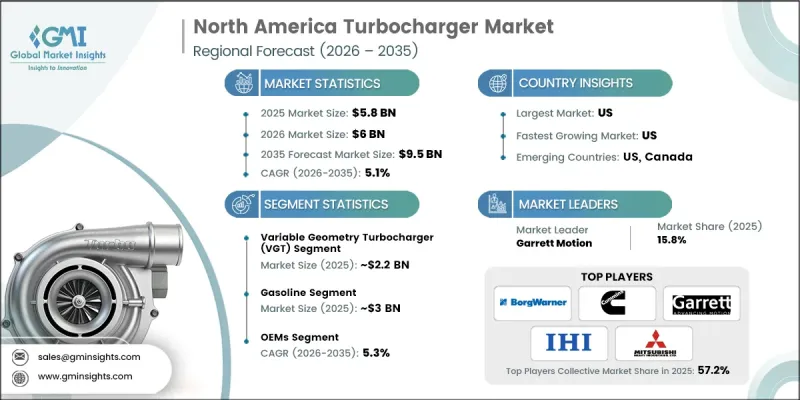
Market expansion is driven by increasingly stringent fuel efficiency and emission standards across the region, encouraging the adoption of technologies that enhance engine performance while reducing environmental impact. Turbochargers play a critical role in enabling engine downsizing without compromising power output, making them an essential component for modern vehicle manufacturing. The region's strong demand for medium and heavy-duty vehicles further supports market growth, as these applications require enhanced power and efficiency. Continuous innovation by manufacturers is also contributing to the advancement of turbocharger systems, improving durability and operational effectiveness. Additionally, North America benefits from a well-established supply chain network, supported by manufacturing facilities and engineering capabilities that enable efficient production and integration of turbocharger components. Collaboration between suppliers and manufacturers continues to enhance product quality and compatibility with evolving engine technologies.
| Market Scope | |
|---|---|
| Start Year | 2025 |
| Forecast Year | 2026-2035 |
| Start Value | $5.8 Billion |
| Forecast Value | $9.5 Billion |
| CAGR | 5.1% |
The variable geometry turbocharger segment held 37.6% share in 2025, generating USD 2.2 billion. These turbochargers are designed with adjustable vane systems that regulate exhaust flow across different engine speeds, resulting in improved combustion efficiency, higher power output, and reduced lag. Their ability to optimize performance under varying conditions has increased their adoption across both passenger and commercial vehicle segments, contributing significantly to overall market revenue.
The gasoline-powered vehicle segment accounted for 52.3% share in 2025, generating USD 3 billion. The widespread use of gasoline engines in passenger vehicles, combined with ongoing vehicle production and replacement cycles, has supported the integration of turbocharging technology to enhance fuel efficiency and driving performance. Increasing demand for passenger vehicles with improved power and efficiency continues to drive growth within this segment, reinforcing its leading position in the market.
Midwest Turbocharger Market reached USD 1.8 billion in 2025 and is projected to grow at a CAGR of 5.4% from 2026 to 2035. This region remains a key hub for automotive innovation and manufacturing, supported by a strong concentration of engineering expertise, component production facilities, and research activities. The presence of advanced development capabilities in engine systems and turbocharger technologies is fostering continuous innovation, particularly in next-generation solutions that improve efficiency and performance.
Key companies operating in the North America Turbocharger Market include BorgWarner, Continental, Cummins, Eaton, Garrett Motion, IHI, Mitsubishi Heavy Industries, Precision Turbo and Engine, Toyota Industries, and Schaeffler (Vitesco). Companies in the North America Turbocharger Market are reinforcing their competitive position through innovation, partnerships, and expansion strategies. A major focus is on developing advanced turbocharging systems that improve fuel efficiency and comply with tightening emission regulations. Manufacturers are investing in research and development to introduce technologies such as variable geometry systems and enhanced electronic controls. Strategic collaborations with automotive manufacturers are helping secure long-term supply agreements and accelerate product integration. Companies are also expanding manufacturing capabilities and optimizing supply chains to improve cost efficiency and meet rising demand. Additionally, firms are targeting high-growth segments and investing in next-generation solutions to strengthen their market presence and sustain long-term growth.
Table of Contents
Chapter 1 Methodology
- 1.1 Research approach
- 1.2 Quality commitments
- 1.2.1 GMI AI policy & data integrity commitment
- 1.3 Research trail & confidence scoring
- 1.3.1 Research trail components
- 1.3.2 Scoring components
- 1.4 Data collection
- 1.4.1 Partial list of primary sources
- 1.5 Data mining sources
- 1.5.1 Paid sources
- 1.6 Base estimates and calculations
- 1.6.1 Base year calculation
- 1.7 Forecast model
- 1.8 Research transparency addendum
Chapter 2 Executive Summary
- 2.1 Industry 360° synopsis
- 2.2 Key market trends
- 2.2.1 Regional
- 2.2.2 Technology
- 2.2.3 Fuel
- 2.2.4 Application
- 2.2.5 Material
- 2.2.6 Sales Channel
- 2.3 TAM analysis, 2026-2035
- 2.4 CXO perspectives: Strategic imperatives
Chapter 3 Industry Insights
- 3.1 Industry ecosystem analysis
- 3.1.1 Supplier landscape
- 3.1.2 Profit margin
- 3.1.3 Cost structure
- 3.1.4 Value addition at each stage
- 3.1.5 Factor affecting the value chain
- 3.1.6 Disruptions
- 3.2 Industry impact forces
- 3.2.1 Growth drivers
- 3.2.1.1 Stringent emission regulations driving engine downsizing
- 3.2.1.2 Rising fuel efficiency demands
- 3.2.1.3 Performance enhancement in passenger vehicles
- 3.2.1.4 Heavy-duty commercial vehicle turbo adoption integration
- 3.2.2 Industry pitfalls and challenges
- 3.2.2.1 Electric vehicle displacement of ICE demand
- 3.2.2.2 Oil leakage and maintenance challenges
- 3.2.3 Market opportunities
- 3.2.3.1 Electric turbocharger commercialization
- 3.2.3.2 Aftermarket growth in aging vehicle fleet
- 3.2.3.3 Off-highway and marine application expansion
- 3.2.3.4 Lightweighting through advanced materials
- 3.2.1 Growth drivers
- 3.3 Growth potential analysis
- 3.4 Regulatory landscape
- 3.4.1 US
- 3.4.1.1 Federal Aviation Administration
- 3.4.1.2 United States Environmental Protection Agency (EPA)
- 3.4.1.3 California Air Resources Board (CARB)
- 3.4.2 Canada
- 3.4.2.1 Environment and Climate Change Canada (ECCC)
- 3.4.2.2 Transport Canada
- 3.4.1 US
- 3.5 Investment & Funding Analysis
- 3.6 Porter's analysis
- 3.7 PESTEL analysis
- 3.8 Technology and innovation landscape
- 3.8.1 Current technologies
- 3.8.1.1 Single-Stage Turbochargers
- 3.8.1.2 Twin-Scroll Turbochargers
- 3.8.1.3 Variable Geometry Turbochargers (VGT)
- 3.8.2 Emerging technologies
- 3.8.2.1 Hybrid Turbochargers
- 3.8.2.2 Lightweight Turbocharger Materials
- 3.8.1 Current technologies
- 3.9 Pricing analysis (Driven by Primary Research)
- 3.9.1 Historical Price Trend Analysis
- 3.9.2 Pricing Strategy by Player Type (Premium / Value / Cost-plus)
- 3.10 Patent landscape (Driven by Primary Research)
- 3.11 Trade Data Analysis (Driven by Paid Database)
- 3.11.1 Import/Export Volume & Value Trends
- 3.11.2 Key Trade Corridors & Tariff Impact
- 3.12 Capacity & Production Landscape (Driven by Primary Research)
- 3.12.1 Installed Capacity by Region & Key Producer
- 3.12.2 Capacity Utilization Rates & Expansion Pipelines
- 3.13 Cost breakdown analysis
- 3.13.1 Material cost structure by technology type
- 3.13.2 Manufacturing cost analysis
- 3.13.3 Total cost of ownership (TCO)
- 3.13.4 Impact of raw material price volatility on profitability
- 3.14 Impact of AI & Generative AI on the Market
- 3.14.1 AI-driven disruption of existing business models
- 3.14.2 GenAI use cases & adoption roadmap by segment
- 3.14.3 Risks, limitations & regulatory considerations
- 3.15 Impact of electric vehicle (EV) adoption
- 3.15.1 Decline in ICE Turbocharger Demand
- 3.15.2 Hybrid and Mild-Hybrid Turbo Integration
- 3.15.3 R&D Shift Towards Electrification
- 3.15.4 Aftermarket Implications
- 3.16 Impact of fuel type shifts
- 3.16.1 Gasoline engine proliferation and turbo adoption
- 3.16.2 Diesel market contraction and strategic response
- 3.16.3 Alternative fuel compatibility assessment (CNG, hydrogen, biofuels)
- 3.16.4 Regulatory influence on fuel type transitions
- 3.17 Case studies
- 3.18 Forecast assumptions & scenario analysis (Driven by primary research)
- 3.18.1 Base Case - key macro & industry variables driving CAGR
- 3.18.2 Optimistic Scenarios - Favorable macro and industry tailwinds
- 3.18.3 Pessimistic Scenario - Macroeconomic slowdown or industry headwinds
Chapter 4 Competitive Landscape, 2025
- 4.1 Introduction
- 4.2 Company market share analysis
- 4.2.1 US
- 4.2.2 Canada
- 4.3 Competitive analysis of major market players
- 4.4 Competitive positioning matrix
- 4.5 Key developments
- 4.5.1 Mergers & acquisitions
- 4.5.2 Partnerships & collaborations
- 4.5.3 New product launches
- 4.5.4 Expansion plans and funding
- 4.6 Company tier benchmarking
- 4.6.1 Tier classification criteria & qualifying thresholds
- 4.6.2 Tier positioning matrix by revenue, geography & innovation
Chapter 5 Market Estimates & Forecast, By Technology, 2022 - 2035 ($Mn, Thousand Units)
- 5.1 Key trends
- 5.2 Single Turbocharger
- 5.2.1 Small Frame Turbochargers
- 5.2.2 Large Frame Turbochargers
- 5.3 Twin-Turbocharger
- 5.4 Twin-Scroll Turbocharger
- 5.5 Variable Geometry Turbocharger (VGT)
- 5.6 Variable Twin-Scroll Turbocharger (VTS)
- 5.7 Electric Turbocharger
Chapter 6 Market Estimates & Forecast, By Fuel, 2022 - 2035 ($Mn, Thousand Units)
- 6.1 Key trends
- 6.2 Gasoline
- 6.3 Diesel
Chapter 7 Market Estimates & Forecast, By Application, 2022 - 2035 ($Mn, Thousand Units)
- 7.1 Key trends
- 7.2 Automotive
- 7.2.1 Passenger cars
- 7.2.1.1 Hatchback
- 7.2.1.2 Sedan
- 7.2.1.3 SUV
- 7.2.2 Commercial vehicles
- 7.2.2.1 LCV
- 7.2.2.2 MCV
- 7.2.2.3 HCV
- 7.2.3 Off-Highway Vehicle
- 7.2.3.1 Agricultural Equipment
- 7.2.3.2 Construction Equipment
- 7.2.3.3 Mining Equipment
- 7.2.1 Passenger cars
- 7.3 Non-automotive
- 7.3.1 Aerospace & defense
- 7.3.1.1 Aircraft Engine Turbochargers
- 7.3.1.2 Military Vehicle Turbochargers
- 7.3.2 Marine
- 7.3.2.1 Commercial ship
- 7.3.2.2 Naval vessel
- 7.3.2.3 Recreational boat
- 7.3.3 Others
- 7.3.1 Aerospace & defense
Chapter 8 Market Estimates & Forecast, By Material, 2022 - 2035 ($Mn, Thousand Units)
- 8.1 Key trends
- 8.2 Cast iron
- 8.3 Aluminum
- 8.4 Others
Chapter 9 Market Estimates & Forecast, By Sales Channel, 2022 - 2035 ($Mn, Thousand Units)
- 9.1 Key trends
- 9.2 OEM
- 9.3 Aftermarket
Chapter 10 Market Estimates & Forecast, By Region, 2022 - 2035 ($Mn, Thousand Units)
- 10.1 Key trends
- 10.2 US
- 10.3 Canada
Chapter 11 Company Profiles
- 11.1 Global players
- 11.1.1 BorgWarner
- 11.1.2 Garrett Motion
- 11.1.3 Mitsubishi Heavy Industries
- 11.1.4 IHI
- 11.1.5 Cummins
- 11.1.6 Continental
- 11.1.7 ABB
- 11.1.8 Toyota Industries
- 11.1.9 Bosch-Mahle
- 11.1.10 Accelleron
- 11.2 Regional players
- 11.2.1 Schaeffler (Vitesco)
- 11.2.2 Precision Turbo & Engine
- 11.2.3 Rotomaster
- 11.2.4 Pure Power Technologies
- 11.2.5 Turbo Internacional
- 11.2.6 Comp Turbo
- 11.3 Emerging players
- 11.3.1 JMTurbo
- 11.3.2 Napier Turbochargers
- 11.3.3 Nissens Turbo
- 11.3.4 Switchblade

