PUBLISHER: Global Market Insights Inc. | PRODUCT CODE: 2019166

PUBLISHER: Global Market Insights Inc. | PRODUCT CODE: 2019166
Eosinophilic Esophagitis Market Opportunity, Growth Drivers, Industry Trend Analysis, and Forecast 2026 - 2035
The Global Eosinophilic Esophagitis Market was valued at USD 477.7 million in 2025 and is estimated to grow at a CAGR of 31.8% to reach USD 7.5 billion by 2035.
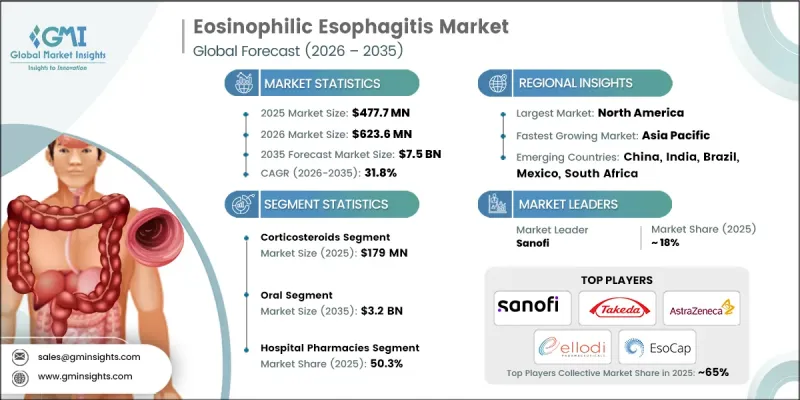
The eosinophilic esophagitis market is driven by the rising prevalence of the disease and improved recognition among healthcare professionals. This condition involves the accumulation of specific immune cells in the esophagus, leading to inflammation and tissue damage that require long-term management. The eosinophilic esophagitis market is also benefiting from increasing patient awareness and advancements in diagnostic capabilities, which are enabling earlier detection and intervention. In addition, the growing availability of targeted therapies is transforming treatment approaches and improving patient outcomes. As healthcare systems place greater emphasis on chronic disease management and personalized medicine, the eosinophilic esophagitis market is expected to witness substantial growth across multiple regions.
| Market Scope | |
|---|---|
| Start Year | 2025 |
| Forecast Year | 2026-2035 |
| Start Value | $477.7 Million |
| Forecast Value | $7.5 Billion |
| CAGR | 31.8% |
The eosinophilic esophagitis market is further supported by rising awareness among both patients and healthcare providers, which is increasing demand for advanced therapeutic solutions. The condition is being more frequently identified across different age groups, contributing to expanding treatment needs. The eosinophilic esophagitis market is also benefiting from the introduction of innovative therapies, including biologics and targeted treatment approaches that address underlying disease mechanisms. These advancements are improving clinical outcomes and expanding available treatment options, supporting continued market development.
The corticosteroids segment reached USD 179 million in 2025 and remains a key treatment category due to its strong anti-inflammatory effects. These therapies are widely utilized for symptom management and are often considered a primary treatment approach. The eosinophilic esophagitis market benefits from the effectiveness of corticosteroids in controlling inflammation and improving patient comfort, supporting their continued adoption in clinical practice.
The oral segment is projected to reach USD 3.2 billion by 2035. This segment is expanding due to the convenience and accessibility of oral treatment options, which allow for easier administration compared to alternative methods. The eosinophilic esophagitis market is also supported by the ongoing development of oral therapies that target specific biological pathways, improving treatment precision and effectiveness. Enhanced safety profiles and reduced systemic side effects are further contributing to the growing preference for oral medications.
North America Eosinophilic Esophagitis Market accounted for 45.5% share in 2025, driven by advanced healthcare infrastructure and strong adoption of innovative treatments. The eosinophilic esophagitis market in this region is supported by high awareness levels, robust diagnostic capabilities, and access to specialized care. Continued introduction of new therapies and strong distribution networks are further sustaining long-term growth.
Key companies operating in the Global Eosinophilic Esophagitis Market include AstraZeneca, Sanofi, Takeda Pharmaceutical, GlaxoSmithKline, Cipla, Teva Pharmaceutical, Allakos, Arena Pharmaceuticals, Revolo Biotherapeutics, Ellodi Pharmaceuticals, EsoCap, and Sun Pharmaceutical. Companies in the Global Eosinophilic Esophagitis Market are strengthening their market presence through innovation and strategic collaborations. Many players are investing heavily in research and development to introduce targeted therapies and biologics that address unmet clinical needs. Partnerships with research institutions and healthcare providers are enabling faster development and commercialization of new treatments. Companies are also focusing on expanding their product pipelines and gaining regulatory approvals to enhance market reach. In addition, increasing investment in patient awareness programs and physician education is supporting early diagnosis and treatment adoption.
Table of Contents
Chapter 1 Methodology and Scope
- 1.1 Market scope and definition
- 1.2 Research approach
- 1.3 Quality commitments
- 1.3.1 GMI AI policy and data integrity commitment
- 1.3.1.1 Source consistency protocol
- 1.3.1 GMI AI policy and data integrity commitment
- 1.4 Research trail and confidence scoring
- 1.4.1 Research trail components
- 1.4.2 Scoring components
- 1.5 Data collection
- 1.5.1 Partial list of primary sources
- 1.6 Data mining sources
- 1.6.1 Paid sources
- 1.6.1.1 Sources, by region
- 1.6.1 Paid sources
- 1.7 Base estimates and calculations
- 1.7.1 Revenue share analysis
- 1.7.2 Base year calculation
- 1.8 Forecast model
- 1.9 Research transparency addendum
- 1.9.1 Source attribution framework
- 1.9.2 Quality assurance metrics
- 1.9.3 Our commitment to trust
Chapter 2 Executive Summary
- 2.1 Industry 360° synopsis
- 2.2 Key market trends
- 2.2.1 Regional trends
- 2.2.2 Drug class trends
- 2.2.3 Route of administration trends
- 2.2.4 Age group trends
- 2.2.5 Distribution channel trends
- 2.3 CXO perspectives: Strategic imperatives
Chapter 3 Industry Insights
- 3.1 Industry ecosystem analysis
- 3.2 Industry impact forces
- 3.2.1 Growth drivers
- 3.2.1.1 Rising prevalence of eosinophilic esophagitis
- 3.2.1.2 Advancement in diagnostic techniques
- 3.2.1.3 Development of target drug therapies
- 3.2.1.4 Increasing healthcare investment
- 3.2.2 Industry pitfalls and challenges
- 3.2.2.1 Competition from generic drugs
- 3.2.2.2 High cost of treatment
- 3.2.3 Market opportunities
- 3.2.3.1 Expansion of non-invasive diagnostic and monitoring tools
- 3.2.3.2 Rising adoption of personalized and precision-based EoE therapies
- 3.2.1 Growth drivers
- 3.3 Growth potential analysis
- 3.4 Regulatory landscape (Driven by Primary Research)
- 3.4.1 North America
- 3.4.2 Europe
- 3.4.3 Asia Pacific
- 3.5 Patent analysis
- 3.6 Pipeline analysis
- 3.7 Impact of AI & GEN AI
- 3.8 Future market trends (Driven by Primary Research)
- 3.9 Impact of AI and generative AI on the market
- 3.10 Porter's analysis
- 3.11 PESTEL analysis
Chapter 4 Competitive Landscape, 2025
- 4.1 Introduction
- 4.2 Company market share analysis
- 4.3 Company matrix analysis
- 4.4 Competitive analysis of major market players
- 4.5 Competitive positioning matrix
- 4.6 Key developments
- 4.6.1 Merger and acquisition
- 4.6.2 Partnership and collaboration
- 4.6.3 New product launches
- 4.6.4 Expansion plans
Chapter 5 Market Estimates and Forecast, By Drug Class, 2022 - 2035 ($ Mn)
- 5.1 Key trends
- 5.2 Biologics
- 5.3 Corticosteroids
- 5.4 Proton pump inhibitors
- 5.5 Immunomodulators
- 5.6 Other drug class
Chapter 6 Market Estimates and Forecast, By Route of Administration, 2022 - 2035 ($ Mn)
- 6.1 Key trends
- 6.2 Oral
- 6.3 Injectable
- 6.4 Topical
Chapter 7 Market Estimates and Forecast, By Age Group, 2022 - 2035 ($ Mn)
- 7.1 Key trends
- 7.2 Pediatric
- 7.3 Adult
- 7.4 Geriatric
Chapter 8 Market Estimates and Forecast, By Distribution Channel, 2022 - 2035 ($ Mn)
- 8.1 Key trends
- 8.2 Hospital pharmacies
- 8.3 Retail pharmacies
- 8.4 Online pharmacies
Chapter 9 Market Estimates and Forecast, By Region, 2022 - 2035 ($ Mn)
- 9.1 Key trends
- 9.2 North America
- 9.2.1 U.S.
- 9.2.2 Canada
- 9.3 Europe
- 9.3.1 Germany
- 9.3.2 UK
- 9.3.3 France
- 9.3.4 Spain
- 9.3.5 Italy
- 9.3.6 Netherlands
- 9.4 Asia Pacific
- 9.4.1 China
- 9.4.2 India
- 9.4.3 Japan
- 9.4.4 Australia
- 9.4.5 South Korea
- 9.5 Latin America
- 9.5.1 Brazil
- 9.5.2 Mexico
- 9.5.3 Argentina
- 9.6 Middle East and Africa
- 9.6.1 South Africa
- 9.6.2 Saudi Arabia
- 9.6.3 UAE
Chapter 10 Company Profiles
- 10.1 Allakos
- 10.2 Arena Pharmaceuticals
- 10.3 AstraZeneca
- 10.4 Cipla
- 10.5 Ellodi Pharmaceuticals
- 10.6 EsoCap
- 10.7 GlaxoSmithKline
- 10.8 Revolo Biotherapeutics
- 10.9 Sanofi
- 10.10 Sun Pharmaceutical
- 10.11 Takeda Pharmaceutical Company
- 10.12 Teva Pharmaceutical

