
PUBLISHER: Global Market Insights Inc. | PRODUCT CODE: 2019170

PUBLISHER: Global Market Insights Inc. | PRODUCT CODE: 2019170
Europe Smart Home Market Opportunity, Growth Drivers, Industry Trend Analysis, and Forecast 2026 - 2035
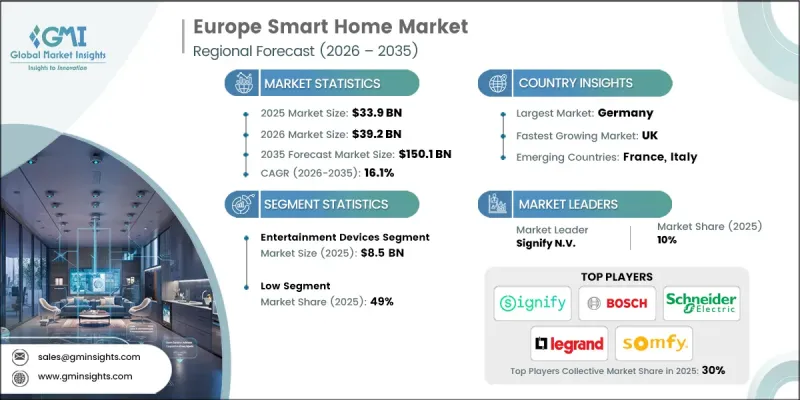
Europe Smart Home Market was valued at USD 33.9 billion in 2025 and is estimated to grow at a CAGR of 16.1% to reach USD 150.1 billion by 2035.
Homeowners across Europe are increasingly adopting smart home solutions for their combination of security, convenience, and design appeal. Modern smart devices such as locks, cameras, and motion-controlled lighting are no longer merely functional tools; they are integrated seamlessly into home decor to complement interior aesthetics. Consumers are demanding products that enhance safety without compromising style, creating environments that are secure, elegant, and visually cohesive. Alongside security, convenience remains a top priority, with smart home technologies responding automatically to daily routines, offering intuitive, personalized living experiences. Voice-controlled devices and mobile app integration allow users to manage lighting, appliances, and entertainment effortlessly, transforming homes into adaptive, comfortable spaces while simplifying everyday tasks. This focus on blending technology, design, and ease-of-use is a driving factor in market expansion.
| Market Scope | |
|---|---|
| Start Year | 2025 |
| Forecast Year | 2026-2035 |
| Start Value | $33.9 Billion |
| Forecast Value | $150.1 Billion |
| CAGR | 16.1% |
In 2025, smart home entertainment devices generated USD 8.5 billion. Advanced entertainment solutions enable consumers to connect audio systems to voice assistants, integrate smart TVs with streaming platforms, and coordinate multiple devices with a single command. Users increasingly prioritize systems that offer seamless control, minimizing reliance on multiple remotes or complicated setups, and allowing for a consistent audio-visual experience throughout the home.
The low-priced segment held a 49% share in 2025. Affordable smart home products, including basic bulbs, entry-level sensors, and simple voice-control accessories, provide first-time users with accessible ways to experience automation without high investment. These products serve as entry points for expanding smart home ecosystems, enabling consumers to upgrade to more advanced solutions over time.
Germany Smart Home Market captured USD 8.4 billion in 2025, which accounted for approximately 25% of the regional market. German households are embracing connected living, adopting solutions that enhance comfort, energy efficiency, and security. Rising familiarity with home automation technologies, coupled with a preference for well-engineered and reliable products, is driving adoption of smart lighting, temperature controls, appliances, and voice-enabled systems. Consumers increasingly prioritize high-quality, durable solutions that integrate seamlessly with their daily routines.
Key players in the Europe Smart Home Market include Legrand, Schneider Electric, Robert Bosch, Ajax Systems, Albrecht Jung GmbH & Co. KG, Fibaro, Nuki Home Solutions GmbH, Hager Group, Loxone Electronics GmbH, LEDVANCE GmbH, Somfy S.A., Signify N.V., Busch-Jaeger Elektro GmbH, Shelly Group, and Tado GmbH. Companies in the Europe Smart Home Market are strengthening their foothold through strategies focused on innovation, partnerships, and accessibility. Firms are investing in R&D to create products that combine security, convenience, and design aesthetics. Strategic collaborations with distributors, tech integrators, and real estate developers expand market reach and visibility. Companies emphasize user-friendly interfaces, voice control compatibility, and mobile app integration to enhance consumer adoption. Marketing campaigns highlight lifestyle benefits, energy efficiency, and security features to drive awareness. Warranty programs and after-sales service strengthen consumer trust, while sustainability initiatives and compliance with European standards enhance brand credibility and long-term loyalty across diverse market segments.
Table of Contents
Chapter 1 Methodology and Scope
- 1.1 Market scope and definition
- 1.2 Research design
- 1.2.1 Research approach
- 1.2.2 Data collection methods
- 1.3 Data mining sources
- 1.3.1 Country
- 1.4 Base estimates and calculations
- 1.4.1 Base year calculation
- 1.4.2 Key trends for market estimation
- 1.5 Primary research and validation
- 1.5.1 Primary sources
- 1.6 Forecast model
- 1.7 Research assumptions and limitations
Chapter 2 Executive Summary
- 2.1 Industry 360° synopsis
- 2.2 Key market trends
- 2.2.1 Country
- 2.2.2 Product
- 2.2.3 Connectivity
- 2.2.4 Price range
- 2.2.5 Application
- 2.2.6 Distribution channel
- 2.3 CXO perspectives: Strategic imperatives
- 2.3.1 Key decision points for industry executives
- 2.3.2 Critical success factors for market players
- 2.4 Future outlook and strategic recommendations
Chapter 3 Industry Insights
- 3.1 Industry ecosystem analysis
- 3.1.1 Supplier landscape
- 3.1.2 Profit margin
- 3.1.3 Value addition at each stage
- 3.1.4 Factor affecting the value chain
- 3.2 Industry impact forces
- 3.2.1 Growth drivers
- 3.2.1.1 Growing focus on home security & convenience
- 3.2.1.2 Strong push for energy efficiency
- 3.2.1.3 Higher disposable incomes in Western Europe
- 3.2.2 Industry pitfalls & challenges
- 3.2.2.1 High upfront costs
- 3.2.2.2 Data privacy & cybersecurity concerns
- 3.2.3 Opportunities
- 3.2.3.1 Voice assistants, AI & predictive automation
- 3.2.3.2 Renewable energy & home electrification
- 3.2.1 Growth drivers
- 3.3 Growth potential analysis
- 3.4 Future market trends
- 3.5 Technology and innovation landscape
- 3.5.1 Current technological trends
- 3.5.2 Emerging technologies
- 3.6 Price trends
- 3.6.1 By country
- 3.6.2 By product
- 3.7 Regulatory landscape
- 3.7.1 Standards and compliance requirements
- 3.7.2 Regional regulatory frameworks
- 3.7.3 Certification standards
- 3.8 Porter's analysis
- 3.9 PESTEL analysis
- 3.10 Pricing analysis (driven by primary research)
- 3.10.1 Historical price trend analysis (2022-2025)
- 3.10.2 Pricing strategy by player type (premium / value / cost-plus)
- 3.10.3 Price elasticity by product category
- 3.11 Trade data analysis (driven by primary research)
- 3.11.1 Import/export volume & value trends
- 3.11.2 Key trade corridors & tariff impact
- 3.11.3 Intra-european trade flows
- 3.12 Impact of AI & generative AI on the market
- 3.12.1 AI-driven disruption of existing business models
- 3.12.2 GenAI use cases & adoption roadmap by segment
- 3.12.3 Risks, limitations & regulatory considerations
- 3.13 Distribution infrastructure & channel penetration landscape (driven by primary research)
- 3.13.1 Channel coverage by region & format (modern vs. traditional trade)
- 3.13.2 Last-mile infrastructure gaps & emerging channel shifts
- 3.13.3 Online penetration by country & product category
Chapter 4 Competitive Landscape, 2025
- 4.1 Introduction
- 4.2 Company market share analysis
- 4.2.1 By country
- 4.2.1.1 UK
- 4.2.1.2 Germany
- 4.2.1.3 France
- 4.2.1.4 Italy
- 4.2.1.5 Spain
- 4.2.1 By country
- 4.3 Company matrix analysis
- 4.4 Competitive analysis of major market players
- 4.5 Competitive positioning matrix
- 4.6 Key developments
- 4.6.1 Mergers & acquisitions
- 4.6.2 Partnerships & collaborations
- 4.6.3 New product launches
- 4.6.4 Expansion plans
Chapter 5 Market Estimates and Forecast, By Product, 2022 - 2035 (USD Billion) (Thousand Units)
- 5.1 Key trends
- 5.2 Entertainment devices
- 5.3 Security & access controls
- 5.4 Hvac
- 5.5 Home appliances
- 5.6 Smart kitchen appliances
- 5.7 Lighting control
- 5.8 Home healthcare
- 5.9 Smart furniture
- 5.10 Other devices
Chapter 6 Market Estimates and Forecast, By Connectivity, 2022 - 2035 (USD Billion) (Thousand Units)
- 6.1 Key trends
- 6.2 Wireless protocols
- 6.3 Wired protocols
- 6.4 Hybrid
Chapter 7 Market Estimates and Forecast, By Price Range, 2022 - 2035 (USD Billion) (Thousand Units)
- 7.1 Key trends
- 7.2 Low
- 7.3 Medium
- 7.4 High
Chapter 8 Market Estimates and Forecast, By Application, 2022 - 2035 (USD Billion) (Thousand Units)
- 8.1 Key trends
- 8.2 New Construction
- 8.3 Retrofit
Chapter 9 Market Estimates and Forecast, By Distribution Channel, 2022 - 2035 (USD Billion) (Thousand Units)
- 9.1 Key trends
- 9.2 Online
- 9.2.1 E-commerce
- 9.2.2 Company owned website
- 9.3 Offline
- 9.3.1 Supermarkets & hypermarkets
- 9.3.2 Specialty stores
- 9.3.3 Others (department stores etc.)
Chapter 10 Market Estimates and Forecast, By Country, 2022 - 2035 (USD Billion) (Thousand Units)
- 10.1 Key trends
- 10.2 UK
- 10.3 Germany
- 10.4 France
- 10.5 Italy
- 10.6 Spain
Chapter 11 Company Profiles
- 11.1 Ajax Systems
- 11.2 Albrecht Jung GmbH & Co. KG
- 11.3 Busch-Jaeger Elektro GmbH
- 11.4 Fibaro
- 11.5 Hager Group
- 11.6 LEDVANCE GmbH
- 11.7 Legrand
- 11.8 Loxone Electronics GmbH
- 11.9 Nuki Home Solutions GmbH
- 11.10 Robert Bosch
- 11.11 Schneider Electric
- 11.12 Shelly Group
- 11.13 Signify N.V.
- 11.14 Somfy S.A.
- 11.15 Tado GmbH

