
PUBLISHER: Global Market Insights Inc. | PRODUCT CODE: 2019175

PUBLISHER: Global Market Insights Inc. | PRODUCT CODE: 2019175
Bovine Mastitis Market Opportunity, Growth Drivers, Industry Trend Analysis, and Forecast 2026 - 2035
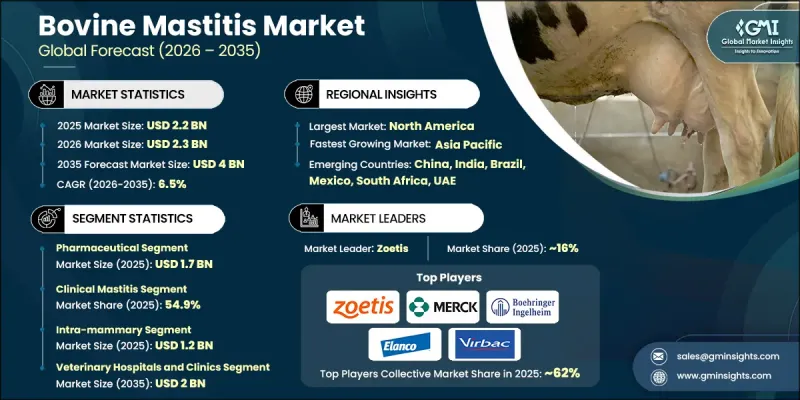
The Global Bovine Mastitis Market was valued at USD 2.2 billion in 2025 and is estimated to grow at a CAGR of 6.5% to reach USD 4 billion by 2035.
Growth is supported by the increasing prevalence of mastitis in dairy cattle and the rising emphasis on maintaining high-quality milk production standards. Greater awareness surrounding animal health and welfare, combined with the need to reduce financial losses associated with the disease, is encouraging the adoption of effective treatment and prevention strategies. Advancements in veterinary diagnostics, including rapid detection tools and on-site testing solutions, are enabling earlier identification and improved disease management. Ongoing investments in research and development are leading to the introduction of enhanced vaccines, antibiotics, and alternative antimicrobial solutions, further strengthening the market outlook. In addition, supportive government initiatives aimed at improving livestock productivity and modernizing dairy farming practices are contributing to sustained demand for advanced mastitis management solutions.
| Market Scope | |
|---|---|
| Start Year | 2025 |
| Forecast Year | 2026-2035 |
| Start Value | $2.2 Billion |
| Forecast Value | $4 Billion |
| CAGR | 6.5% |
Bovine mastitis is defined as an inflammatory condition affecting the udder tissue of dairy cattle, most commonly caused by bacterial infections that negatively impact milk quality and yield. It remains one of the most widespread and economically significant health challenges in dairy farming, requiring timely diagnosis and effective therapeutic intervention. The bovine mastitis market includes a wide range of diagnostic, therapeutic, and preventive approaches designed to improve animal health while minimizing production losses.
The pharmaceutical segment accounted for USD 1.7 billion in 2025. This segment focuses on the development and use of veterinary medicines to treat infections in dairy cattle, including antibiotics, anti-inflammatory agents, and supportive therapies for both clinical and subclinical cases. Continuous advancements in drug delivery methods are improving treatment effectiveness and outcomes. The introduction of new formulations and biologic therapies is further expanding available treatment options, while ongoing research into combination therapies is addressing challenges related to treatment adherence, antimicrobial resistance, and milk safety.
The clinical mastitis segment held a 54.9% share in 2025. This segment is driven by the need to manage visible symptoms and prevent declines in milk production. Increasing awareness and improved access to treatment solutions are supporting higher adoption rates globally. Technological advancements in dairy farm operations, including automated systems for monitoring and detection, are enhancing disease management capabilities. At the same time, growing concerns around antimicrobial resistance are encouraging the development and adoption of alternative therapies, including non-antibiotic approaches.
North America Bovine Mastitis Market was valued at USD 834.7 million in 2025 and is expected to grow at a CAGR of 6.3% through 2026-2035. Market growth in the region is supported by a well-established dairy industry, a strong focus on animal health management, and widespread adoption of advanced diagnostic and treatment solutions. Strict regulatory standards related to milk quality, along with a robust veterinary care infrastructure, are promoting preventive healthcare practices and early disease detection. The presence of specialized veterinary services further supports effective diagnosis and treatment, positioning North America as a leading market for advanced mastitis management.
Key companies operating in the Global Bovine Mastitis Market include Advanced Animal Diagnostics, Boehringer Ingelheim, Ceva, DeLaval, Elanco, Heilsaa, HIPPRA, ImmuCell, Merck, Norbrook, Virbac, and Zoetis. Companies in the Bovine Mastitis Market are strengthening their market position through continuous innovation, strategic collaborations, and expanded product development. A major focus is being placed on advancing diagnostic technologies to enable faster and more accurate detection of infections. Firms are investing in research to develop new treatment options, including biologics and non-antibiotic therapies, to address rising concerns over antimicrobial resistance. Partnerships with veterinary service providers and dairy farms are helping improve product adoption and distribution reach. Additionally, companies are expanding their presence in emerging markets and enhancing their product portfolios to meet diverse customer needs. Emphasis on education and awareness initiatives is also supporting market growth by encouraging better disease management practices.
Table of Contents
Chapter 1 Methodology and Scope
- 1.1 Market scope and definition
- 1.2 Research approach
- 1.3 Quality commitments
- 1.3.1 GMI AI policy and data integrity commitment
- 1.3.1.1 Source consistency protocol
- 1.3.1 GMI AI policy and data integrity commitment
- 1.4 Research trail and confidence scoring
- 1.4.1 Research trail components
- 1.4.2 Scoring components
- 1.5 Data collection
- 1.5.1 Partial list of primary sources
- 1.6 Data mining sources
- 1.6.1 Paid sources
- 1.6.1.1 Sources, by region
- 1.6.1 Paid sources
- 1.7 Base estimates and calculations
- 1.7.1 Revenue share analysis
- 1.7.2 Base year calculation
- 1.8 Forecast model
- 1.9 Research transparency addendum
- 1.9.1 Source attribution framework
- 1.9.2 Quality assurance metrics
- 1.9.3 Our commitment to trust
Chapter 2 Executive Summary
- 2.1 Industry 360° synopsis
- 2.1.1 Business trends
- 2.1.2 Regional trends
- 2.1.3 Product trends
- 2.1.4 Type trends
- 2.1.5 Route of administration trends
- 2.1.6 End use trends
- 2.2 CXO perspectives: Strategic imperatives
Chapter 3 Industry Insights
- 3.1 Industry ecosystem analysis
- 3.2 Industry impact forces
- 3.2.1 Growth drivers
- 3.2.1.1 Rising global dairy consumption
- 3.2.1.2 Advancements in mastitis detection technologies
- 3.2.1.3 Growing awareness of animal health
- 3.2.2 Industry pitfalls and challenges
- 3.2.2.1 High treatment costs
- 3.2.2.2 Antibiotic resistance concerns
- 3.2.3 Market opportunities
- 3.2.3.1 Rising adoption of rapid on-farm diagnostic technologies
- 3.2.3.2 Growing demand for antibiotic-free and alternative mastitis treatments
- 3.2.1 Growth drivers
- 3.3 Growth potential analysis
- 3.4 Regulatory landscape (Driven by primary research)
- 3.4.1 North America
- 3.4.1.1 U.S.
- 3.4.1.2 Canada
- 3.4.2 Europe
- 3.4.3 Asia Pacific
- 3.4.1 North America
- 3.5 Technology and innovation landscape
- 3.5.1 Current technologies
- 3.5.2 Emerging technologies
- 3.6 Future market trends (Driven by primary research)
- 3.7 Impact of AI and Generative AI on the market (Driven by primary research)
- 3.8 Porter's analysis
- 3.9 PESTEL analysis
Chapter 4 Competitive Landscape, 2025
- 4.1 Introduction
- 4.2 Company market share analysis
- 4.3 Company matrix analysis
- 4.4 Competitive analysis of major market players
- 4.5 Competitive positioning matrix
- 4.6 Key developments
- 4.6.1 Merger and acquisition
- 4.6.2 Partnership and collaboration
- 4.6.3 New product launches
- 4.6.4 Expansion plans
Chapter 5 Market Estimates and Forecast, By Product, 2022-2035 ($ Mn)
- 5.1 Key trends
- 5.2 Pharmaceutical
- 5.2.1 Antibiotics
- 5.2.2 Vaccines
- 5.2.3 Other pharmaceuticals
- 5.3 Diagnostics
Chapter 6 Market Estimates and Forecast, By Type, 2022-2035 ($ Mn)
- 6.1 Key trends
- 6.2 Clinical mastitis
- 6.3 Sub-clinical mastitis
Chapter 7 Market Estimates and Forecast, By Route of Administration, 2022-2035 ($ Mn)
- 7.1 Key trends
- 7.2 Intra-mammary
- 7.3 Systemic
Chapter 8 Market Estimates and Forecast, By End Use, 2022-2035 ($ Mn)
- 8.1 Key trends
- 8.2 Veterinary hospitals and clinics
- 8.3 Diagnostic laboratories
- 8.4 Other end users
Chapter 9 Market Estimates and Forecast, By Region, 2022-2035 ($ Mn)
- 9.1 Key trends
- 9.2 North America
- 9.2.1 U.S.
- 9.2.2 Canada
- 9.3 Europe
- 9.3.1 Germany
- 9.3.2 UK
- 9.3.3 France
- 9.3.4 Spain
- 9.3.5 Italy
- 9.3.6 Netherlands
- 9.4 Asia Pacific
- 9.4.1 China
- 9.4.2 Japan
- 9.4.3 India
- 9.4.4 Australia
- 9.4.5 South Korea
- 9.5 Latin America
- 9.5.1 Brazil
- 9.5.2 Mexico
- 9.5.3 Argentina
- 9.6 Middle East and Africa
- 9.6.1 South Africa
- 9.6.2 Saudi Arabia
- 9.6.3 UAE
Chapter 10 Company Profiles
- 10.1 Advanced Animal Diagnostics
- 10.2 Boehringer Ingelheim
- 10.3 Ceva
- 10.4 DeLaval
- 10.5 Elanco
- 10.6 Heilsaa
- 10.7 HIPPRA
- 10.8 ImmuCell Corporation
- 10.9 Merck
- 10.10 Norbrook
- 10.11 Virbac
- 10.12 Zoetis

