PUBLISHER: Global Market Insights Inc. | PRODUCT CODE: 2019183

PUBLISHER: Global Market Insights Inc. | PRODUCT CODE: 2019183
Underwater Pelletizing Market Opportunity, Growth Drivers, Industry Trend Analysis, and Forecast 2026 - 2035
The Global Underwater Pelletizing Market was valued at USD 679.1 million in 2025 and is estimated to grow at a CAGR of 4% to reach USD 994 million by 2035.
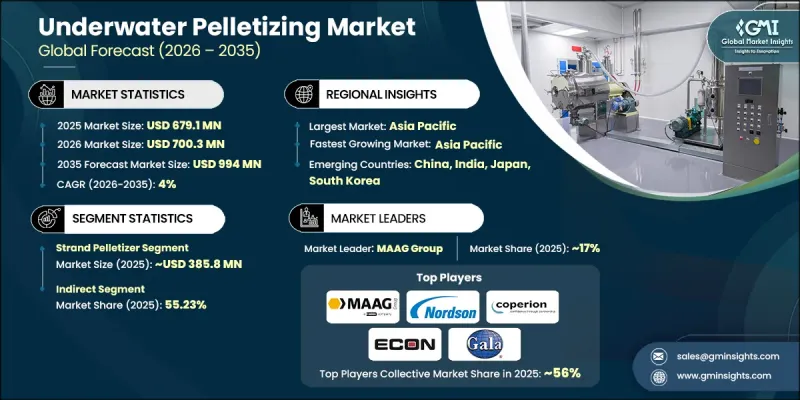
Market expansion is driven by the rising demand for efficient compounding and extrusion processes within the plastics industry. Manufacturers are increasingly prioritizing systems that deliver consistent and uniform pellet quality to support downstream production requirements involving molten polymers. Underwater pelletizing systems enable high-volume processing while maintaining product consistency, making them a preferred choice across polymer manufacturing operations. The growing demand for engineered and specialty plastics is further accelerating the need for reliable pelletizing solutions. Processors are investing in advanced equipment to enhance cooling efficiency, reduce material waste, and achieve precise pellet size control. In addition, the expansion of polymer applications across multiple industries is strengthening demand for high-quality pellets. Continuous improvements in pelletizer design are enhancing operational efficiency and reliability, while increased availability of recycled materials is encouraging further investment in advanced pelletizing technologies.
| Market Scope | |
|---|---|
| Start Year | 2025 |
| Forecast Year | 2026-2035 |
| Start Value | $679.1 Million |
| Forecast Value | $994 Million |
| CAGR | 4% |
The strand pelletizer segment generated USD 385.8 million in 2025 and is expected to grow at a CAGR of 4.2% from 2026 to 2035. This segment is widely utilized due to its cost-effectiveness and adaptability in processing a broad range of thermoplastic materials. The production process involves forming continuous strands of molten polymer that are cooled and then cut into uniform pellets, ensuring consistent output. Strand pelletizing systems are commonly adopted for applications requiring moderate production capacity and operational flexibility. Their straightforward design and ease of maintenance make them a reliable choice for many processing facilities.
The semi-automatic segment held the largest share in 2025. These systems combine automated pellet cutting and cooling functions with manual oversight, allowing operators to maintain control over key operational parameters. This balance between automation and flexibility makes semi-automatic systems particularly attractive for facilities seeking efficient production without significant capital investment. They are widely used in operations where consistent pellet quality and adaptability across different materials are essential, enabling operators to fine-tune processes and maintain stable output.
China Underwater Pelletizing Market accounted for USD 70.5 million in 2025 and is projected to grow at a CAGR of 5.6% through 2035. Market growth in the region is supported by the rapid expansion of polymer manufacturing and increasing demand for high-quality plastic pellets. Industrial players are investing in advanced pelletizing technologies to improve efficiency, minimize waste, and ensure consistent product characteristics. Technological advancements in system components are enhancing durability and performance in large-scale production environments. Ongoing capacity expansions within the polymer sector are further contributing to sustained demand for advanced pelletizing equipment.
Key companies operating in the Global Underwater Pelletizing Market include Coperion GmbH, Cowell Extrusion, Cowin Extrusion, Davis-Standard, ECON GmbH, Farrel Pomini, Gala Industries, IPS Intelligent Pelletizing Solutions, Jieya Machinery, MAAG Group, Nordson Corporation, Trendelkamp Technologie GmbH, USEON Nanjing Extrusion Machinery, Wuxi Huachen, and Xinda Corporation. Companies in the Global Underwater Pelletizing Market are strengthening their position through technological innovation, strategic partnerships, and expansion into emerging markets. A key focus is being placed on developing advanced systems that enhance efficiency, reduce energy consumption, and improve pellet quality. Manufacturers are investing in research and development to introduce durable and high-performance equipment capable of handling diverse polymer materials. Collaborations with polymer producers and recycling companies are helping expand application areas and customer reach. Firms are also optimizing production processes and supply chains to remain competitive. Additionally, expanding product portfolios and targeting growing demand in recycling and specialty plastics segments are key strategies supporting long-term market growth.
Table of Contents
Chapter 1 Methodology & Scope
- 1.1 Market scope and definition
- 1.2 Research design
- 1.2.1 Research approach
- 1.2.2 Data collection methods
- 1.3 Data mining sources
- 1.3.1 Global
- 1.3.2 Regional/Country
- 1.4 Base estimates and calculations
- 1.4.1 Base year calculation
- 1.4.2 Key trends for market estimation
- 1.5 Primary research and validation
- 1.5.1 Primary sources
- 1.6 Forecast model
- 1.7 Research assumptions and limitations
Chapter 2 Executive Summary
- 2.1 Industry 360° synopsis
- 2.2 Key market trends
- 2.2.1 Regional
- 2.2.2 Type
- 2.2.3 Production Capacity
- 2.2.4 Level of Automation
- 2.2.5 Material Type
- 2.2.6 Application
- 2.2.7 End Use Industry
- 2.2.8 Distribution channel
- 2.3 CXO perspectives: Strategic imperatives
- 2.3.1 Key decision points for industry executives
- 2.3.2 Critical success factors for market players
- 2.4 Future outlook and strategic recommendations
Chapter 3 Industry Insights
- 3.1 Industry ecosystem analysis
- 3.1.1 Supplier landscape
- 3.1.2 Profit margin
- 3.1.3 Value addition at each stage
- 3.1.4 Factor affecting the value chain
- 3.2 Industry impact forces
- 3.2.1 Growth drivers
- 3.2.1.1 Increasing prevalence of diabetes and foot-related complications
- 3.2.1.2 Growing geriatric population requiring orthopedic support
- 3.2.1.3 Expansion of podiatry clinics and orthopedic care services
- 3.2.2 Pitfalls & Challenges
- 3.2.2.1 High cost of premium orthopedic and custom-made footwear
- 3.2.2.2 Low awareness of early intervention for foot disorders
- 3.2.3 Opportunities
- 3.2.3.1 Growing demand for 3D-printed and customized foot orthotics
- 3.2.3.2 Integration of smart sensors for gait analysis and pressure monitoring
- 3.2.1 Growth drivers
- 3.3 Growth potential analysis
- 3.4 Future market trends
- 3.5 Technology and innovation landscape
- 3.5.1 Current technological trends
- 3.5.2 Emerging technologies
- 3.6 Price trends
- 3.6.1 By region
- 3.6.2 By product
- 3.7 Regulatory landscape
- 3.7.1 Standards and compliance requirements
- 3.7.2 Regional regulatory frameworks
- 3.7.3 Certification standards
- 3.8 Porter's analysis
- 3.9 PESTEL analysis
- 3.10 Patent Landscape (Driven by Primary Research)
- 3.10.1 Key Patent Holders & Technology Clusters
- 3.10.2 Recent Patent Filings (2022-2025)
- 3.10.3 Patent Expiry Analysis & Generic Opportunities
- 3.10.4 Geographic Patent Distribution
- 3.11 Pricing Analysis (Driven by Primary Research)
- 3.12 Trade Data Analysis (Driven by Paid Data Base)
Chapter 4 Competitive Landscape, 2025
- 4.1 Introduction
- 4.2 Company market share analysis
- 4.2.1 By Region
- 4.2.1.1 North America
- 4.2.1.2 Europe
- 4.2.1.3 Asia Pacific
- 4.2.1.4 Latin America
- 4.2.1.5 Middle East & Africa
- 4.2.1 By Region
- 4.3 Company matrix analysis
- 4.4 Competitive analysis of major market players
- 4.5 Competitive positioning matrix
- 4.6 Key developments
- 4.6.1 Mergers & acquisitions
- 4.6.2 Partnerships & collaborations
- 4.6.3 New product launches
- 4.6.4 Expansion plans
Chapter 5 Market Estimates & Forecast, By Type, 2022 - 2035, (USD Million) (Thousand Units)
- 5.1 Key trends
- 5.2 Up to 100 kg/hr
- 5.3 100 kg/hr to 500 kg/hr
- 5.4 500 kg/hr to 5000 kg/hr
- 5.5 More than 5000 kg/hr
Chapter 6 Market Estimates & Forecast, By Production Capacity, 2022 - 2035, (USD Million) (Thousand Units)
- 6.1 Key trends
- 6.2 Shoes
- 6.3 Sandals
- 6.4 Others
Chapter 7 Market Estimates & Forecast, By Level of Automation, 2022 - 2035, (USD Million) (Thousand Units)
- 7.1 Key trends
- 7.2 Manual
- 7.3 Semi-automatic
- 7.4 Fully automatic
Chapter 8 Market Estimates & Forecast, By Material Type, 2022 - 2035, (USD Million) (Thousand Units)
- 8.1 Key trends
- 8.2 Commodity plastics
- 8.3 Plastics Engineering
- 8.4 High-performance polymers
- 8.5 Bioplastics
- 8.6 Elastomers and thermoplastic elastomers (TPEs)
- 8.7 Additive masterbatch and fillers
Chapter 9 Market Estimates & Forecast, By Application, 2022 - 2035, (USD Million) (Thousand Units)
- 9.1 Key trends
- 9.2 Plastics and polymers manufacturing
- 9.3 Textile and fiber production
- 9.4 Food packaging
- 9.5 Recycling and waste management
- 9.6 Compounding and masterbatch production
- 9.7 Others
Chapter 10 Market Estimates & Forecast, By End Use Industry, 2022 - 2035, (USD Million) (Thousand Units)
- 10.1 Key trends
- 10.2 Automotive
- 10.3 Textile
- 10.4 Pharmaceutical
- 10.5 Construction
- 10.6 Electronics
- 10.7 Others
Chapter 11 Market Estimates & Forecast, By Distribution Channel, 2022 - 2035, (USD Million) (Thousand Units)
- 11.1 Key trends
- 11.2 Direct
- 11.3 Indirect
Chapter 12 Market Estimates & Forecast, By Region, 2022 - 2035, (USD Million) (Thousand Units)
- 12.1 Key trends
- 12.2 North America
- 12.2.1 U.S.
- 12.2.2 Canada
- 12.3 Europe
- 12.3.1 Germany
- 12.3.2 UK
- 12.3.3 France
- 12.3.4 Italy
- 12.3.5 Spain
- 12.4 Asia Pacific
- 12.4.1 China
- 12.4.2 India
- 12.4.3 Japan
- 12.4.4 South Korea
- 12.4.5 Australia
- 12.5 Latin America
- 12.5.1 Brazil
- 12.5.2 Mexico
- 12.5.3 Argentina
- 12.6 MEA
- 12.6.1 Saudi Arabia
- 12.6.2 UAE
- 12.6.3 South Africa
Chapter 13 Company Profiles
- 13.1 Coperion GmbH
- 13.2 Cowell Extrusion
- 13.3 Cowin Extrusion
- 13.4 Davis-Standard
- 13.5 ECON GmbH
- 13.6 Farrel Pomini
- 13.7 Gala Industries
- 13.8 IPS Intelligent Pelletizing Solutions
- 13.9 Jieya Machinery
- 13.10 MAAG Group
- 13.11 Nordson Corporation
- 13.12 Trendelkamp Technologie GmbH
- 13.13 USEON Nanjing Extrusion Machinery
- 13.14 Wuxi Huachen
- 13.15 Xinda Corporation

