PUBLISHER: Global Market Insights Inc. | PRODUCT CODE: 2019185

PUBLISHER: Global Market Insights Inc. | PRODUCT CODE: 2019185
Biosimulation Market Opportunity, Growth Drivers, Industry Trend Analysis, and Forecast 2026 - 2035
The Global Biosimulation Market was valued at USD 4.9 billion in 2025 and is estimated to grow at a CAGR of 17.9% to reach USD 25.1 billion by 2035.
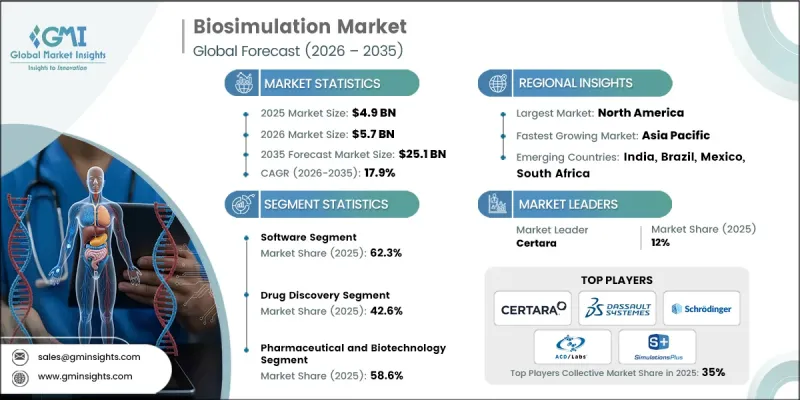
The biosimulation industry is witnessing strong momentum due to the rising burden of chronic diseases, continuous advancements in computational modeling technologies, and the increasing integration of artificial intelligence and machine learning. Growing interest in precision-driven healthcare is also accelerating adoption, as biosimulation enables more targeted and efficient therapeutic development. The demand for personalized medicine is a major contributor to market expansion, as it relies heavily on advanced digital modeling to predict patient-specific outcomes and refine treatment strategies. These solutions support detailed simulation of pharmacokinetics, pharmacodynamics, and disease progression tailored to individual biological profiles. As a result, biosimulation tools are becoming essential across pharmaceutical, biotechnology, and research environments. Their ability to improve clinical success rates, optimize dosing approaches, and reduce development timelines is significantly lowering costs while enhancing regulatory efficiency. The biosimulation market is therefore evolving into a critical component of modern drug development, enabling faster innovation and improved patient outcomes.
| Market Scope | |
|---|---|
| Start Year | 2025 |
| Forecast Year | 2026-2035 |
| Start Value | $4.9 Billion |
| Forecast Value | $25.1 Billion |
| CAGR | 17.9% |
Biosimulation refers to the use of computational techniques to model biological systems, processes, and interactions to evaluate their behavior under different conditions. It combines mathematical frameworks, data-driven algorithms, and experimental inputs to replicate physiological, biochemical, and molecular functions, supporting drug discovery, clinical trial design, and the advancement of personalized treatment approaches.
The software segment reached USD 3 billion in 2025, representing 62.3% share. Advanced biosimulation software leverages sophisticated algorithms and machine learning to replicate complex biological processes with high precision. This capability enables researchers to assess drug safety and effectiveness earlier in development, improving decision-making and overall productivity. By minimizing dependence on traditional laboratory testing, these tools help accelerate development cycles and improve resource efficiency.
The subscription-based model segment held a 55.3% share in 2025. This approach lowers initial investment requirements, making advanced biosimulation platforms more accessible to a wider range of users, including smaller organizations and research institutions. Flexible pricing structures allow users to adjust their usage based on project needs, while bundled services such as training and technical support enhance usability. This model enables organizations to maximize value without requiring extensive in-house expertise, thereby supporting broader adoption.
U.S. Biosimulation Market captured USD 1.8 billion in 2025. Market expansion is driven by the growing prevalence of chronic health conditions and the increasing need for advanced healthcare solutions. Rising demand for innovative research tools and continuous monitoring technologies is further supporting adoption. The country benefits from a well-established healthcare infrastructure, strong investment in research and development, and a supportive regulatory environment, which collectively reinforce its leading position in the global biosimulation market.
Key companies operating in the Global Biosimulation Market include Certara, Dassault Systemes, Thermo Fisher Scientific, Schrodinger, Simulations Plus, Genedata, Advanced Chemistry Development (ACD/Labs), Chemical Computing Group, OpenEye, Allucent, Physiomics, Cellworks, Immunetrics, VeriSIM Life, and In Silico Biosciences. Companies in the biosimulation market are strengthening their competitive position through continuous innovation and strategic expansion. They are investing in advanced computational technologies, including AI-driven modeling and machine learning integration, to enhance simulation accuracy and efficiency. Strategic partnerships with pharmaceutical and biotechnology firms are enabling broader application of biosimulation tools in drug development. Firms are also focusing on expanding cloud-based platforms and subscription models to improve accessibility and scalability. Additionally, companies are enhancing user experience through training, support services, and integrated solutions.
Table of Contents
Chapter 1 Methodology and Scope
- 1.1 Research approach
- 1.2 Quality commitments
- 1.2.1 GMI AI policy & data integrity commitment
- 1.2.1.1 Source consistency protocol
- 1.2.1 GMI AI policy & data integrity commitment
- 1.3 Research trail & confidence scoring
- 1.3.1 Research trail components
- 1.3.2 Scoring components
- 1.4 Data collection
- 1.4.1 Partial list of primary sources
- 1.5 Data mining sources
- 1.5.1 Paid sources
- 1.5.1.1 Sources, by region
- 1.5.1 Paid sources
- 1.6 Base estimates and calculations
- 1.6.1 Base year calculation for any one approach
- 1.7 Forecast model
- 1.7.1 Quantified market impact analysis
- 1.7.1.1 Mathematical impact of growth parameters on forecast
- 1.7.1 Quantified market impact analysis
- 1.8 Research transparency addendum
- 1.8.1 Source attribution framework
- 1.8.2 Quality assurance metrics
- 1.8.3 Our commitment to trust
Chapter 2 Executive Summary
- 2.1 Industry 360° synopsis
- 2.2 Key market trends
- 2.2.1 Regional trends
- 2.2.2 Offering trends
- 2.2.3 Application trends
- 2.2.4 Therapeutic area trends
- 2.2.5 Delivery model trends
- 2.2.6 Deployment model trends
- 2.2.7 End use trends
- 2.3 CXO perspectives: Strategic imperatives
Chapter 3 Industry Insights
- 3.1 Industry ecosystem analysis
- 3.2 Industry impact forces
- 3.2.1 Growth drivers
- 3.2.1.1 Rising prevalence of chronic diseases
- 3.2.1.2 Technological advancements in computational modeling
- 3.2.1.3 Rising demand for personalized medicine
- 3.2.1.4 Increasing use of AI and machine Learning
- 3.2.2 Industry pitfalls and challenges
- 3.2.2.1 High costs of products
- 3.2.2.2 Lack of skilled professionals
- 3.2.3 Market opportunities
- 3.2.3.1 Rising healthcare infrastructure in emerging markets
- 3.2.1 Growth drivers
- 3.3 Growth potential analysis
- 3.4 Regulatory landscape
- 3.4.1 North America
- 3.4.2 Europe
- 3.4.3 Asia Pacific
- 3.5 Technological advancements (Driven by primary research)
- 3.5.1 Current technological trends
- 3.5.1.1 Rapid adoption of in silico modeling and model-informed drug development (MIDD)
- 3.5.1.2 Integration of artificial intelligence and machine learning
- 3.5.1.3 Expansion of cloud-based high-performance computing (HPC)
- 3.5.2 Emerging technologies
- 3.5.2.1 Advanced multi-scale quantitative systems pharmacology (QSP) platforms
- 3.5.2.2 Technological convergence in cloud, AI, and advanced analytics platforms
- 3.5.1 Current technological trends
- 3.6 Future market trends (Driven by primary research)
- 3.7 Pricing analysis
- 3.8 Porter's analysis
- 3.9 PESTEL analysis
Chapter 4 Competitive Landscape, 2025
- 4.1 Introduction
- 4.2 Company market share analysis
- 4.2.1 North America
- 4.2.2 Europe
- 4.2.3 Asia Pacific
- 4.3 Company matrix analysis
- 4.4 Competitive analysis of major market players
- 4.5 Competitive positioning matrix
- 4.6 Key developments
- 4.6.1 Mergers and acquisitions
- 4.6.2 Partnerships and collaborations
- 4.6.3 New product launches
- 4.6.4 Expansion plans
Chapter 5 Market Estimates and Forecast, By Offering, 2022 - 2035 ($ Mn)
- 5.1 Key trends
- 5.2 Software
- 5.2.1 Integrated software suites/platform
- 5.2.1.1 Molecular modeling and simulation software
- 5.2.1.2 Clinical trial design software
- 5.2.1.3 PK/PD modeling and simulation software
- 5.2.1.4 Pbpk modeling and simulation software
- 5.2.1.5 Toxicity prediction software
- 5.2.1.6 Other integrated software suites/platforms
- 5.2.2 Standalone modules
- 5.2.1 Integrated software suites/platform
- 5.3 Service
Chapter 6 Market Estimates and Forecast, By Application, 2022 - 2035 ($ Mn)
- 6.1 Key trends
- 6.2 Drug discovery
- 6.3 Drug development
- 6.4 Disease modeling
- 6.5 Other applications
Chapter 7 Market Estimates and Forecast, By Therapeutic Area, 2022 - 2035 ($ Mn)
- 7.1 Key trends
- 7.2 Oncology
- 7.3 Cardiovascular disease
- 7.4 Neurological disorder
- 7.5 Infectious diseases
- 7.6 Other therapeutic areas
Chapter 8 Market Estimates and Forecast, By Delivery Mode, 2022 - 2035 ($ Mn)
- 8.1 Key trends
- 8.2 Subscription models
- 8.3 Ownership models
- 8.3.1 License-based model
- 8.3.2 Pay-per-use model
- 8.4 Service-based models
Chapter 9 Market Estimates and Forecast, By Deployment Model, 2022 - 2035 ($ Mn)
- 9.1 Key trends
- 9.2 On-premises model
- 9.3 Cloud-based model
Chapter 10 Market Estimates and Forecast, By End Use, 2022 - 2035 ($ Mn)
- 10.1 Key trends
- 10.2 Pharmaceutical and biotechnology companies
- 10.3 Contract research organizations (CROs)
- 10.4 Academic research institutions
Chapter 11 Market Estimates and Forecast, By Region, 2022 - 2035 ($ Mn)
- 11.1 Key trends
- 11.2 North America
- 11.2.1 U.S.
- 11.2.2 Canada
- 11.3 Europe
- 11.3.1 Germany
- 11.3.2 UK
- 11.3.3 France
- 11.3.4 Spain
- 11.3.5 Italy
- 11.3.6 Netherlands
- 11.4 Asia Pacific
- 11.4.1 China
- 11.4.2 India
- 11.4.3 Japan
- 11.4.4 Australia
- 11.4.5 South Korea
- 11.5 Latin America
- 11.5.1 Brazil
- 11.5.2 Mexico
- 11.5.3 Argentina
- 11.6 Middle East and Africa
- 11.6.1 Saudi Arabia
- 11.6.2 South Africa
- 11.6.3 UAE
Chapter 12 Company Profiles
- 12.1 Allucent
- 12.2 Advanced Chemistry Development (ACD/Labs)
- 12.3 Certara
- 12.4 Cellworks
- 12.5 Chemical Computing Group
- 12.6 Dassault Systemes
- 12.7 Genedata
- 12.8 In Silico Biosciences
- 12.9 Immunetrics
- 12.10 OpenEye
- 12.11 Physiomics
- 12.12 Simulations Plus
- 12.13 Schrodinger
- 12.14 Thermo Fisher Scientific
- 12.15 VeriSIM Life

