PUBLISHER: Global Market Insights Inc. | PRODUCT CODE: 2019186

PUBLISHER: Global Market Insights Inc. | PRODUCT CODE: 2019186
Dialysis Machines Market Opportunity, Growth Drivers, Industry Trend Analysis, and Forecast 2026 - 2035
The Global Dialysis Machines Market was valued at USD 4.8 billion in 2025 and is estimated to grow at a CAGR of 5.1% to reach USD 7.7 billion by 2035.
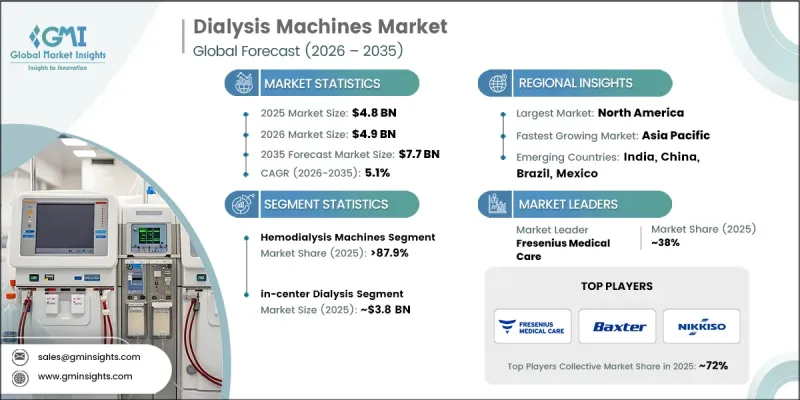
Growth is supported by a combination of factors, including the limited availability of donor organs, increasing cases of end-stage renal disease, and the expanding prevalence of metabolic disorders. Technological progress is also playing a central role, as AI-enabled and IoT-integrated dialysis systems improve monitoring accuracy, treatment personalization, and operational efficiency. The rising adoption of home-based dialysis solutions, along with a growing elderly population requiring long-term care, is further strengthening demand. Additionally, increasing awareness around early diagnosis and treatment of kidney disorders is encouraging timely medical intervention. As healthcare systems continue to evolve, dialysis equipment manufacturers are focusing on innovation, portability, and patient-centric features to enhance treatment outcomes and accessibility across diverse care settings.
| Market Scope | |
|---|---|
| Start Year | 2025 |
| Forecast Year | 2026-2035 |
| Start Value | $4.8 Billion |
| Forecast Value | $7.7 Billion |
| CAGR | 5.1% |
The hemodialysis machines segment accounted for a share of 87.9% in 2025, maintaining its leadership due to its widespread adoption as a primary treatment method for advanced kidney conditions. Continuous improvements in device performance, user interface, and treatment efficiency are supporting segment growth. Enhanced safety features, reduced treatment time, and improved patient comfort are encouraging higher acceptance rates. As the incidence of chronic kidney disorders persists globally, healthcare providers continue to rely heavily on hemodialysis systems for consistent and effective patient care, further reinforcing segment expansion.
The in-center dialysis segment generated USD 3.8 billion in 2025, reflecting its dominant position in the market. Structured treatment environments, access to specialized medical staff, and the availability of advanced equipment contribute to its continued preference among patients. These facilities offer consistent monitoring and controlled treatment conditions, which help improve patient outcomes and confidence. Favorable reimbursement frameworks and insurance coverage also make in-center dialysis a widely accessible option, supporting sustained demand within this segment.
United States Dialysis Machines Market reached USD 2 billion in 2025, driven by strong adoption of dialysis therapies, advancements in medical technologies, and supportive reimbursement policies. The presence of established industry participants and ongoing investments in innovation further strengthen the regional landscape. Additionally, the growing shift toward home-based dialysis solutions is improving patient flexibility and convenience, supported by increased awareness, education initiatives, and advancements in compact and user-friendly devices.
Key companies operating in the Global Dialysis Machines Market include B. Braun, Baxter International, Dialife SA, Fresenius Medical Care, JMS Co., Ltd., Medtronic, Nikkiso, Nipro, Outset Medical, Quanta Dialysis Technologies, and Toray Medical. Companies in the Global Dialysis Machines Market are strengthening their competitive position through continuous innovation, strategic partnerships, and expansion of product portfolios. They are investing in advanced technologies such as AI-enabled monitoring systems, portable dialysis devices, and IoT-integrated solutions to enhance treatment efficiency and patient experience. Many players are focusing on expanding home dialysis offerings to tap into the growing demand for convenient care solutions. Collaborations with healthcare providers and research institutions help accelerate product development and clinical validation. Additionally, companies are increasing their global footprint through mergers, acquisitions, and distribution network expansion. Emphasis on cost optimization, regulatory compliance, and improved after-sales services further supports long-term market growth and brand positioning.
Table of Contents
Chapter 1 Research Methodology
- 1.1 Research approach
- 1.2 Quality commitments
- 1.2.1 GMI AI policy & data integrity commitment
- 1.2.1.1 Source consistency protocol
- 1.2.1 GMI AI policy & data integrity commitment
- 1.3 Research trail & confidence scoring
- 1.3.1 Research trail components
- 1.3.2 Scoring components
- 1.4 Data collection
- 1.4.1 Partial list of primary sources
- 1.5 Data mining sources
- 1.5.1 Paid sources
- 1.5.1.1 Sources, by region
- 1.5.1 Paid sources
- 1.6 Base estimates and calculations
- 1.6.1 Base year calculation
- 1.7 Forecast model
- 1.7.1 Quantified market impact analysis
- 1.7.1.1 Mathematical impact of growth parameters on forecast
- 1.7.1 Quantified market impact analysis
- 1.8 Research transparency addendum
- 1.8.1 Source attribution framework
- 1.8.2 Quality assurance metrics
- 1.8.3 Our commitment to trust
Chapter 2 Executive Summary
- 2.1 Industry 360° synopsis
- 2.2 Key market trends
- 2.2.1 Regional trends
- 2.2.2 Product type trends
- 2.2.3 End use trends
- 2.3 CXO perspectives: Strategic imperatives
Chapter 3 Industry Insights
- 3.1 Industry ecosystem analysis
- 3.2 Industry impact forces
- 3.2.1 Growth drivers
- 3.2.1.1 Rising number of end stage renal diseases (ESRD) patients
- 3.2.1.2 Increasing incidence of diabetes
- 3.2.1.3 Shortage of donor kidneys
- 3.2.1.4 Favorable reimbursement scenario available for dialysis treatment
- 3.2.2 Industry pitfalls and challenges
- 3.2.2.1 Product recalls
- 3.2.2.2 Complication in the treatment
- 3.2.3 Opportunities
- 3.2.3.1 Growth of home hemodialysis and peritoneal dialysis
- 3.2.3.2 Development of portable and wearable dialysis systems
- 3.2.1 Growth drivers
- 3.3 Growth potential analysis
- 3.4 Regulatory landscape (Driven by Primary Research)
- 3.4.1 North America
- 3.4.2 Europe
- 3.4.3 Asia Pacific
- 3.5 Technology and innovation landscape
- 3.5.1 Current technological trends
- 3.5.2 Emerging technologies
- 3.6 Future market trends (Driven by Primary Research)
- 3.7 Home dialysis landscape
- 3.8 Reimbursement scenario
- 3.9 Impact of AI & generative AI on the market (Driven by Primary Research)
- 3.9.1 AI-Driven disruption of existing business models
- 3.9.2 GenAI use cases & adoption roadmap by segment
- 3.10 Gap analysis
- 3.11 Porter's analysis
- 3.12 PESTEL analysis
Chapter 4 Competitive Landscape, 2025
- 4.1 Introduction
- 4.2 Company matrix analysis
- 4.3 Company market share analysis (Driven by Primary Research)
- 4.3.1 Global
- 4.3.2 North America
- 4.3.3 Europe
- 4.3.4 Asia Pacific
- 4.4 Competitive analysis of major market players
- 4.5 Competitive positioning matrix
- 4.6 Key developments
- 4.6.1 Mergers & acquisitions
- 4.6.2 Partnerships & collaborations
- 4.6.3 New product launches
- 4.6.4 Expansion plans
Chapter 5 Market Estimates and Forecast, By Product Type, 2022 - 2035 ($ Mn)
- 5.1 Key trends
- 5.2 Hemodialysis machines
- 5.3 Peritoneal dialysis machines
Chapter 6 Market Estimates and Forecast, By End Use, 2022 - 2035 ($ Mn)
- 6.1 Key trends
- 6.2 In-center dialysis
- 6.3 Home center dialysis
Chapter 7 Market Estimates and Forecast, By Region, 2022 - 2035 ($ Mn)
- 7.1 Key trends
- 7.2 North America
- 7.2.1 U.S.
- 7.2.2 Canada
- 7.3 Europe
- 7.3.1 Germany
- 7.3.2 UK
- 7.3.3 France
- 7.3.4 Spain
- 7.3.5 Italy
- 7.3.6 Netherlands
- 7.4 Asia Pacific
- 7.4.1 China
- 7.4.2 Japan
- 7.4.3 India
- 7.4.4 Australia
- 7.4.5 South Korea
- 7.5 Latin America
- 7.5.1 Brazil
- 7.5.2 Mexico
- 7.5.3 Argentina
- 7.6 MEA
- 7.6.1 South Africa
- 7.6.2 Saudi Arabia
- 7.6.3 UAE
Chapter 8 Company Profiles
- 8.1 B. Braun
- 8.2 Baxter International
- 8.3 Dialife SA
- 8.4 Fresenius Medical Care
- 8.5 JMS Co., Ltd.
- 8.6 Medtronic
- 8.7 Nikkiso
- 8.8 Nipro
- 8.9 Outset Medical
- 8.10 Quanta Dialysis Technologies
- 8.11 Toray Medical

